
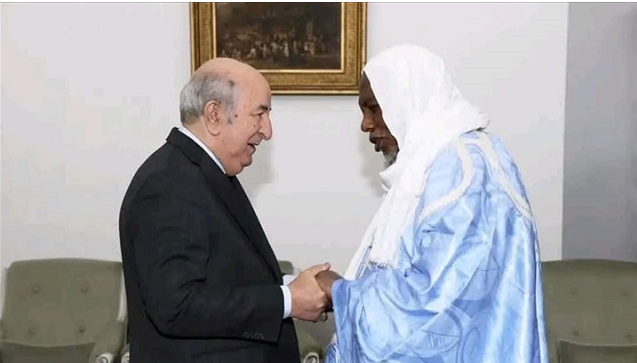
The security landscape in Mali has deteriorated sharply, with recent attacks resulting in significant civilian and military fatalities, as reported by credible security sources. The turmoil gripping the nation has far-reaching implications, particularly for the Sahel region, where neighboring countries such as Niger, Burkina Faso, Chad, and Mauritania are closely monitoring developments.
Northern Mali: a strategic battleground
Western analysts highlight that control over northern Mali—home to key cities like Kidal, Gao, and Timbuktu—could redefine regional power structures. These areas are not just territorial markers; they serve as critical hubs for trade routes, alliances, and geopolitical influence. Imam Mahmoud Dicko, a prominent religious figure, has emerged as a central player in this high-stakes equation, leveraging his spiritual and moral authority to expand his regional footprint.
Algeria’s covert involvement and Dicko’s rising influence
From his base in Algeria, Imam Mahmoud Dicko has transcended his traditional role as a moral guide. His supporters now portray him as a quasi-caliphal figure, wielding authority that extends beyond spiritual guidance. This evolving perception has drawn parallels to centralized religious leadership models, such as the one seen in Iran.
Local reports from Tamanrasset suggest that Algeria’s military has intensified its engagement in the region. A battalion from the Algerian army’s 4th Military Region has reportedly been redeployed to the 6th Military Region, with forces divided into smaller units to evade satellite surveillance. This maneuver underscores Algeria’s strategic commitment to supporting Dicko’s militias and armed jihadist factions, aiming to secure northern Mali and subsequently target leaders across the Sahel.
Leadership dynamics in Algeria
The Algerian regime, under the stewardship of President Abdelmadjid Tebboune and General Saïd Chengriha, is reportedly backing these efforts to bolster its regional standing. While Dicko remains officially in exile, unconfirmed reports indicate he is quietly consolidating decision-making power, filling a void left by Algeria’s waning influence in the region.
Regional instability and international responses
Recent attacks, including a wave of violence on April 25 that struck multiple locations—including the capital, Bamako—have heightened concerns about Mali’s stability. In response, the French Foreign Ministry issued updated travel advisories, urging French nationals in Mali to arrange temporary departures via available commercial flights.
Meanwhile, Mali’s transitional leader, General Assimi Goïta, addressed the nation in a televised speech, asserting that the security situation was under control. His remarks followed a series of unprecedented attacks by jihadists from the Jama’at Nusrat al-Islam wal-Muslimin (JNIM), an Al-Qaeda-affiliated group, in collaboration with Tuareg separatists from the Azawad Liberation Front (FLA).