
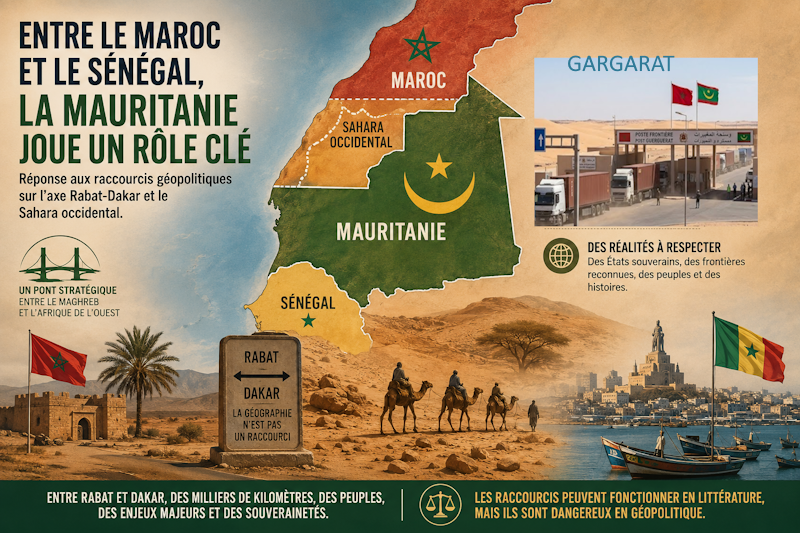

A late July 2026 diplomatic incident in Dakar has thrust Mauritania’s carefully calibrated stance on the Western Sahara conflict back into the spotlight. As Morocco and its regional partners navigate complex geopolitical waters, Nouakchott finds itself walking a tightrope between economic imperatives and diplomatic neutrality.
What began as a seemingly routine cultural event at the Moroccan embassy in Dakar quickly escalated into a full-blown diplomatic row. Former Senegalese foreign minister Cheikh Tidiane Gadio’s remarks about Morocco’s historical proximity to Senegal—seen as an implicit challenge to Mauritania’s territorial integrity—sparked an immediate reaction. Mauritanian diplomat Mohamed Ould Abdellahi Ould Ethmane interrupted the speech, accusing Gadio of historical revisionism that erased Mauritania’s existence as an independent nation.
While Morocco’s ambassador, Hassan Naciri, worked swiftly to mediate the dispute, the episode laid bare the tensions underlying Mauritania’s carefully constructed neutrality. The country must simultaneously attend events celebrating Morocco’s claims to Western Sahara while maintaining its official recognition of the Sahrawi Arab Democratic Republic (SADR)—a position it adopted in 1984. This delicate balancing act extends to its refusal to grant diplomatic status to the SADR’s representation in Nouakchott, a concession to Rabat that prevents outright conflict but stops short of full endorsement.
The fallout from Gadio’s comments continues to reverberate across Mauritania. Former Mauritanian foreign minister Isselmou Ahmed Izidbih took to social media to demand the Senegalese politician be declared persona non grata, stating that Gadio would not be welcome in Mauritanian airspace, territorial waters, or on its soil.
Navigating the tightrope of neutrality
Mauritania’s diplomatic strategy is no accident of indecision but a deliberate survival tactic. Trapped between Morocco’s economic ambitions and Algeria’s geopolitical sensitivities, Nouakchott cannot afford to alienate either neighbor without risking severe repercussions. The country’s leadership has openly embraced this ambiguity, maintaining open channels with both the Polisario Front and Algeria while avoiding direct confrontation with Morocco.
This calculated neutrality extends to Mauritania’s economic lifelines. The Guerguerat border crossing, situated at the intersection of Western Sahara and Mauritanian territory, has become a critical artery for trade. Daily convoys of Moroccan trucks pass through, supplying food and manufactured goods to markets across Mauritania, Senegal, and Mali. For Nouakchott, blocking this flow would be economic suicide, yet endorsing Morocco’s control over the territory would provoke Algeria and undermine its own sovereignty claims.
The economic stakes at Guerguerat
The border post at Guerguerat is more than a symbolic line—it’s the backbone of regional commerce. The uninterrupted flow of goods through this corridor sustains Mauritania’s economy, ensuring food security and stabilizing prices for essential commodities. By facilitating this trade, Mauritania implicitly acknowledges Morocco’s operational control over Western Sahara without ever granting formal recognition. It’s a pragmatic solution that prioritizes stability over ideology, though one that remains fraught with diplomatic risk.
Why Mauritania’s strategy is a masterclass in survival
To outside observers, Mauritania’s approach may seem contradictory, but it reflects the harsh realities of its geopolitical position. The country cannot afford to pick sides in a decades-old conflict that pits Morocco against the Polisario Front, backed by Algeria. Any misstep could trigger economic isolation, border insecurity, or even military confrontation. The incident in Dakar was a stark reminder of how quickly tensions can flare when Mauritania’s territorial integrity or national identity is questioned.
The response from Nouakchott was swift and unequivocal. The interruption of Gadio’s speech sent a clear message: Mauritania’s sovereignty is non-negotiable. Yet, the government simultaneously continues to benefit from the economic ties that bind it to Morocco. This duality—simultaneously asserting independence and reaping economic rewards—is the hallmark of a nation playing the long game in one of Africa’s most volatile regions.