
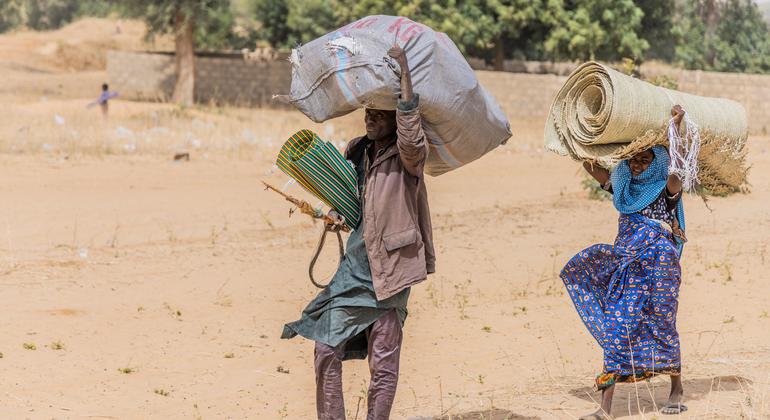
The recent wave of violence in Nigeria—marked by mass abductions, village attacks, and assaults on worshippers in churches and mosques—has thrust the nation back into the global spotlight. The situation took a new geopolitical turn when the United States launched airstrikes on Christmas Day against jihadist positions in northern Nigeria, framed as a move to protect Christian communities from imminent threats.
a crisis stretching beyond religious divides
While headlines focus on high-profile attacks against Christian civilians, Nigeria faces a far broader security and humanitarian emergency. According to Mohamed Malik Fall, United Nations Humanitarian Coordinator in Nigeria, the violence is no longer confined to a single region but has become a nationwide crisis.
Over nearly two decades, the conflict in the northeast—once driven by Boko Haram and later its splinter factions like the Islamic State’s West Africa Province—has displaced more than two million people. These are not temporary displacements. Entire generations have grown up in displacement camps, knowing no other life.
The human cost is staggering: over 40,000 deaths, thousands of schools and health centers destroyed, and vast agricultural lands rendered inaccessible. Yet the impact goes deeper. Communities have been cut off from economic opportunities, stripping individuals of their livelihoods and dignity.
the rise of banditry and local conflicts
The northeast insurgency has been compounded by escalating violence in the northwest. In states like Zamfara, Katsina, and Sokoto, armed criminal gangs—often labeled as “bandits”—engage in looting, kidnapping, and extortion. Whole villages have been abandoned, forcing nearly one million people to flee in the northwest alone.
Central Nigeria is plagued by clashes between farmers and herders over land and resources, intensified by climate pressures and population growth. In the south, separatist movements and oil-related sabotage add to the volatility. As a result, with approximately 3.5 million internally displaced persons (IDPs), Nigeria accounts for nearly 10% of Africa’s total displaced population.
mapping the humanitarian emergency
Behind the security turmoil lies a massive, underfunded humanitarian crisis. In the northeast alone, 7.2 million people require urgent assistance, with nearly 6 million in severe or critical need, according to UN estimates.
Food insecurity is reaching alarming levels. Projections indicate up to 36 million people could face various stages of food insecurity in the coming months. Among children under five, over 3.5 million are at risk of acute malnutrition. Fall warns that the consequences are long-term: “Malnutrition affects cognitive development, education, and carries lifelong repercussions.”
The crisis is further compounded by recurring climate shocks—droughts, floods—and outbreaks of diseases like cholera and meningitis. A weakened health system struggles to cope, while funding has plummeted. Fall notes, “A few years ago, the humanitarian response plan was nearly one billion dollars annually. In 2024, it dropped to $585 million. Last year, it barely reached $262 million. This year, we may not even hit $200 million.”
addressing the root: economic inequality and governance gaps
Nigeria stands at a paradox: one of Africa’s largest economies grappling with a severe humanitarian disaster. As Fall emphasizes, “Nigeria is not Sudan or Somalia. It has resources. The primary responsibility for humanitarian response lies with the government.”
The UN is urging a shift toward empowering local and federal authorities to lead the response, while calling on international donors to maintain their commitment. “No community wants to live on aid forever,” he concludes. “People want access to economic opportunities—not handouts. Teaching them to fish is more valuable than giving fish.”