
The fractured geopolitical landscape of West Africa has taken a new turn as Niger’s transitional authorities implement controversial trade measures that are reshaping regional economic dynamics.
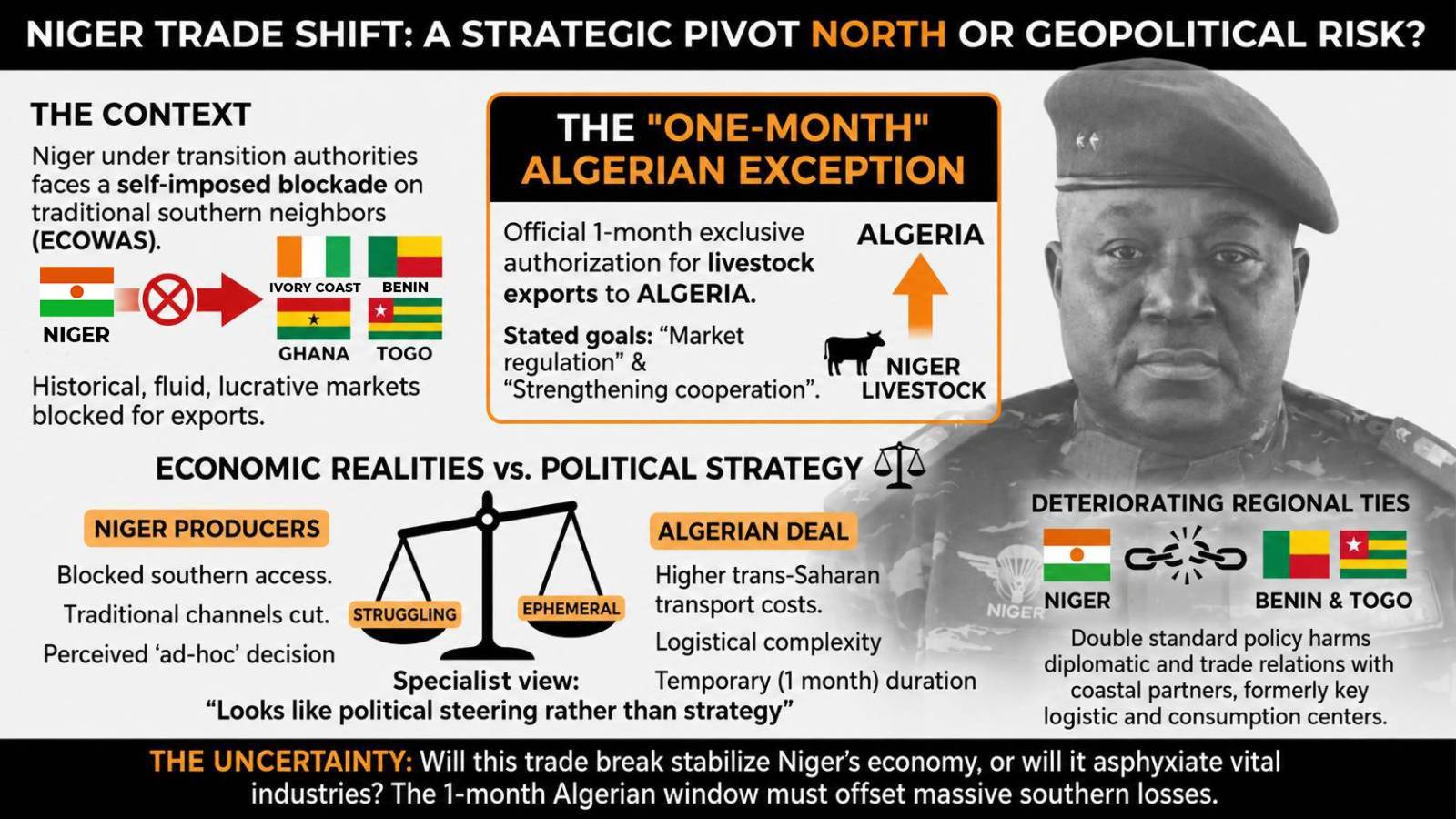
While commercial borders with Gulf of Guinea nations such as Côte d’Ivoire, Bénin, Ghana, and Togo remain tightly controlled or outright closed, Niamey has unexpectedly opened a temporary gateway to the North. For a single month, Algerian traders have been granted exclusive permission to import livestock from Niger under a special waiver.
An unconventional trade pivot
Officially framed as a means to « stabilize domestic markets » and « enhance economic cooperation » between Niger and Algeria, the decision has sparked skepticism among analysts and producers alike. Historically, the Gulf of Guinea has served as the primary, most efficient, and most profitable outlet for Niger’s livestock sector—an industry that sustains millions of pastoral families.
Critics argue that redirecting exports away from regional neighbors toward a distant North African partner reflects a short-term political calculus rather than a sustainable economic vision. « Sacrificing immediate, high-volume markets for a one-month window in Algeria appears more like crisis-driven improvisation than a thought-out strategy, » notes a regional trade analyst familiar with Sahelian cross-border flows.
A growing divide in regional relations
The policy has deepened unease among West African partners, particularly those in the Economic Community of West African States (ECOWAS), who view it as a deliberate sidelining of long-standing trade alliances. Bénin and Togo, long-standing logistical hubs and major consumers of Nigerien livestock, now find themselves sidelined in favor of a Saharan corridor that is logistically costly and operationally risky.
For local herders, the consequences are immediate. With exports to traditional markets in Côte d’Ivoire, Ghana, and beyond suspended, many are forced to rely on an untested and expensive northern route. Even if the Algerian window delivers some revenue, the high cost of trans-Saharan transport could erode most of the gains, leaving producers in a precarious position.
As diplomats and economists debate the long-term implications, one question looms large: Can a single month of preferential trade with Algeria truly offset the losses incurred from severed ties with regional partners? The answer may well determine whether this policy stabilizes Niger’s economy—or further destabilizes its vital pastoral sector.