
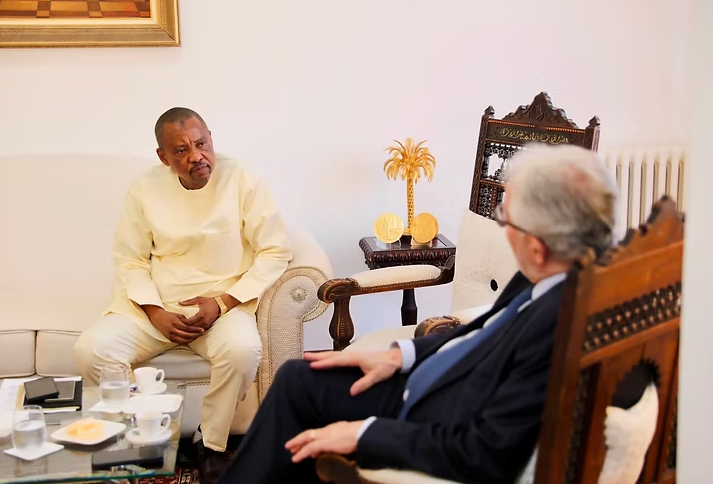
The unexpected meeting between Hamadou Saley, chargé d’affaires at the Nigerien embassy in France, and Chems-eddine Hafiz, rector of the Grand Mosque of Paris, has ignited fresh debates. While framed as a cultural or religious collaboration, this encounter reveals a far more calculated political maneuver: a regime in Niamey seeking to bypass Paris’s official channels by leveraging France’s Muslim institutions, blocked from direct diplomatic engagement.
Bypassing institutional deadlocks
Following Niger’s political upheavals and the sharp deterioration of ties with France, bilateral relations have effectively ground to a halt. Expulsions of diplomats, anti-French rhetoric, and the suspension of cooperation agreements have severed the Paris-Niamey axis. Yet, economic, migration, and geopolitical realities inevitably demand some form of communication. The question remains: how can Niger maintain contact with France when the traditional diplomatic route is deliberately barred?
The answer lies in backchannel diplomacy, specifically what some analysts call faith-based mediation. By sending its chargé d’affaires to an institution as influential as the Grand Mosque of Paris, Niamey isn’t just seeking spiritual dialogue—it’s exploiting a loophole. Without the possibility of a ministerial reception at the Quai d’Orsay, the Nigerien representative is turning to a pillar of France’s Muslim community, hoping to secure an audience where official channels have failed.
The risks of instrumentalizing religion
This approach isn’t merely a matter of courtesy; it’s a calculated attempt to circumvent institutional boycotts. The Grand Mosque of Paris, with its deep-rooted ties to the French state, offers a backdoor into the country’s public and political discourse. For Niamey, this is a chance to reinsert itself into the conversation after being shut out of formal negotiations.
Yet this strategy raises serious concerns about consistency. While Niger’s government loudly condemns foreign interference and champions a clean break from its former partner, its diplomats are quietly exploiting religious structures in a third country to soften its image and restore indirect dialogue. Cultural and religious initiatives, no matter how well-intentioned, cannot serve as a smokescreen for a covert political rapprochement.
If Niamey truly aims to rebuild constructive relations with France, it must do so transparently, through official state channels and international protocols—not by manipulating religious sensitivities to bypass diplomatic protocols.