
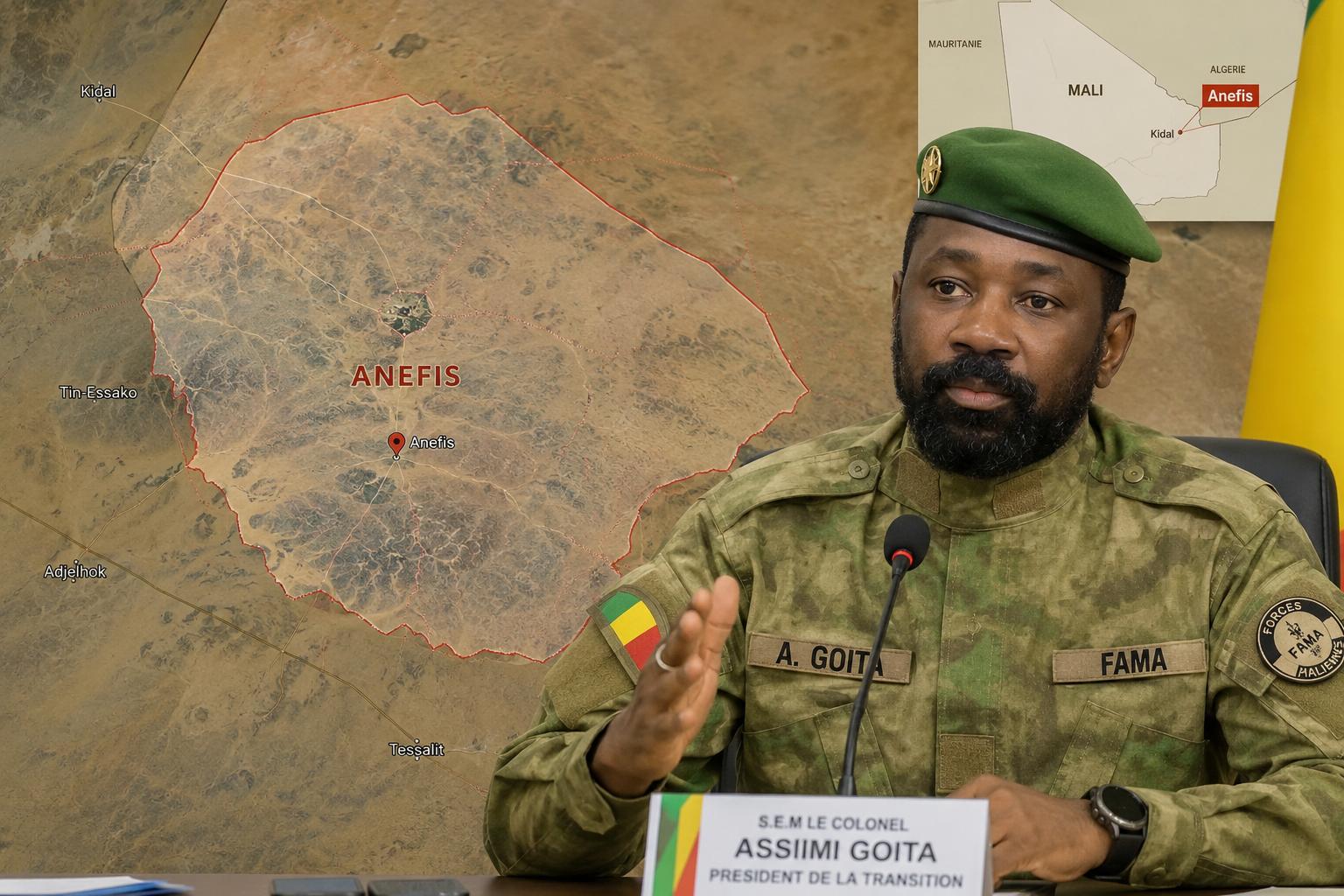
Fierce fighting erupted yesterday near Tabankort in northern Mali, where a large military convoy from the Malian Armed Forces (FAMa) and their Russian-backed Africa Corps allies was ambushed by a coalition of rebel and terrorist groups. The clashes unfolded in Tin Araban, a remote area about 100 kilometers south of Anéfis, along the Gao-Anéfis axis—a critical supply route under intense pressure.
The convoy, comprising roughly 60 vehicles including logistics trucks, armored units, and infantry, had departed from Gao earlier in the week with a clear mission: to reinforce and resupply the beleaguered garrison at Anéfis, a strategic stronghold in the Kidal region facing relentless attacks from armed groups opposed to Bamako’s authority.
The ambush was no random strike—it was a meticulously coordinated assault involving heavy weaponry, artillery fire, and drone strikes. According to intercepted communications, the attackers were a hybrid force merging the Tuareg separatist Front de Libération de l’Azawad (FLA) with jihadist fighters from the Group for the Support of Islam and Muslims (JNIM), an al-Qaeda affiliate. The battle raged for most of the day, leaving behind a trail of destruction and casualties.
heavy losses in a conflict shrouded in secrecy
Despite the severity of the attack, no official statement has been released by Malian authorities. Military and government spokespeople in Bamako have maintained a total blackout, refusing to acknowledge the scale of the losses or even confirm the engagement. Fragmentary reports from rebel channels, however, suggest significant damage: multiple FAMa transport vehicles and light armored units operated by Africa Corps instructors—formerly linked to the Wagner Group—were either destroyed or seized. Partial footage also indicates the loss of reconnaissance drones and dozens of casualties on both sides.
This deliberate silence is not merely a tactical delay—it reflects a broader strategy to conceal the true state of insecurity gripping northern Mali. By withholding information, the transitional government in Bamako appears intent on preserving a narrative of unstoppable military progress, even as reality contradicts official claims of FAMa’s exclusive ascendancy in the region.
the stakes at Anéfis: a turning point for northern operations
The outcome of this battle carries consequences far beyond the immediate tactical setback. The Gao-Anéfis supply corridor is the lifeline sustaining Bamako’s presence in the north. If the convoy’s failure to reach Anéfis is confirmed and reinforcements fail to arrive, the garrison could face isolation—potentially opening the door to a sweeping counteroffensive by the coalition of northern armed groups. Such a scenario would expose the fragility of the government’s control and challenge the credibility of its military narrative, one increasingly at odds with ground realities.