
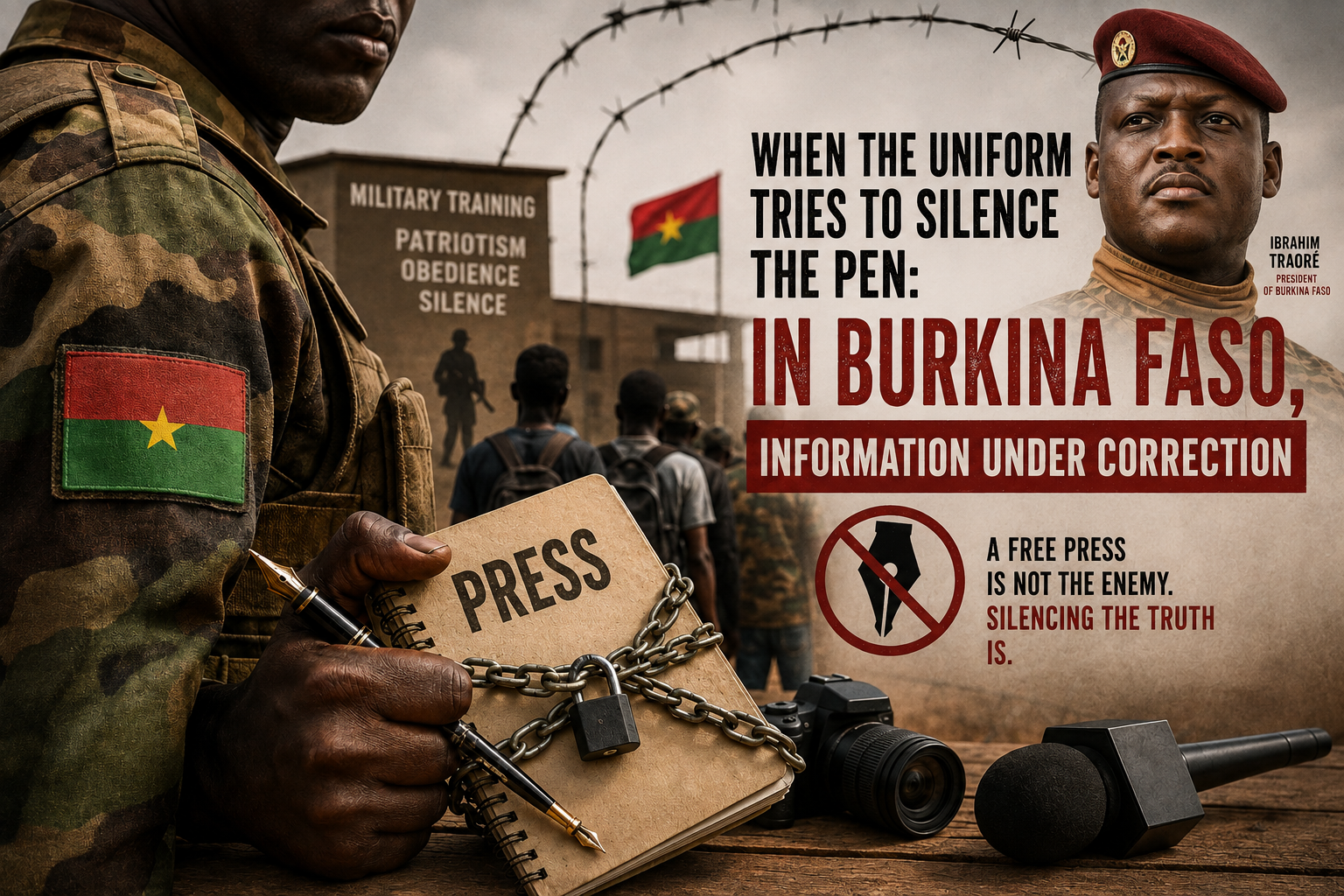
An unsettling scene has emerged near Ouagadougou, where over forty Burkinabè journalists recently completed a so-called ‘patriotism training’ program. While framed as civic engagement, this initiative masks a deeper agenda: an attempt to re-educate and align the press with state narratives.
Journalism under duress: the erosion of press freedom
Burkina Faso’s investigative reporters now face grave risks when documenting the realities of the nation’s security challenges, civilian hardships, or institutional failures. Reporting on such issues is increasingly met with accusations of ‘treason’ or ‘lack of patriotism.’ By compelling journalists into undisclosed military-like facilities, authorities are not fostering informed citizenship they are cultivating compliant mouthpieces for propaganda.
This coercive alignment signals a troubling shift. The crisis unfolding is not merely about military governance amid escalating security threats; it reflects an authoritarian impulse to monopolize truth and suppress dissent. By silencing independent journalism, the state assumes the sole authority to define national narratives, leaving citizens without credible sources of information.
The consequences of a press restricted to state-sanctioned narratives are severe. When credible reporting is suppressed, misinformation, unverified claims, and social media rumors fill the void. A public denied access to verified facts becomes vulnerable to manipulation, eroding trust in institutions rather than strengthening them.
Patriotism versus truth: a false dichotomy
The claim that patriotism requires journalists to avoid uncomfortable truths is fundamentally flawed. True patriotism does not demand blind allegiance to those in power. Rather, it involves a commitment to uncovering realities that affect the nation’s stability and well-being. A journalist who remains silent in the face of injustice or misconduct fails not only their profession but also the citizenry they are meant to serve.
In a functioning democracy, the role of the press is to hold power to account. This includes scrutinizing government actions, exposing inefficiencies, and amplifying the voices of affected communities. When these functions are obstructed under the guise of ‘patriotism,’ the very foundations of democratic governance are undermined.
Security vs. censorship: where to draw the line?
It is undeniable that national security concerns may necessitate certain precautions in reporting. Protecting classified military operations or safeguarding sensitive identities is a legitimate state responsibility. However, these imperatives must not be exploited to justify broader censorship or ideological conformity among journalists.
The distinction between necessary operational secrecy and political control of information is critical. A state threatened by armed groups must secure its borders and operations, but it cannot equate its political survival with national security. The moment journalism is reduced to a tool for regime preservation, the public loses its most vital safeguard against abuses of power.
A dangerous precedent for democratic institutions
The implications of this militarized approach to journalism extend beyond the media sector. If journalists are compelled to prove their loyalty to the state, what prevents similar demands from being imposed on academics, judges, activists, or civil society leaders? The danger lies in normalizing ideological conformity as a prerequisite for civic participation.
A robust democracy thrives on constructive criticism and pluralistic debate. It does not punish dissent; it engages with it. When dissent is framed as a threat to national unity, the state risks alienating the very citizens it claims to protect.
The resilience of truth in the face of repression
History demonstrates that regimes seeking to control all forms of communication ultimately fail to suppress truth permanently. Facts inevitably surface through alternative channels oral testimonies, diaspora networks, international media, or digital platforms. The question, therefore, is not whether information can be contained, but whether a society will accept a reality distorted by state propaganda.
Burkina Faso stands at a crossroads. Will it embrace a model where information is vetted by those in power, or will it uphold a system where journalists retain the right to report facts even when they challenge official narratives? The choice will define not only the future of its press but the very nature of its democracy.
Patriotism, at its core, is not the absence of criticism. It is the courage to confront uncomfortable truths for the sake of the nation’s progress. A journalist who investigates state failures does not betray Burkina Faso; they fulfill the highest duty of their profession.