
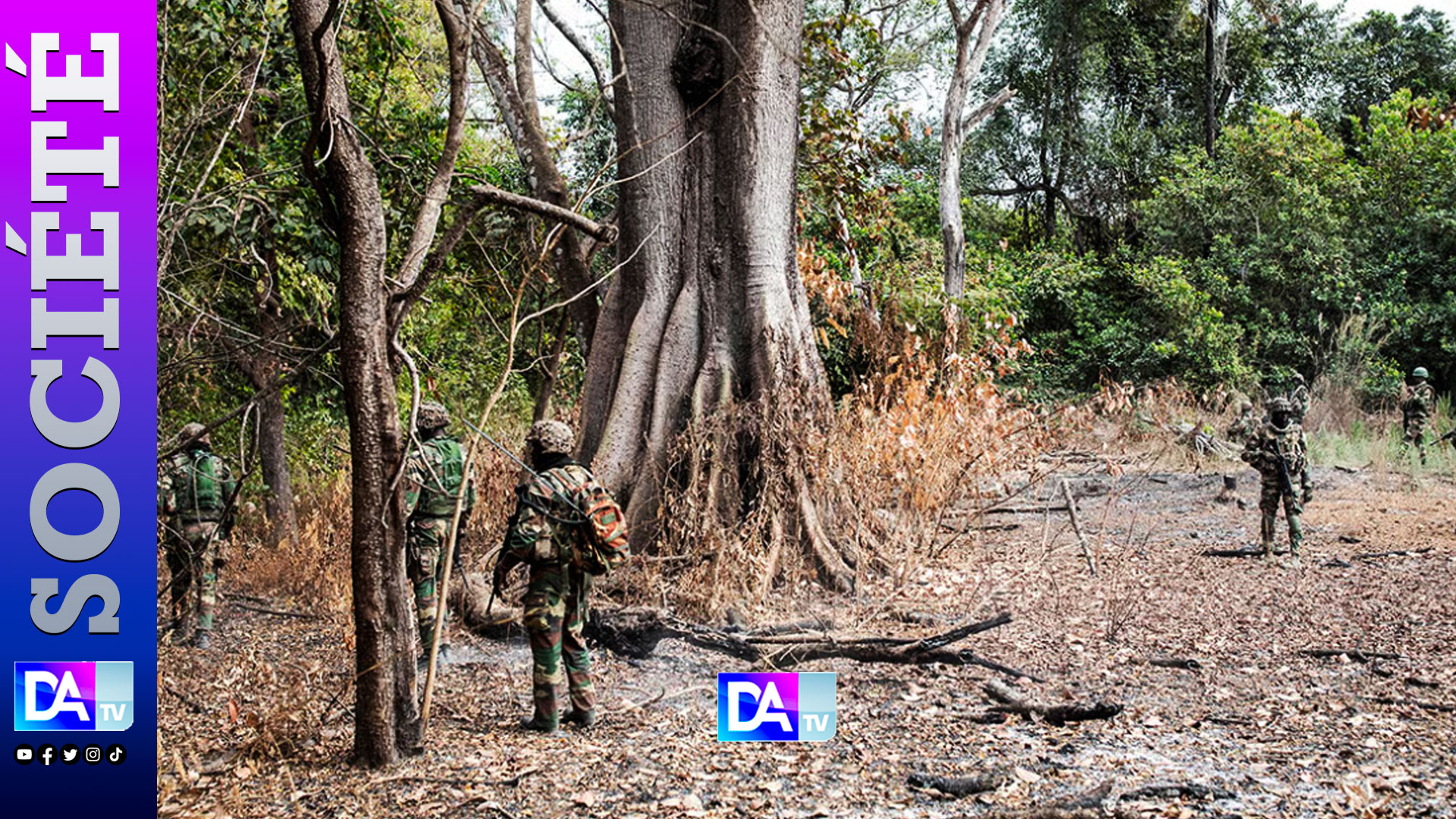
In early May, Senegalese soldiers and gendarmes, supported by trained detection dogs, destroyed cannabis plantations in Casamance. This latest operation marks another chapter in one of Africa’s longest-running conflicts—a struggle that has simmered for over four decades in southern Senegal, despite a severely weakened separatist rebellion.
The military action took place near the Gambia border, where fighters of the Mouvement des forces démocratiques de Casamance (MFDC) have been active since December 1982, seeking independence for the region separated from the rest of Senegal by Gambia.
According to Colonel Cheikh Guèye, regional army commander in Ziguinchor—one of three departments in Casamance and the epicenter of this low-intensity conflict that has claimed thousands of lives—the operation proceeded “without major difficulties.” Fourteen individuals were arrested, along with a cache of firearms and more than six tons of cannabis seized.
a rebellion stripped of its strength
Military experts and analysts confirm that the MFDC has been significantly weakened. “It now commands only residual forces, has stopped recruiting, and faces aging combatants,” said one defense analyst familiar with the dossier. “Meanwhile, the army has grown stronger in both personnel and equipment.”
The group also suffers from “deep divisions among its political and military factions” and struggles with limited access to weapons and ammunition since neighboring Gambia and Guinea-Bissau—once safe havens for rebels—have increased cooperation with Dakar to curb instability.
Local civil society leaders point to another factor: the gradual erosion of the rebellion’s political and emotional support among Casamance communities. “The long conflict has led to disillusionment and disengagement,” said a prominent activist. “People now yearn for peace.”
Additionally, the rise of political leaders from Casamance—including Prime Minister Ousmane Sonko, leader of the country’s majority party—has helped ease tensions, the activist noted. “Many now feel a sense of vindication, believing the region is finally being heard in national politics after years of exclusion.”
cannabis as the last lifeline
In mid-March, Mr. Sonko stated in Ziguinchor, the region’s main city, that the MFDC has not controlled a single village in over 40 years. His remarks followed a deadly incident on March 17, when an explosion during anti-cannabis operations killed three soldiers and injured three others. Just days earlier, on March 11, one soldier was killed and six wounded in a similar incident. In November 2025, a soldier held captive for seven months by an armed group was finally released.
Prime Minister Sonko emphasized that independence is no longer a viable goal—”at best a symbolic stance.” The real issue, he stressed, is cannabis cultivation. “We will deploy all necessary means to eliminate it,” he declared. “Cannabis funds the armed groups and fuels their criminal activities.”
Colonel Guèye echoed this view, stating that the May operation aimed to strike at the financial heart of the rebellion, calling cannabis its “war economy.”
While rebel bases in Guinea-Bissau were dismantled in 2021, recent unrest has shifted to Nord Sindian, near the Gambia border—a densely forested, remote area with limited infrastructure despite rich agricultural and forestry resources. Local populations, struggling to sell their produce due to poor roads, have become dependent on illicit trade.
communities caught between survival and peace
Some residents have even questioned religious authorities on whether Islamic law permits cannabis cultivation. Meanwhile, Prime Minister Sonko has extended an olive branch to the MFDC, but with a firm condition: “We cannot accept the loss of even an inch of our national territory.”
This week, civil society in Ziguinchor marked the third anniversary of a peace agreement between a rebel faction and the government. Another accord was signed in February 2025 in Bissau, though several previous agreements have failed. Across most of the region, refugees and internally displaced persons are gradually returning home, thanks to reduced hostilities and partial disarmament efforts.
Yet peace remains fragile. “The road to full pacification is still long,” said a local civil society leader. “Some armed elements remain reluctant to lay down their weapons.”