
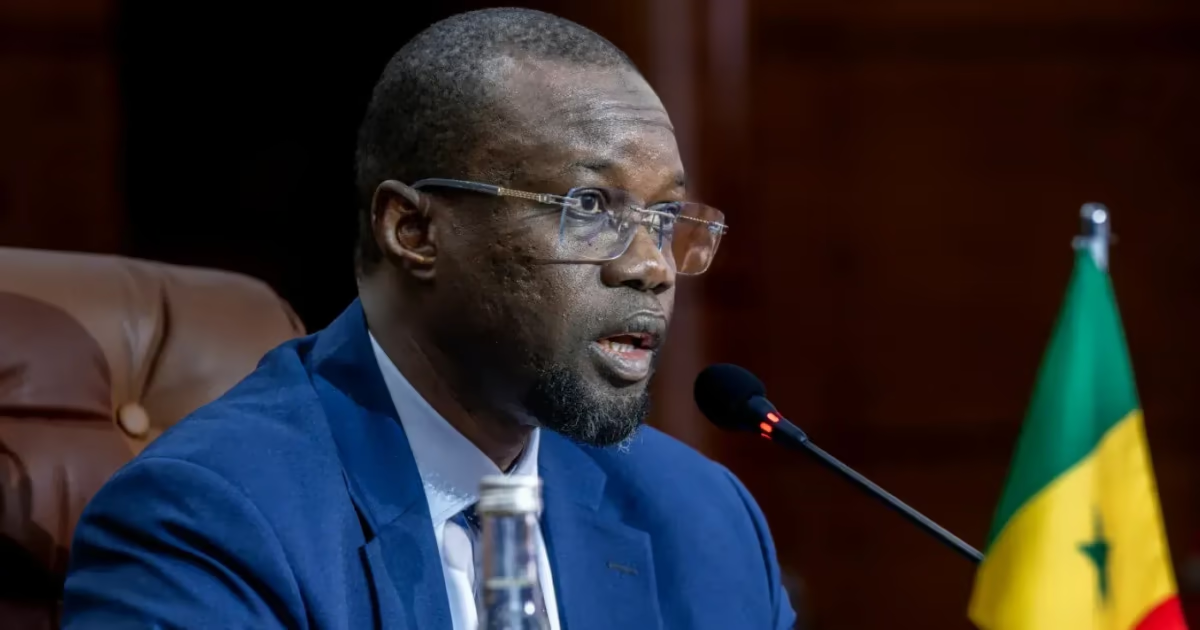
Senegal’s judicial overhaul fuels speculation on Ousmane Sonko’s 2029 exclusion
Recent judicial appointments in Senegal have sparked intense debate about their potential impact on the nation’s political future. Political analyst Mamadou Wane suggests President Bassirou Diomaye Faye may be strategizing to block Ousmane Sonko from contesting the 2029 presidential election, though such plans could underestimate the resilience of Senegalese citizens.
The appointment of new magistrates to the Constitutional Council and Saint-Louis Court of Appeal represents a significant shift in Senegal’s judicial landscape. According to political scientist Mamadou Wane, widely known as Mao, President Faye appears to be implementing a revisionist strategy aimed at restoring elements of the previous neocolonial order while systematically working to sideline Ousmane Sonko politically by 2029. This subtle maneuver is likely to encounter fierce resistance from a Senegalese population hardened by years of struggle and a ruling party whose current momentum shows no signs of weakening.
Wane argues that Faye may attempt to prevent Sonko from running in 2029 by leveraging state institutions—particularly the judiciary—through the appointment of former regime officials to critical positions. However, he believes such efforts will ultimately fail, as they disregard the proven ability of Senegalese citizens to resist political exclusion. The analyst points out that Sonko has consistently maintained strong public support, which has repeatedly thwarted previous attempts to permanently exclude him from electoral processes.
On July 13, 2023, President Bassirou Diomaye Faye issued decrees appointing magistrate Ousmane Diagne as president of the Constitutional Council, replacing the late Mamadou Badio Camara. Days earlier, the president had appointed former prosecutor Serigne Bassirou Guèye as Advocate General at the Saint-Louis Court of Appeal—a move that surprised many observers.
Both appointees have had contentious histories with Sonko. Ousmane Diagne’s disagreements with the PASTEF leader centered on delays in financial accountability reviews and reluctance to prosecute those responsible for crimes committed between March 2012 and February 2024. Serigne Bassirou Guèye’s relationship with Sonko was openly hostile; the opposition leader has repeatedly accused Guèye of falsifying a gendarmerie investigation report during his tenure as prosecutor to orchestrate a politically motivated conspiracy against him.
Wane refrains from preemptively judging Ousmane Diagne, emphasizing that actions should speak louder than assumptions. However, he reserves harsh criticism for Serigne Bassirou Guèye: “When a magistrate engages in document falsification, as Guèye did in Sonko’s trial, they forfeit the right to hold judicial office.”
Neocolonial restoration: the hidden agenda behind judicial appointments
The analyst frames the current situation as part of a revisionist agenda—one that seeks to revive the old order. The recent appointments signal the resurgence of former regime figures and align with what Wane describes as President Faye’s broader strategy to consolidate a centrist political force by co-opting cadres from the previous governing coalition.
“Revisionism, in this context, means an attempt to restore the old system,” Wane explains. “We are witnessing a clear divide: on one side, those pushing to reinstate neocolonial structures; on the other, those advocating for national sovereignty, patriotism, and democratic revolution.”
He cautions the president and his supporters against any attempt to exclude Ousmane Sonko from the political arena, warning of political myopia: “Those pursuing this path overlook the deep-rooted tradition of resistance among Senegalese citizens. The current administration exists only because the people mobilized. Any attempt to politically liquidate Sonko by dissolving the Assembly or fabricating charges will fail—mark my words.”
The PASTEF phenomenon and the awakening of Senegal’s youth
Wane highlights the unprecedented surge in PASTEF membership card sales as a clear indicator of the party’s ground-level strength. “PASTEF is not just the most organized party in Senegal today—it is the most dynamic, with the strongest leadership around Ousmane Sonko. This organizational capacity and grassroots network are what set it apart,” he observes.
The analyst emphasizes that Senegal has reached an irreversible stage of democratic maturity, forged through the political transitions of 2000 and 2012 and solidified during the intense three-year struggle between 2021 and 2024. “In March 2021, the people didn’t resist for days—they held firm for nearly three years. They learned how to push back against even the most entrenched regimes,” he states. This collective memory, he argues, makes any attempt to politically eliminate Sonko doomed from the start.