
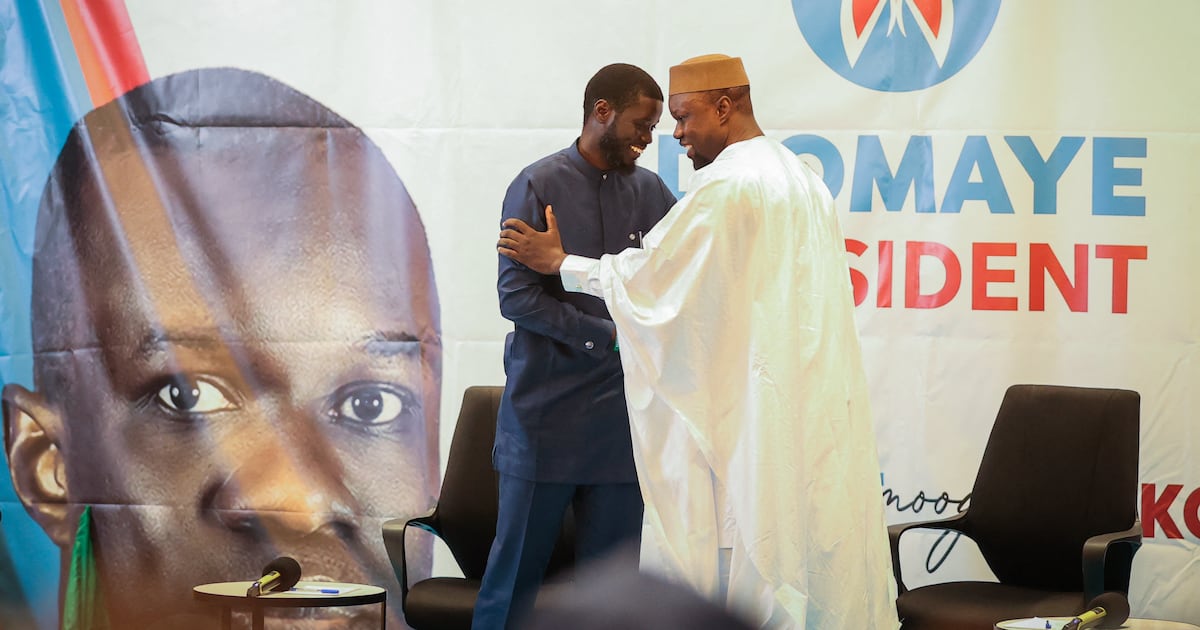
In Dakar’s political circles, the signs were unmistakable. Over recent months, a growing consensus emerged in salons, newsrooms, and even modest neighborhoods: the alliance that propelled Senegal’s opposition to victory was unraveling. The once-powerful campaign slogan « Diomaye mooy Sonko, Sonko mooy Diomaye »—meaning Diomaye is Sonko, and Sonko is Diomaye in Wolof—had long since lost its resonance. It was gradually replaced by a starker observation: « Diomaye is no longer Sonko », as the two men’s growing public disagreements became impossible to ignore.
What began as subtle differences in governance style evolved into deep-seated friction. Clashes over decision-making, struggles for influence within the ruling party, and rivalries between their respective inner circles turned what was supposed to be a harmonious leadership into a precarious cohabitation. The writing was on the wall: one of them would eventually have to step aside.
The calculated gamble of Ousmane Sonko
For months, Ousmane Sonko seemed to push Bassirou Diomaye Faye’s patience to its limit. The Pastef leader understood that sharing power indefinitely with a president intent on asserting full authority was unsustainable. Yet he also knew that in any direct confrontation, his emotional bond with party militants would likely tip the scales in his favor.
His strategy was clear: force Diomaye Faye into an impossible choice—either concede to a weakened presidency or take the drastic step of dismissing him. Each ambiguous statement, each public divergence, and every reminder of his status as the movement’s founding figure tightened the noose around the president’s authority.
By remaining in government while asserting political independence, Sonko made the situation untenable for Diomaye Faye. The president found himself trapped: accept a weakened leadership or remove Sonko and risk being seen as the one who shattered the movement’s founding spirit. Ironically, Sonko stood to gain from dismissal. His forced departure could transform him into a martyr, reinforcing his image as the movement’s undisputed leader in the eyes of a significant portion of the base.
The lure of opportunistic allies
Bassirou Diomaye Faye may have fallen into another trap—this one set by a new circle of advisors. Since taking office, a flock of political operators, former supporters of Macky Sall’s regime, and self-serving notables have surrounded him, all whispering the same message: « You are the president. Show them who’s in charge. »
Such counsel flatters presidential ego and aligns with Senegal’s institutional norms, where the head of government is expected to hold unchallenged authority. Yet the president would be wise to question the true motives of these new allies. Where were they when Sonko and Faye faced the former regime’s judicial machine? Where were they during the crackdowns on protests, the imprisonments, and the smear campaigns against the Pastef? Many enjoyed the privileges of the very system they now condemn with revolutionary fervor.
These political chameleons thrive on division. They amplify rivalries, nurture fragile egos, and feed on internal fractures—less concerned with strengthening the president’s power than with undermining the movement itself. The history of African politics is littered with examples of movements that self-destructed not from external opposition, but from their own internal divisions.
The looming threat of a fragmented Pastef
The power struggle is now in full swing, and Ousmane Sonko may yet emerge as the victor. The political reality in Senegal remains unyielding: the Pastef commands an exceptional grassroots following, a youthful and mobilized base, and a powerful narrative forged in years of confrontation with the previous regime. At the heart of this movement stands Sonko, whose influence remains undiminished despite his absence from the ballot box last year.
Many Senegalese viewed Diomaye Faye’s election as a proxy victory for Sonko. It was his resilience, his defiance, and his enduring popularity that galvanized the movement. While Diomaye Faye holds institutional legitimacy, Sonko wields unmatched popular legitimacy. In any future political or electoral showdown, this could prove decisive.
If the Pastef fractures—some factions loyal to Diomaye Faye, others to Sonko—the outcome is far from certain. Many party cadres, elected officials, and activists may rally behind the figure they still see as the movement’s core. Diomaye Faye lacks a fully autonomous political structure capable of counterbalancing Sonko’s influence. That remains his greatest vulnerability.
The curse of political heirs
The tragedy of many political heirs is their relentless drive to carve out their own identity. No president can indefinitely accept playing second fiddle. Yet beyond personalities, the very coherence of the Pastef’s project is now in question. The movement was born from a promise of radical change—good governance, sovereignty, social justice, and national dignity. Power struggles, however, have a way of derailing even the most noble missions.
The irony is palpable: the Pastef’s opponents may ultimately benefit from a crisis they did not have to engineer.