
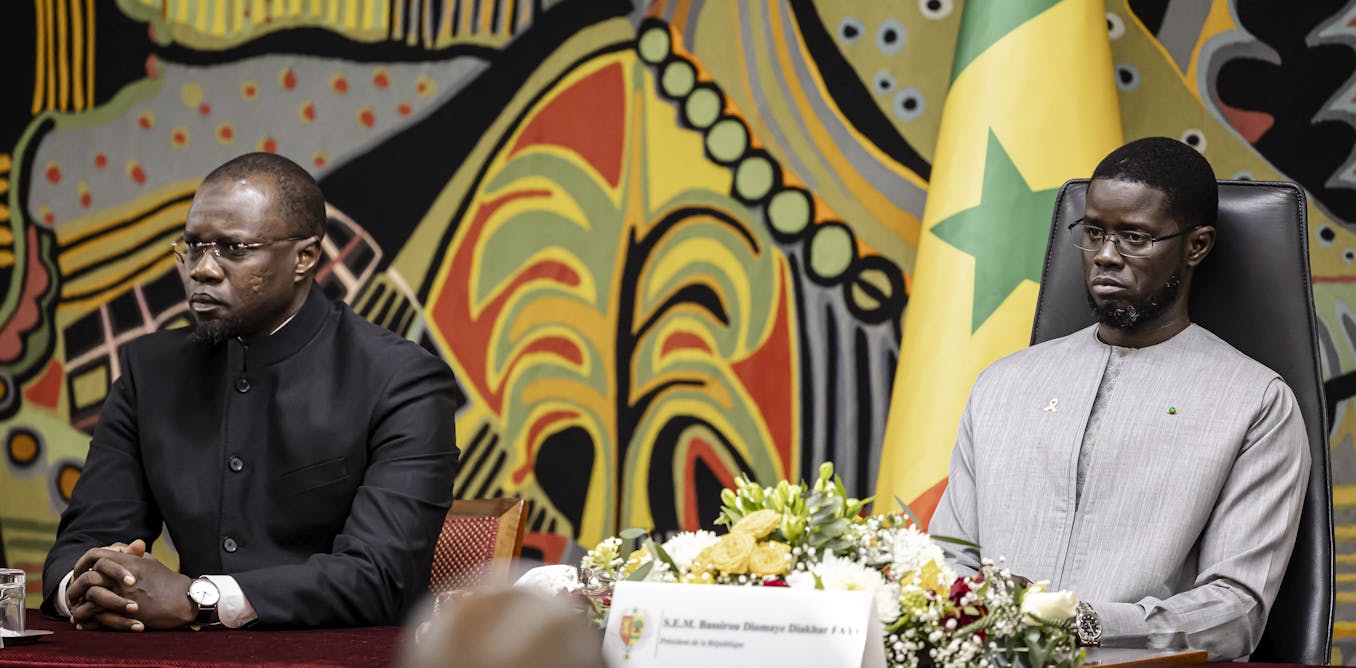
Politics in Senegal often thrives on shifting alliances, whether within the same party or across rival factions. As the British statesman Lord Palmerston once remarked in 1848, “In politics, there are no permanent enemies or friends, only permanent interests.” This axiom now resonates deeply at the highest echelons of Senegal’s government.
The once-united leadership duo of Bassirou Diomaye Faye, President of Senegal, and Ousmane Sonko, Prime Minister, has fractured under mounting internal pressures. These growing tensions culminated in the President dismissing the Prime Minister on May 22, followed by the dissolution of the government.
Early signs of discord emerged during the November 8, 2025 rally, but it was the May 2, 2026 meeting that removed all ambiguity. The President openly criticized his Prime Minister, accusing him of excessive personalization of power around his figure.
the illusion of a united leadership
Originally forged in a spirit of political synergy, the Sonko-Diomaye tandem appeared to offer a harmonious balance: one focused on state governance, the other on political legitimacy. However, the PASTEF rally on November 8, 2025 exposed the fragility of this supposed unity. Sonko declared that the post-rally era would mark a turning point for their institutional partnership—but today, their relationship is paralyzed by deadlock.
Disagreements have surfaced over key strategic decisions, including the selection of the ruling coalition’s coordinator, differing visions of governance, and alliance choices. The once-powerful slogan “Sonko mooy Diomaye” (“Sonko is Diomaye” in Wolof), a unifying mantra against the previous regime, now rings hollow. In its place, rival slogans like “Sonko is Sonko” or “Ousmane is Sonko” are gaining traction, signaling a clear shift toward individual ambitions over collective unity.
This evolution reflects a deeper transformation: what once functioned as a symbolic fusion—where supporters of PASTEF saw the President and Prime Minister as a single, indivisible force—has dissolved into a visible duality. The theoretical framework of symbolic domination reveals how Sonko built a proxy capital by aligning his image with Diomaye’s. Yet, as Bourdieu’s theory of institutional habitus suggests, the roles prescribed by the Constitution (articles 42 to 52) inherently clash. The President embodies sovereign authority, while the Prime Minister retains a mobilizing, disruptive persona—roles that are increasingly incompatible.
Diomaye’s institutional posture demands protocol-driven communication, where the President’s image takes precedence over partisan narratives. Sonko, by contrast, thrives in grassroots mobilization. This divergence has led to a political polarization: pro-Diomaye factions versus pro-Sonko blocs, each vying for influence within the state apparatus.
the inherent contradictions of power sharing
In fluid dynamics, when two bodies of unequal mass occupy the same space, the heavier displaces the lighter. A similar principle applies to Senegal’s leadership crisis. Sonko’s charisma and control over PASTEF lend popular legitimacy to Diomaye’s presidency, while Diomaye’s executive decrees and state decisions give tangible form to the party’s agenda. Yet, this interdependence breeds instability.
If Sonko overreaches, he encroaches on Diomaye’s institutional territory, making the President appear constrained. If Diomaye asserts autonomy, he risks losing the vital legitimacy Sonko provides. Theirs is a relationship of mutual dependence—and mutual destruction. Power oscillates precariously between the presidential palace and the Prime Minister’s office, sustaining a persistent undercurrent of rivalry.
As they mirror each other’s ambitions, their differences intensify. Both seek the same objectives: executive authority, political dominance, and institutional control. Sonko’s aspirations to the presidency and Diomaye’s efforts to consolidate power create a paradox where proximity fuels conflict. The classic “number two syndrome” has resurfaced: the loyal lieutenant, once in the shadows, now challenges the leader who once elevated him.
The dominant figure, fearing future electoral risks, may transform a trusted ally into a rival through suspicion—fostering a climate of mutual distrust. This paranoia foreshadows a period of social and political turbulence, where the fragile balance of power risks collapse.