
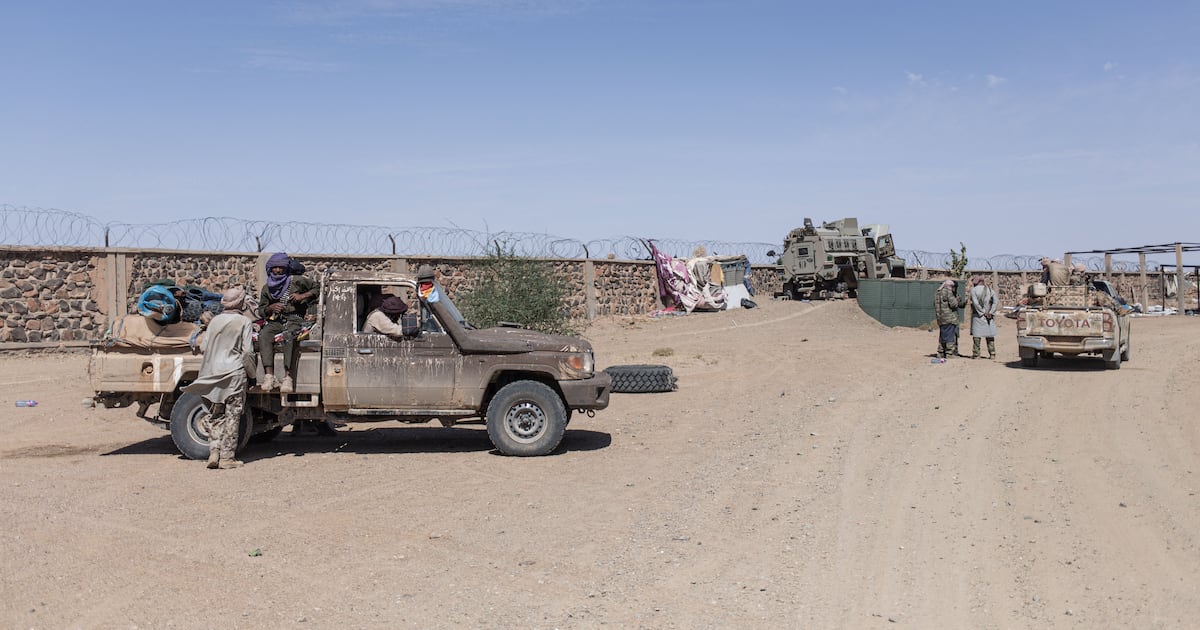
The coordinated assaults on 25 and 26 April in Bamako, Kati, Gao, Sévaré and Kidal have reignited a long-suppressed debate in Mali’s security circles: is it time to engage in dialogue with jihadist factions? With the combined might of the Jnim—an Al-Qaïda affiliate—and the Tuareg rebels of the Front de libération de l’Azawad (FLA) stretching government forces to their limits, some analysts now argue that a purely military response has reached its ceiling.
From northern to southern Mali, the offensive unfolded with unprecedented speed. Armed groups staged synchronized strikes against military outposts and state symbols in at least six cities, even reaching the outskirts of Bamako. For the first time, Jnim and the FLA operated in tandem. Established in November 2024 following the dissolution of the Cadre stratégique permanent, the FLA demands self-determination for the Azawad, Mali’s vast northern territory.
These coordinated attacks laid bare the vulnerabilities of Mali’s regime. Neither the junta led by Assimi Goïta nor its Russian allies within the Africa Corps have managed to halt the armed groups’ advance. Within regional media and diplomatic circles, the possibility of negotiating with Jnim is now being discussed more openly, amid Bamako’s growing suffocation and the regional entanglement. Yet the Malian authorities continue to rule out any talks, insisting they will not engage in “any dialogue with terrorist armed groups,” clinging to a strictly military strategy despite rapidly deteriorating security.
Since late April, pressure on the regime has intensified. In central Mali, violence has surged. Just last Friday, multiple villages in the Bankass area—including Kouroude and Dougara—were struck. Local and security sources report that the combined death toll from Wednesday and Friday’s attacks stands between 70 and 80.
An unprecedented alliance sends shockwaves
Jnim remains the driving force behind the jihadist surge across the Sahel, particularly in Mali, Burkina Faso and Niger. For the military juntas united under the Alliance des États du Sahel (AES), the deadlock is tightening. Having seized power on promises of restoring security, these regimes now struggle to curb an ever-expanding threat. Over the past year in Mali, attacks have inched ever closer to the capital.
“From July 2025 onward, jihadists targeted western Mali, striking gold panning sites and industrial facilities. They then focused on the Bamako–Dakar corridor, choking off the capital,” explains Alain Antil, director of the Sub-Saharan Africa Center at the Ifri. “What’s striking this time is not just the scale of the operation, but the deliberate choice of targets—Kati and Bamako represent the heart of the regime,” adds Héni Nsaibia of the Armed Conflict Location & Event Data Project (ACLED).
The death of Mali’s Defence Minister, Sadio Camara, in Kati dealt a severe blow to the government. The loss of Kidal—retaken in late 2023 and hailed as a major victory—has further weakened Mali strategically.
Starving the capital into submission
Even before this latest offensive, experts noted a shift in Jnim’s tactics. “Their goal is to create a stronger power dynamic—not merely through military pressure, but to push Malian authorities toward negotiation,” Antil observes.
The group now appears to be scaling up local strategies: economic blockades, gradual encirclement of urban centers and pressure on supply routes. “Jnim is attempting to impose an economic siege around Bamako,” Antil stresses.
According to Abdel Nasser Ould Ethmane Elyessa, this strategy is part of a long-term plan: “They aim to weaken the regime from within, exploiting military fractures and prolonging a strategy of attrition.” He adds: “Jnim no longer makes the implementation of sharia a prerequisite for peace and now claims openness to dialogue.”
The rivalry with the Islamic State in the Greater Sahara (EIGS) further destabilizes the region, as both groups vie for territorial control and influence.
A taboo option gains traction
Officially, Sahelian regimes reject any form of dialogue. “For the AES leadership, political negotiation is off the table. The discourse remains uncompromising, with military force as the only response,” notes Antil.
Yet on the ground, realities are far more complex. State forces and their Russian allies have been implicated in widespread civilian casualties. Between January 2024 and March 2025, nearly 1,500 civilians were killed by government troops and their allies in Mali—nearly five times the toll attributed to Jnim, according to the Global Initiative Against Transnational Organized Crime (GI-TOC). Such violence fuels resentment and fuels jihadist recruitment.
States must accept a compromise of the brave.
Abdel Nasser Ould Ethmane Elyessa, Sahel researcher
Faced with this impasse, an increasing number of experts advocate a paradigm shift. “A purely military approach is a dead end when confronting Sahelian jihadism. It must be paired with political negotiations,” argues Antil. Certain grievances raised by jihadist groups—corruption, justice, access to resources—could serve as a basis for discussion, though their violence cannot be ignored.
Elyessa goes further: “States must accept a compromise of the brave. The idea would be to integrate jihadists into the political process to expose their limitations.” Yet he sets clear red lines: “Gender equality and the secular nature of the state are non-negotiable.”
As jihadist offensives gain ground, the once-unthinkable notion of negotiation is shifting from heresy to plausible policy. For many experts in Mali, the question is no longer whether to talk, but how long Bamako can continue to refuse.