
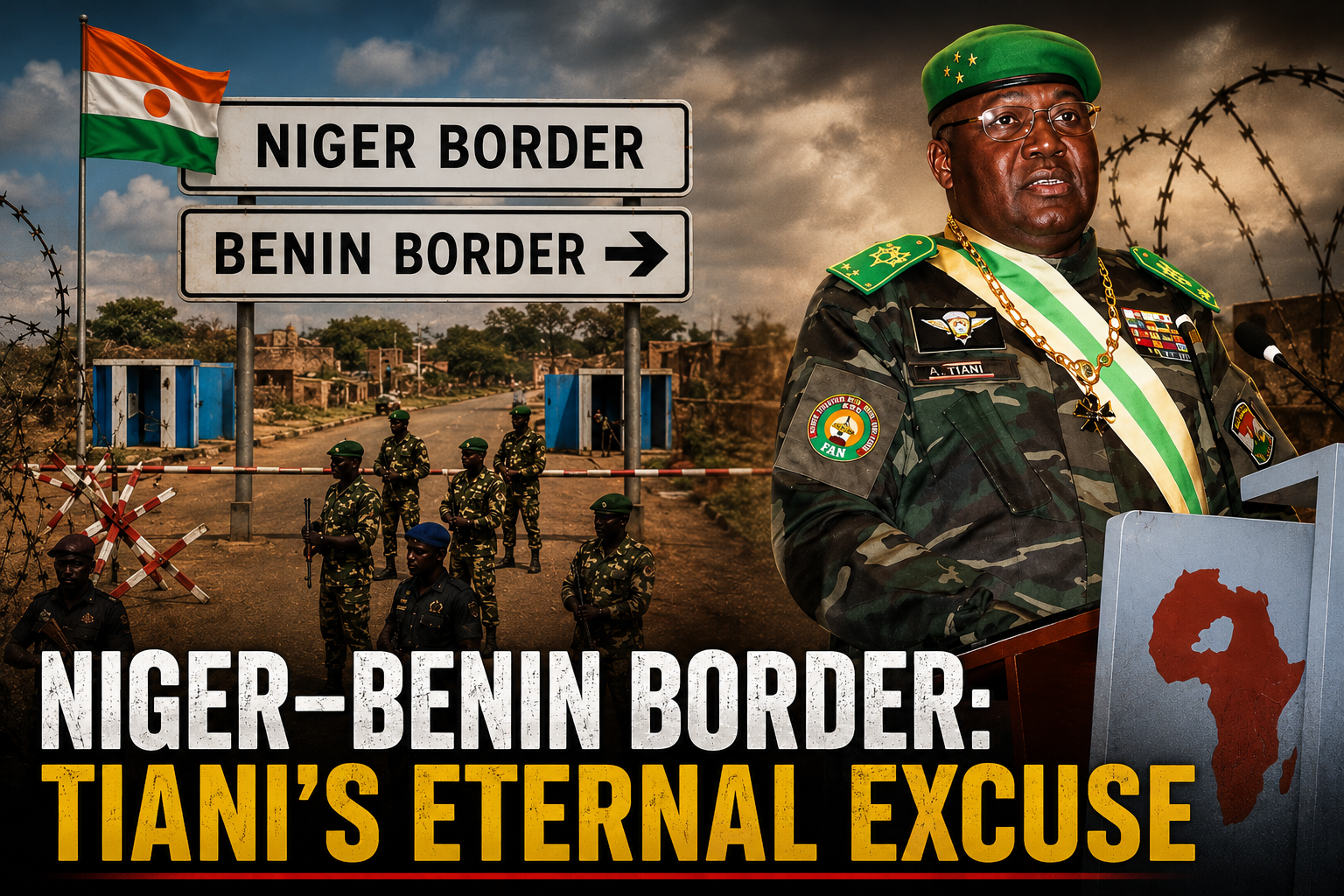
Initial optimism for a swift resolution to the border crisis between Niger and Bénin has waned, despite recent diplomatic efforts. Hopes had been buoyed by a visit from Béninese President Romuald Wadagni to Niamey eight weeks prior, followed by expert-level discussions between the two nations five weeks ago. These technical engagements appeared to rekindle dialogue, hinting at a gradual resumption of cross-border activities.
However, on July 26, marking the first anniversary of his ascent to power, General Abdourahamane Tiani decisively closed the door on any immediate prospect of reopening. Speaking on national television, ORTN, he articulated, ‘There are prerequisites that must be addressed before an irreversible decision regarding the border’s opening can be made.’
This declaration reinforces a pattern observed over nearly three years: the frontier has transcended its role as a mere transit point. It has evolved into a strategic political instrument, employed to foster a narrative of national sovereignty and maintain persistent tension with Cotonou.
‘Prerequisites’ without definition, an indefinite blockade
The fundamental challenge lies in the complete absence of specificity.
Precisely what do these ‘prerequisites’ entail? What criteria would signify their fulfillment? What timeframe is being considered? None of these critical details have been clarified.
Such imprecision grants the military authority a substantial political advantage, enabling it to indefinitely defer the border’s reopening without needing to offer concrete justifications for its refusal.
In practice, any new demand can be substituted for a prior one, effectively transforming the border issue into an open-ended dossier.
This strategy deliberately perpetuates an enduring state of uncertainty, thereby precluding any lasting normalization.
A security rhetoric that fails to convince
Since the July 2023 coup d’état, security has served as the central justification for the regime’s actions.
Niamey frequently asserts that Béninese territory is being utilized as a rear base by armed factions or foreign powers potentially threatening Niger.
Nevertheless, these allegations have consistently lacked public evidence to substantiate such claims.
Concurrently, terrorist attacks persist across several Nigerien regions, notably Tillabéri, Tahoua, and Diffa. This demonstrates that the closure of the border with Bénin has not yielded a significant improvement in the internal security situation.
This inherent contradiction prompts a legitimate inquiry: if the closure was intended to bolster national security, why does the high incidence of violence continue unabated?
Expert findings relegated
Just weeks prior, Béninese and Nigerien experts had engaged in renewed dialogue to explore the technical modalities for a gradual resumption of exchanges.
The precise objective of these meetings was to identify mechanisms that could simultaneously address security concerns and facilitate the restoration of commercial flows.
By implicitly dismissing these advancements, General Tiani conveys a clear message: the ultimate decision rests solely on political arbitration.
In other words, technical discussions now appear to serve more as a tactic for gaining time than as a pathway to formulating a genuine solution.
A closed border primarily disadvantages Niger
The protracted closure generates substantial economic repercussions for both nations.
Bénin naturally experiences a decline in transit traffic destined for the port of Cotonou, a reduction in customs revenues, and a slowdown in the activities of numerous transporters.
However, the ramifications appear even more severe for Niger.
As a landlocked nation, Niger has historically relied on regional corridors for its supply chain. The necessity of utilizing longer routes through alternative countries significantly escalates logistical expenses.
This increase is subsequently passed on to consumers, leading to:
- heightened prices for foodstuffs;
- increased costs for construction materials;
- more expensive medications and imported goods;
- supply chain challenges for merchants;
- a reduction in the competitiveness of Nigerien businesses.
Small-scale traders operating along the border are among the primary victims of this situation. Many have witnessed a significant portion of their income vanish, while some formerly vibrant localities now experience a marked economic downturn.
Regional cooperation significantly undermined
Beyond the economic ramifications, this closure profoundly weakens regional cooperation as a whole.
Academic exchanges, relationships between border communities, joint development projects, and initiatives aimed at combating cross-border trafficking all become considerably more challenging to implement.
Paradoxically, an officially closed border does not deter clandestine networks from thriving.
On the contrary, when legitimate commercial channels cease to exist, informal trade often tends to expand, further complicating governmental control.
Sovereignty as a tool for political communication
By characterizing the decision as ‘irreversible,’ Abdourahamane Tiani also seeks to frame this issue within a symbolic context.
The border closure is portrayed as a clear demonstration of sovereignty in the face of external pressures.
However, this approach raises a fundamental question: is sovereignty measured by a nation’s capacity to isolate its economy, or by its ability to effectively safeguard the interests of its populace?
For numerous observers, the protracted closure now appears to align more with a logic of political communication than with an objectively measurable security strategy.
It serves to perpetuate a discourse of perpetual resistance, thereby consolidating the junta’s internal legitimacy among a segment of its public.
The human toll of a political standoff
Behind the official pronouncements lie thousands of families directly affected.
Transporters deprived of their livelihood, ruined merchants, students prevented from traveling, separated families, and economic operators facing profound uncertainty: the human consequences remain largely underestimated.
Each additional week of closure intensifies these hardships and further postpones the prospects of a normal resumption of exchanges.
An enduring impasse
Three years into the crisis, the Niger-Bénin border appears less as a security concern and more as a political instrument.
By invoking ‘prerequisites’ that remain perpetually undefined, the Nigerien leadership retains complete discretion to prolong the status quo for as long as it deems fit.
Meanwhile, the populace continues to bear the economic, social, and human consequences of a decision whose tangible benefits remain challenging to substantiate.
Ultimately, normalization is likely to occur only when political considerations cease to overshadow the daily interests of citizens and the imperative to restore regional cooperation founded on dialogue, trust, and pragmatism.