
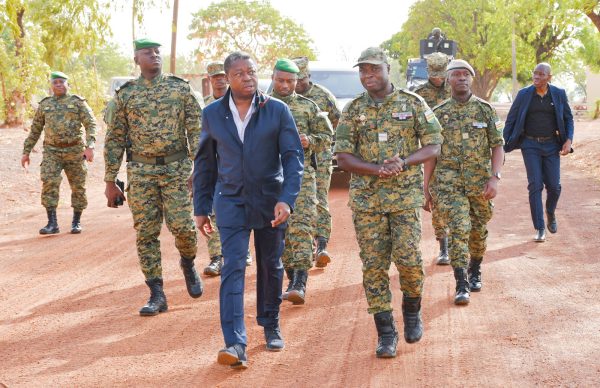
President Faure Gnassingbé visits Koundjoaré frontline amid rising regional threats
The Togo president and supreme commander of the armed forces, Faure Gnassingbé, made a high-stakes visit to the Koundjoaré operation front in the Savanes region on May 7, 2026. This strategic move came as violent extremism edges closer to Togo‘s northern borderlands, where troops endure grueling warfare. The presidential deployment placed him at the heart of danger, where every second counts and the hum of helicopter blades disrupts the tense silence.
The Savanes region, a border area where the dry harmattan winds give way to stifling May heat, is more than a line on a map. It’s a zone of constant tension where the enemy hides in plain sight—behind bushes and rocky outcrops—with no face or uniform to identify them. Here, Togo wages one of its most critical battles to safeguard its territorial integrity. Around 10 a.m. that Thursday, Faure Gnassingbé landed in this hostile landscape to assess the situation firsthand.
Command post briefings: uncovering the security threat
His first stop was the Operational Command Post (PCO), a secure and confined space where satellite maps and intelligence reports painted a stark picture of the evolving threat. Military officers outlined the harsh realities on the ground: asymmetric warfare, improvised explosive devices (IEDs), infiltration attempts by armed terrorist groups from the Sahel, and the persistent challenge of securing hundreds of porous kilometers of border.
The president listened intently as commanders detailed operational constraints and material shortages faced by frontline troops. He pressed for continuous adaptation—enhancing security measures, improving unit responsiveness, and boosting operational efficiency to minimize vulnerabilities. His focus remained unwavering: every decision made in this command center impacts lives.
Tchamonga: where strategy meets sacrifice
The most symbolic part of the visit was yet to come. Faure Gnassingbé flew eastward to the forward operational base (POA) of Tchamonga, situated directly along the border. Here, the threat felt even more tangible. In front of a tactical sandbox—a tool used to simulate enemy positions—the president examined patrol mechanisms and intervention scenarios in this sensitive zone.
Next, he met the soldiers—faces etched with sleepless nights, harsh weather, and relentless pressure. Speaking to the troops, he praised their unwavering sense of duty and sacrifice, acknowledging that many comrades had already laid down their lives for national security. He urged them to maintain constant vigilance against an unpredictable foe while reaffirming full military support. He also highlighted ongoing efforts to strengthen equipment and operational capabilities, a message aimed at lifting morale among those stationed on this critical front.
Koundjoaré: blending military might with community resilience
Why is this visit so pivotal now? Because winning the battle in the Savanes isn’t just about firepower. It’s also about the minds and daily lives of local populations, who are prime targets for terrorist indoctrination. Faure Gnassingbé‘s visit highlighted Togo‘s holistic approach to combating security threats, combining military action with social measures. The government’s strategy rests on two pillars:
- Operation Koundjoaré (The Shield): The military operation forming the essential defensive barrier against armed groups.
- Community resilience programs: Initiatives designed to counter radicalization and strengthen local cohesion.
Key programs include:
- The Savanes Emergency Program (PURS): Delivering clean water, electricity, schools, and roads to prevent poverty from fueling extremism.
- The CIPLEV: An inter-ministerial committee working with traditional leaders and youth to detect signs of radicalization and foster social unity.
Regional cooperation: a fight beyond borders
This frontline visit also underscored Togo‘s commitment to regional security cooperation, particularly with the Benin and Burkina Faso. Authorities emphasize that tackling violent extremism requires stronger cross-border coordination. In a West Africa reshaped by geopolitical shifts and security fragilities, stabilizing northern Togo is no longer just a national concern—it’s a regional imperative.
By visiting Tchamonga and engaging directly with deployed units, Faure Gnassingbé sent a clear message: Togo will maintain pressure on armed groups and defend its territory, even amid an unstable regional landscape.