
In Bénin, traditional leaders remain pillars of sociocultural life, deeply rooted in the nation’s heritage. They embody the continuity of local values, traditions, and identities while serving as moral and cultural anchors for their communities (Affo, Sina, & Gnanvi, 2019). Their roles extend beyond cultural preservation, as they play an active part in conflict resolution and social cohesion.
To formalize their position, the Béninois government enacted Law No. 2025-09 of April 3, 2025, establishing a legal framework for traditional chieftaincies. This legislation categorizes traditional leadership structures and grants them formal recognition. It also highlights their contributions to socioeconomic development, social cohesion, and cultural identity preservation. Under this law, 16 kingdoms and 90 traditional chieftaincies now hold official status in the country (Fatondji, 2025).
However, their influence extends into the political arena, where some traditional leaders are courted by political parties seeking electoral support. In exchange, they may receive material benefits or financial incentives, a practice that has sparked controversy (Cessou, 2017). To curb such entanglements, Bénin has prohibited traditional rulers from engaging in partisan politics (République du Bénin, 2025).
Recent surveys shed light on how Béninois citizens view traditional leaders, their perceived influence, and their role in local governance. Findings reveal that traditional leaders continue to hold significant sway in public life: nearly a quarter of citizens reported contacting them in the year prior to the survey. A majority express trust in these leaders and believe they positively impact local governance, with many advocating for an even greater role in community decision-making.
Yet, this positive perception is tempered by concerns over integrity. Three-quarters of respondents suspect that some traditional leaders are involved in corruption, a concern that has grown since 2022. Distrust in their leadership has also declined compared to 2020.
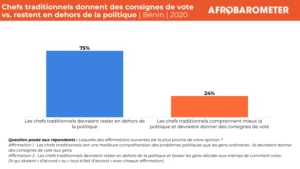
Despite their respected status, citizens overwhelmingly believe traditional leaders should refrain from political involvement. They argue that voting decisions should remain free from external influence, emphasizing the importance of preserving the autonomy of the electorate.