
Ukraine’s evolving military strategy reshapes the conflict’s dynamics
Four years into a relentless war, Ukraine has transformed its approach to counter Russian aggression. No longer confined to its own borders, the conflict now extends deep into Russian territory, where targeted strikes are redefining the aerial and naval balance of this prolonged confrontation.
Cutting off the lifelines of Russia’s military machine
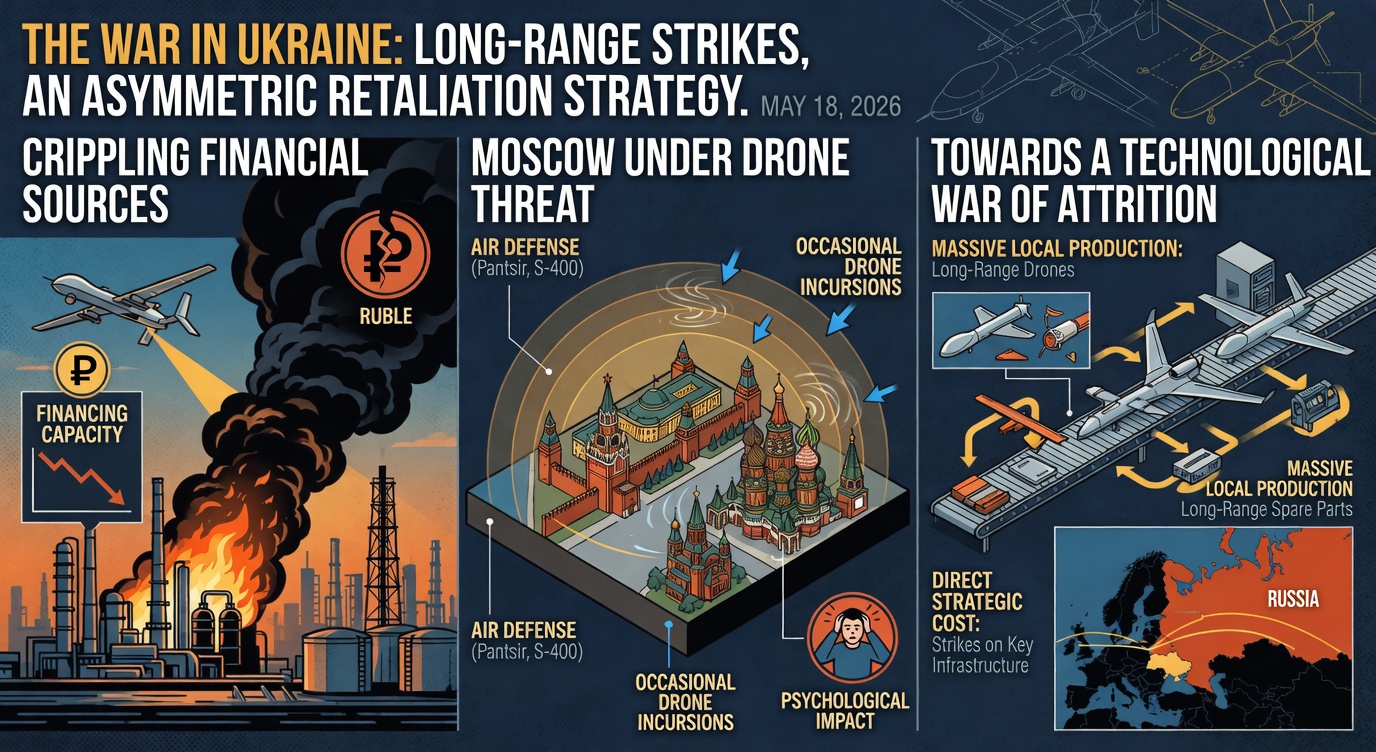
Kiev’s military doctrine has shifted from defense to proactive deterrence. By focusing on long-range strikes, Ukrainian forces are systematically degrading Russia’s war-sustaining capabilities. Critical military installations and energy infrastructure—including oil refineries and fuel storage depots—are now within striking distance, disrupting Moscow’s logistical networks.
The dual impact of these operations is undeniable. On the battlefield, they directly impair the operational readiness of Russian troops by restricting fuel supplies. Strategically, they erode Russia’s economic foundation, which remains heavily reliant on hydrocarbon exports and refining. This two-pronged approach weakens both the immediate war effort and Moscow’s long-term capacity to sustain hostilities.
Psychological and tactical ripple effects on Moscow
While drone incursions near Moscow are infrequent, their psychological and operational repercussions are profound. The Russian capital, situated over 400 kilometers from the Ukrainian border, benefits from one of the world’s most robust air defense systems. Yet, even sporadic breaches have far-reaching consequences.
Beyond superficial damage, these strikes shatter the illusion of invulnerability for urban populations, fostering uncertainty and instability. More critically, they force the Russian military to divert advanced anti-air systems—such as the Pantsir and S-400—from active combat zones to protect key political and economic hubs. This redistribution of resources dilutes frontline defenses and exposes vulnerabilities in Russia’s strategic posture.
Technology-driven warfare: A new era of attrition
This shift underscores Ukraine’s pivot toward a technologically driven war of attrition. By deploying domestically produced long-range drones, Kiev has demonstrated an ability to project power beyond traditional frontlines. These capabilities signal a clear message: Ukraine is no longer merely reacting to Russian assaults but is actively imposing costs on its adversary.
For the international community, the message is equally potent. The conflict has evolved into a test of technological resilience, where innovation and industrial capacity determine the trajectory of the war. As Ukraine continues to refine its long-range strike capabilities, the calculus for both sides—and the broader geopolitical landscape—is being rewritten in real time.