
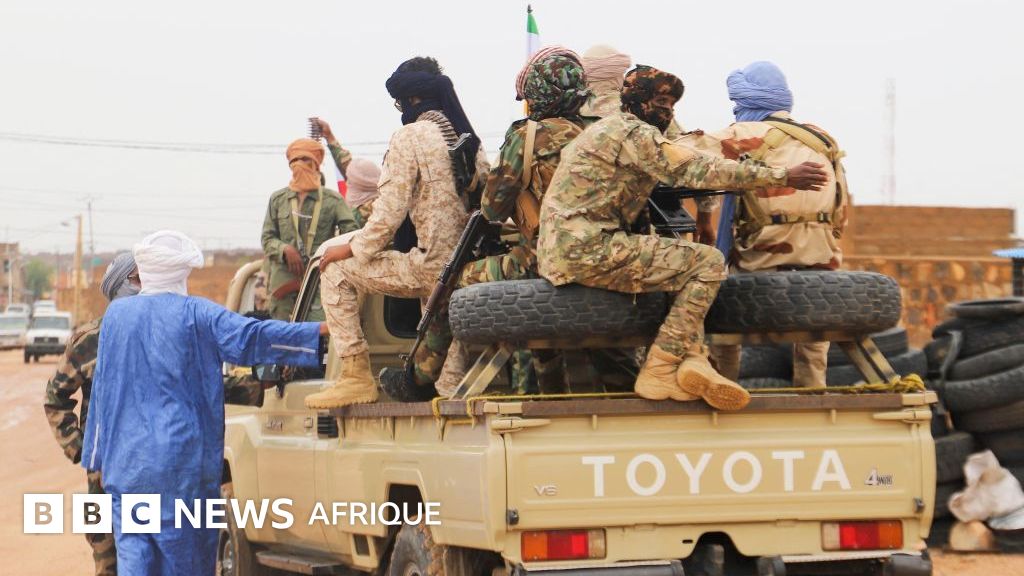
Mali under siege: how a radical alliance is challenging the military junta
Coordinated attacks this past weekend by the Group for the Support of Islam and Muslims (JNIM), an Al-Qaeda affiliate, and Tuareg separatists from the Azawad Liberation Front (FLA) have exposed the fragility of Mali’s military-led government. The simultaneous strikes across multiple cities—from Bamako to Kidal—marked an unprecedented level of tactical unity between groups with historically opposing agendas.
While JNIM seeks to impose a transnational Islamic order through guerrilla warfare and terror tactics, the FLA fights for regional autonomy or independence for northern Mali’s Azawad territory. Despite their ideological differences, both groups have now directed their firepower toward a common adversary: the military junta in power.
From rivals to allies: a tactical convergence
Historically, the FLA and JNIM viewed each other with deep suspicion. The separatists rejected the jihadists’ extremist agenda, while the militants saw the rebels as competitors vying for control over the same regions. Yet this recent cooperation signals a shift in strategy.
The alliance appears to be driven by mutual benefit. The FLA contributes local legitimacy, deep community networks, and intimate knowledge of the terrain, while JNIM brings combat experience, heavy firepower, and cross-border operational capacity. Together, they have created a more formidable threat to the Malian state.
According to Emmanuel Odilon Koukoubou, a political scientist and researcher at the Civic Academy for Africa’s Future (CiAAF), similar alliances have emerged before. In 2012–2013, the National Movement for the Liberation of Azawad (MNLA) briefly joined forces with groups like AQMI and Ansar Dine to push Malian forces out of northern Mali. That alliance, however, quickly unraveled as the jihadists turned on their erstwhile partners.
“The FLA is clearly pursuing independence for the north, while jihadists aim to establish a caliphate across the Sahel,” Koukoubou explains. “Their goals are fundamentally incompatible in the long run. This cooperation is purely tactical—rooted in a shared enemy: the Malian state.”
A coordinated assault on the heart of power
The timing and scale of the attacks suggest a deliberate effort to destabilize the government. Among the most shocking developments was the killing of Sadio Camara, Mali’s Defense Minister and a key figure in the military leadership, in an ambush at his residence in Kati. The attack occurred without any prior warning from intelligence services, underscoring a critical vulnerability in the regime’s security apparatus.
The absence of President Assimi Goïta from public view for 48 hours fueled speculation and raised concerns about internal instability. It was Prime Minister Abdoulaye Maïga who addressed the nation, acknowledging the “asymmetry” of the threat and vowing to strengthen counter-terrorism measures.
“The assassination of Sadio Camara is not just a loss of a human life—it’s a blow to the entire command structure,” says Alioune Tine, founder of the Dakar-based think tank Afrikajom Center and former UN expert on Mali. “Camara was more than a defense minister; he was a strategist, an intellectual, and a unifying force within the military.” His death, Tine warns, “sends a dangerous signal: even the regime’s strongholds are not safe.”
Regional risks: a potential domino effect
The crisis comes at a time when Mali’s diplomatic isolation is growing. The junta has distanced itself from Western partners and increasingly relies on support from Russia and the Alliance of Sahel States (AES). Yet analysts warn that this backing may not be enough to counter the mounting insurgency.
“The Malian regime is now exposed and increasingly isolated,” Koukoubou notes. “The risk is real: further weakening could lead to collapse, with spillover effects across the entire Sahel.”
Tine goes further, calling the situation “unprecedented” and urging urgent regional action. “The fall of Mali could trigger a domino effect across West Africa, just as the spread of jihadism did years ago,” he says. “We need a collective defense strategy—one based on shared sovereignty and regional solidarity. Without coordinated action, there is no solution.”
He calls on the ECOWAS and AES to convene an extraordinary summit focused solely on regional security. “Leaders must set aside national egos and build a unified security architecture. The priority is clear: survival through collective strength.”