
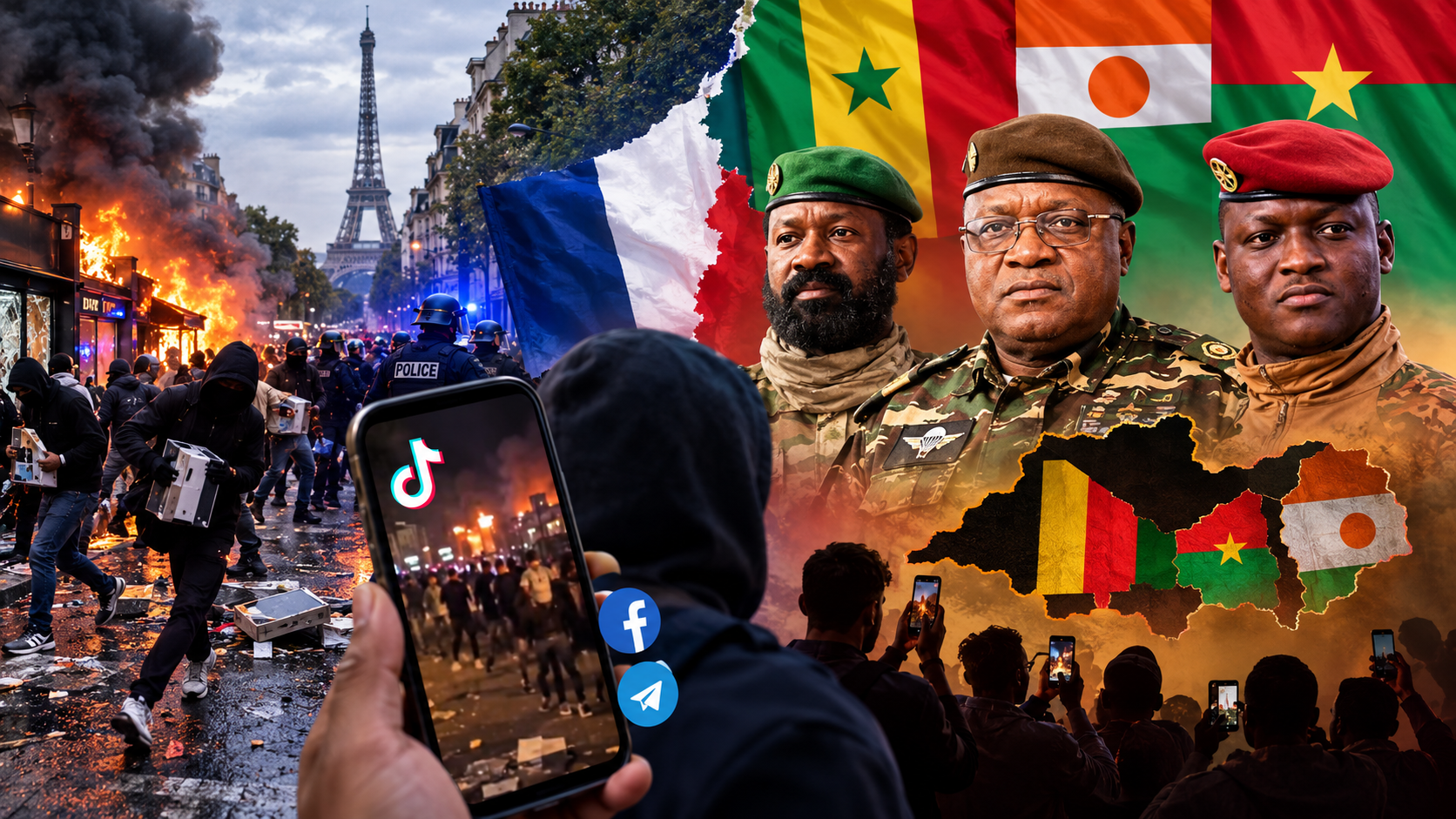
When domestic unrest becomes a political weapon
The recent wave of urban violence in France has resonated far beyond its borders, particularly in the Sahel region where military-led governments in Mali, Burkina Faso, and Niger have seized upon these events to amplify their anti-French narratives. Through social media platforms such as TikTok, Facebook, and Telegram, images of looting, property destruction, and clashes with law enforcement have been rapidly recycled to undermine Paris’s credibility on issues of democracy, security, and governance.
Exploiting France’s contradictions: a strategic misstep?
Proponents of the Sahel juntas’ military regimes argue that the unrest exposes a fundamental hypocrisy: if France condemns their governance models, how can it maintain moral authority while grappling with internal instability? This narrative seeks not only to discredit Paris but also to position the juntas as legitimate alternatives in a post-colonial context. Yet this argument overlooks a critical distinction: the difference between systemic failure and isolated incidents of lawlessness.
Individual accountability in times of crisis
While the political exploitation of these events garners attention, the legal dimension remains equally significant. Investigations into alleged involvement by foreign nationals including some from Sahelian countries, potentially in irregular situations have been launched. If evidence confirms their participation in acts of violence or vandalism, these individuals must face consequences under French law, irrespective of their nationality. The principle is clear: no one is above the law, and foreign status does not grant immunity.
The judicial process as a counter-narrative
As prosecutors gather evidence, verify identities, and assess individual roles, the legal proceedings will either substantiate or refute claims of coordinated involvement. Should investigations confirm the presence of Malian, Burkinabè, or Nigerien nationals in the unrest, their legal accountability must be acknowledged transparently. Conversely, if no such evidence emerges, the narratives propagated by external actors lose their foundation. The justice system, not social media pundits, must determine the facts.
Distinguishing facts from propaganda
Not all narratives circulating online are factual. Some images may be misrepresented either through misleading captions, outdated footage, or exaggerated claims while isolated incidents are framed as systemic failures. To assess whether a coordinated campaign exists, it is essential to examine the origins of viral content, verify its authenticity, and trace potential linkages among accounts amplifying similar messages. Relying on unverified claims risks distorting reality and undermining public discourse.
Responsibility without collective blame
The potential involvement of foreign nationals in France’s unrest does not justify sweeping condemnations of entire communities. The vast majority of Malian, Burkinabè, and Nigerien residents in France live law-abiding lives and contribute positively to society. Responsibility, when established, must remain individual. However, accusations of collective guilt are not only unjust but also counterproductive to the goal of fostering mutual understanding in a politically charged climate.
Beyond the rhetoric: what the law will decide
As France’s judicial institutions proceed with their inquiries, the outcomes will either reinforce or dismantle the propaganda narratives currently circulating in Sahelian digital spheres. The juntas’ attempts to frame the unrest as evidence of Western decline may gain temporary traction, but they cannot erase the legal and institutional realities that underpin France’s democratic framework. Justice, not rhetoric, will ultimately determine the truth.
By Henri Nkeng — Journalist