
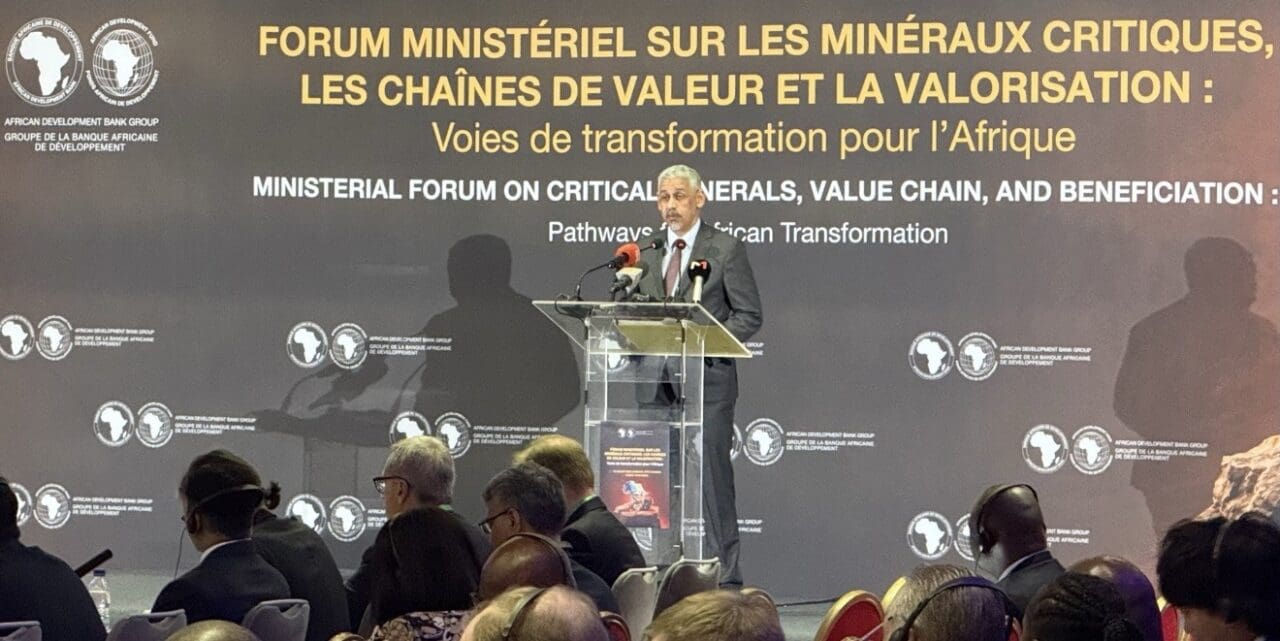
In Abidjan, African nations rich in critical minerals and their global partners convened to forge a united strategy: leveraging the continent’s vast mineral wealth as a catalyst for economic, industrial, and social transformation. Discussions centered on local value creation, sustainable financing mechanisms, and the development of regional supply chains capable of meeting surging global demand.
Ministers from African countries with significant mineral reserves, alongside representatives from the African Union Commission, the African Continental Free Trade Area (AfCFTA) secretariat, the United Nations Economic Commission for Africa, regional development banks, financial institutions, and international investors, gathered for a ministerial conference on July 10 to redefine Africa’s role in the global critical minerals economy.
Abidjan hosts landmark African minerals pact
The gathering aimed to shift the narrative from raw material export to value-added industrialization, ensuring that Africa’s natural wealth translates into tangible benefits for its people. With over 30% of the world’s critical mineral reserves, including cobalt, lithium, graphite, rare earths, platinum-group metals, copper, manganese, and nickel, the continent stands at the precipice of an unprecedented opportunity.
«A paradigm shift» for Africa’s resource governance
Opening the conference, the President of the African Development Bank (AfDB), Sidi Ould Tah, underscored the urgency of reforming Africa’s approach to natural resource management. «This gathering is about more than dialogue—it’s about action,» he stated. «We must transition from exporting unprocessed minerals to building integrated value chains that drive industrialization, job creation, and inclusive growth.»
Ould Tah highlighted the need to strengthen local processing capacities, noting that Africa’s over 100 development finance institutions collectively account for just 1% of global development finance assets. «To unlock our potential, we must recapitalize these institutions and align them with continental industrial strategies,» he emphasized.
The AfDB President also stressed the importance of resilient infrastructure and domestic industries to maximize the benefits of mineral wealth. «Africa cannot afford to remain a mere supplier of raw materials,» he warned. «Our minerals must fuel our own industrial revolution.»
Côte d’Ivoire’s bold vision for mineral-led growth
The Ivorian Minister of Mines, Petroleum, and Energy, Mamadou Sangafowa-Coulibaly, reinforced the call for continental solidarity. «No single nation can achieve industrialization in isolation,» he asserted. «We must collaborate to create regional value chains that distribute prosperity equitably.»
Sangafowa-Coulibaly revealed that nearly three-quarters of Côte d’Ivoire’s landmass holds potential for critical minerals, positioning the country as a future hub in Africa’s mineral economy. Under President Alassane Ouattara’s leadership, Côte d’Ivoire aims to achieve upper-middle-income status by 2030, with a 2026–2040 mineral and energy strategy valued at 38 trillion West African CFA francs—88% of which is expected to be financed by the private sector.
Unleashing Africa’s mineral wealth amid global demand surge
Africa’s untapped mineral reserves are estimated at $8.6 trillion, with the continent holding 20% of the world’s critical mineral resources. Yet, the true challenge lies in meeting the explosive global demand driven by the energy transition. By 2040, platinum-group metals demand could skyrocket by over 1,000%, lithium by 842%, and copper by 88% compared to 2023 levels.
The electric vehicle and battery supply chain alone could grow from $7 trillion in 2030 to $59 trillion by 2050, presenting Africa with a historic chance to pivot from extraction to industrial dominance. «This is our moment to break free from the colonial-era resource curse,» declared a delegate from a mineral-rich landlocked nation. «We will either seize this opportunity or remain spectators in our own economic future.»
Africa’s minerals as the backbone of industrialization
The Abidjan conference marked a turning point in how Africa engages with its mineral wealth. By prioritizing local processing, infrastructure development, and regional cooperation, the continent is positioning itself to capture a larger share of the global value chain. The goal is clear: transform critical minerals into engines of sustainable prosperity, ensuring that Africa’s resources drive its own economic transformation rather than fueling foreign industries.