
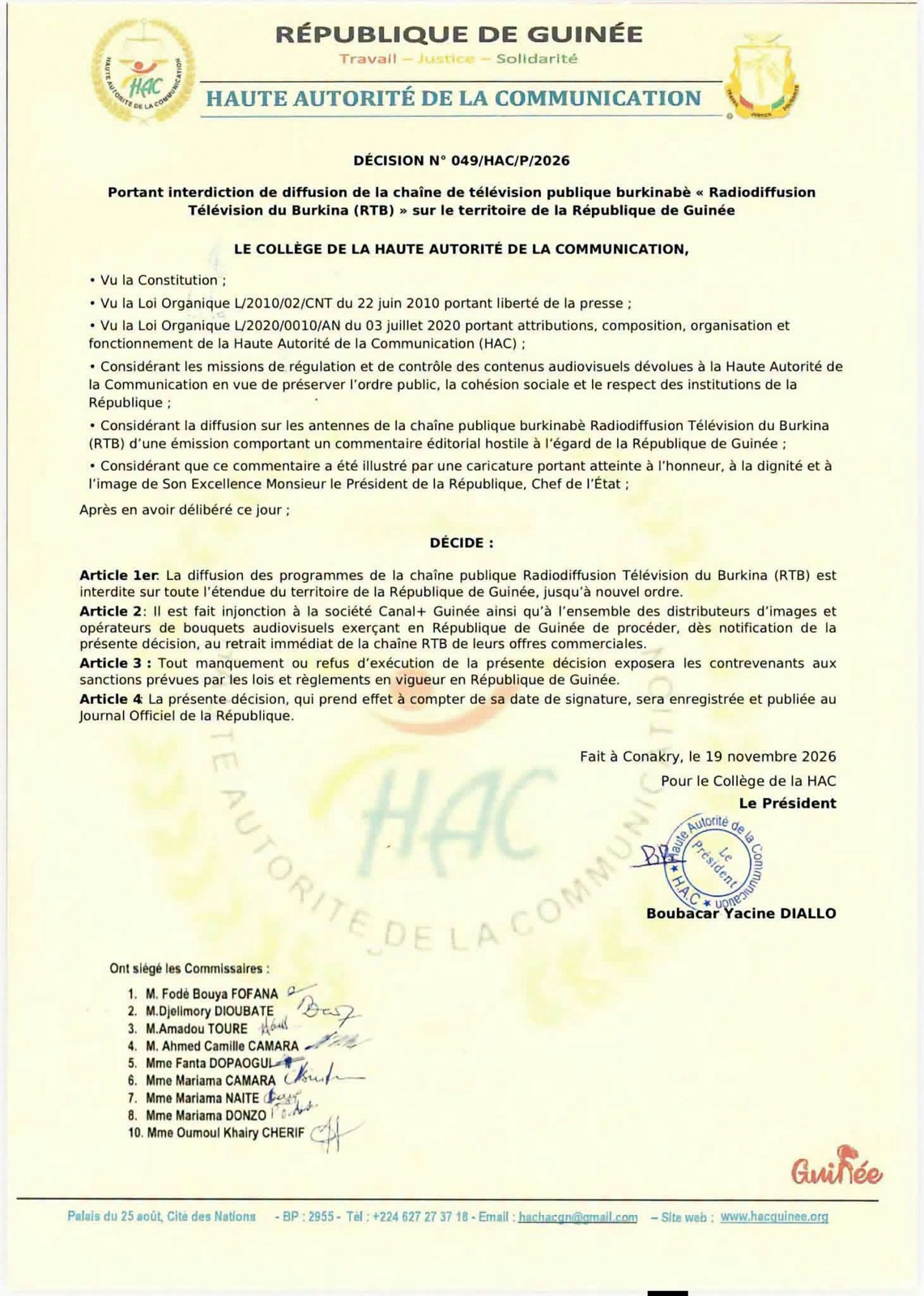
When a public broadcaster prioritizes political allegiance over journalistic integrity, undermines diverse perspectives, and abandons its core mission of accurate reporting, its very purpose comes under scrutiny. The High Authority for Communication (HAC) of Guinea’s decision to suspend the broadcasting of Burkina Faso’s Radiodiffusion Télévision du Burkina (RTB) across the nation raises a critical question: what remains of a public media’s credibility when its editorial choices appear to mirror the political agenda of a regime?
Under the leadership of Burkina Faso’s transitional authorities, RTB is mandated to uphold professional journalism, ensure balanced reporting, and uphold pluralism. Yet, when political narratives overshadow factual reporting, the distinction between news and propaganda blurs dangerously. A public broadcaster must inform, not indoctrinate. It must present verified facts, encourage scrutiny, and allow citizens to form their own conclusions not impose a single viewpoint.
Systematic disparagement, partisan commentary, and the suppression of dissenting voices cannot replace the fundamental demands of ethical journalism. A state-funded broadcaster is not the personal megaphone of a political leader, nor a tool to shield a government’s reputation. It belongs to the people and must serve the public interest, irrespective of the political ambitions of those in office.
The consequences of mixing journalism and state propaganda
The consequences of this editorial drift extend beyond administrative decisions in Guinea. They strike at the heart of public broadcasting’s role in Africa. Can a country claim to uphold media sovereignty while its outlets function as instruments of political propaganda? Media sovereignty is not a licence to misinform. Public service journalism deserves better than being reduced to a narrative of regime support.
What defines the mission of a public broadcaster?
A public broadcaster’s mission is anchored in transparency, accuracy, and impartiality. It must act as a neutral forum for public discourse not as a mouthpiece for a political agenda. When the line between news and political endorsement fades, public trust erodes. Citizens rely on these institutions to deliver truth, not rehearsed talking points. The RTB suspension in Guinea signals more than a bilateral dispute; it reflects a broader crisis of identity within public media across West Africa.
The erosion of journalistic standards
Public broadcasters are expected to challenge power, not amplify it. When editorial decisions are dictated by political convenience, the integrity of journalism is compromised. The result is not just blurred reporting, but a dangerous precedent. If a broadcaster serves only one side of a political spectrum, it ceases to be a public service and becomes a propaganda vehicle. Such practices weaken democracy, distort public perception, and undermine the foundations of an informed citizenry.
Accountability and the future of public broadcasting
The suspension of RTB in Guinea serves as a wake-up call. Public broadcasters must be held to the highest standards of journalistic ethics. They must be insulated from political interference and shielded from becoming tools of state narratives. The future of public broadcasting in Africa depends on reclaiming its purpose: to serve the public, not the powerful. Without this commitment, the very notion of a free and independent media becomes a myth.
This decision challenges all public broadcasters in the region to reflect deeply on their role. Will they remain guardians of truth and diversity, or will they surrender to the pressures of political conformity? The answer will shape the credibility and relevance of public media for generations to come.
By Henri Nkeng — Journalist