
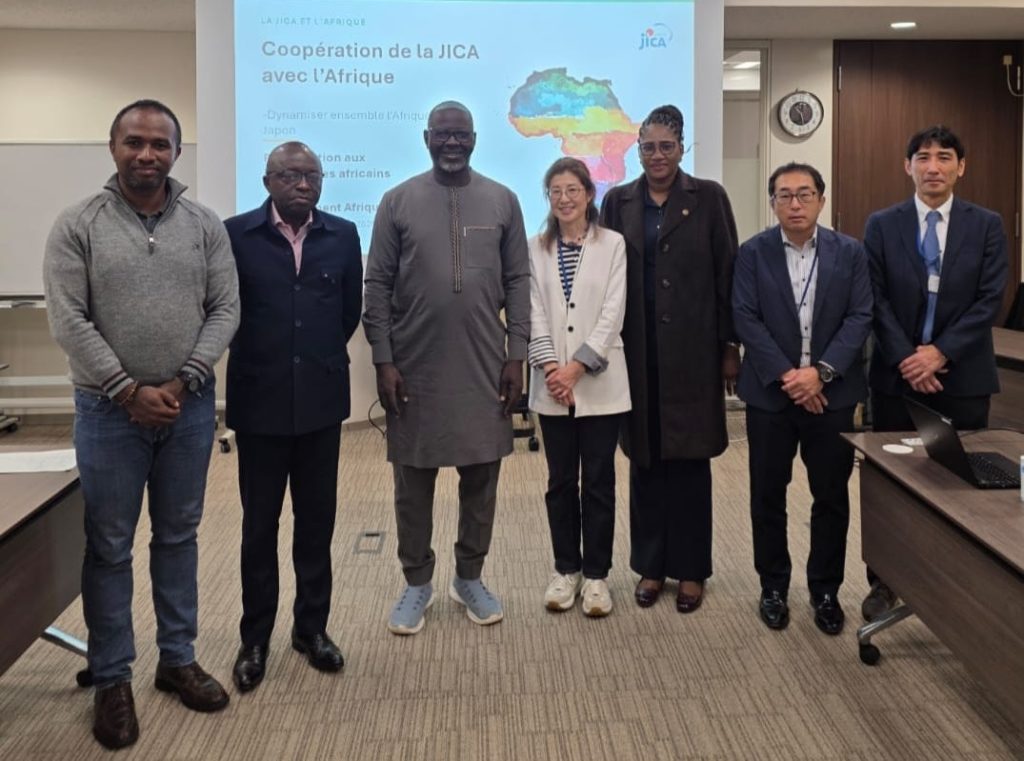
From irrigation to education, healthcare to waste management, the Japan International Cooperation Agency (JICA) is playing a pivotal role in Burkina Faso’s development journey. With a focus on sustainable solutions and long-term capacity building, this partnership is redefining Burkina Faso’s approach to overcoming its most pressing challenges.
JICA’s footprint across Africa
Since 2024, the Japan International Cooperation Agency has expanded its operations across 49 African nations, with investments totaling over 133 billion yen. Beyond bilateral projects, JICA actively supports continental initiatives aligning with the African Union’s Agenda 2063, including infrastructure development, economic integration through the African Continental Free Trade Area (AfCFTA), industrialization, and healthcare system strengthening.
What sets JICA apart is its emphasis on knowledge transfer rather than dependency creation. By equipping local institutions with technical skills and fostering self-sufficiency, the agency ensures that Burkina Faso’s development trajectory remains sustainable and locally driven.
Modernizing agriculture for food security
Agriculture remains the backbone of Burkina Faso’s economy, yet climate volatility, water scarcity, and aging irrigation systems threaten its productivity. The Projet de Renforcement des Capacités pour la Revitalisation des Périmètres Irrigués (PReCaRI), launched between 2022 and 2025, has already made strides in rehabilitating irrigation networks and enhancing agricultural management systems. A new 1.405 billion yen grant announced in early 2026 will further reinforce equipment maintenance and preserve critical hydro-agricultural infrastructures.
Future JICA support could extend to:
- Establishing regional agricultural equipment maintenance centers
- Training specialized mechanics in preventive maintenance
- Promoting solar-powered irrigation systems
- Enhancing small-scale processing units for rice, maize, sesame, and vegetables
- Professionalizing farming cooperatives with Japanese-style Kaizen principles
Education and vocational training: Building a skilled workforce
In May 2026, Burkina Faso inaugurated eight new schools — five general secondary schools and three polyvalent colleges — as part of a broader program that has delivered 26 fully equipped educational facilities since 2022. However, infrastructure alone will not suffice. The next phase must prioritize curriculum quality and alignment with market demands.
JICA is uniquely positioned to assist by:
- Supporting vocational programs in agricultural mechanics, solar energy, and agro-processing
- Facilitating partnerships between Burkinabe technical schools and Japanese training institutes
- Introducing Kaizen methodologies to instill a culture of continuous improvement in schools and workplaces
- Promoting internships, teacher exchanges, and hands-on learning
Water, environment, and sustainable infrastructure
Burkina Faso faces severe environmental pressures: water scarcity, soil degradation, waste management crises, and recurring flooding. Leveraging Japan’s expertise in disaster resilience, water resource management, and urban planning, JICA could launch pilot programs in:
- School and health center rainwater harvesting systems
- Community-based organic waste composting and plastic recycling
- Land restoration initiatives in degraded zones
- Preventive maintenance of rural roads and public infrastructure
One transformative project could integrate waste management into local economies by involving youth associations, women-led enterprises, and small businesses, turning environmental challenges into economic assets and job creation opportunities.
Healthcare innovation and social cohesion
The health sector offers another avenue for deepening cooperation. JICA has already contributed through programs like the Biomedical Technician Training Initiative and cold chain improvement for vaccine storage. Future efforts could focus on:
- Strengthening primary healthcare through community health worker training
- Improving nutrition programs linked to school feeding systems
- Enhancing medical equipment maintenance and logistics
Over 1,000 professionals have benefited from JICA’s Knowledge Co-Creation Program, with more than 400 Japanese volunteers deployed in public services between 2000 and 2019. Establishing an alumni network could amplify impact by fostering peer learning and mentorship among Burkinabe professionals trained in Japan.
Five priority areas for future cooperation
To translate current progress into lasting impact, JICA and Burkina Faso could co-design five complementary program streams:
- Productive Burkina Faso: Large-scale irrigation, agricultural modernization, local processing, and equipment maintenance
- Skilled Burkina Faso: Vocational training, technology transfer, and youth entrepreneurship
- Resilient Burkina Faso: Climate adaptation, water management, waste recycling, and disaster risk reduction
- Modern Burkina Faso: Sustainable infrastructure, digital governance, and public service delivery improvement
- United Burkina Faso: Education for all, community health, women empowerment, and social cohesion
These initiatives should be developed in close consultation with national stakeholders, grounded in feasibility studies, and anchored in measurable outcomes to ensure long-term ownership and sustainability.
The essence of effective international cooperation
True partnership is measured not by aid volume or facility count, but by the skills transferred, jobs created, and technologies mastered. For Burkina Faso — at a crossroads of geopolitical realignment and national development priorities — collaboration with Japan offers a model of expertise-driven engagement.
The goal is clear: transform temporary interventions into permanent capabilities, turn training into operational expertise, and convert investments into sustainable national wealth. In doing so, Burkina Faso can build a future not dependent on external support, but powered by its own competence, resilience, and innovation.