
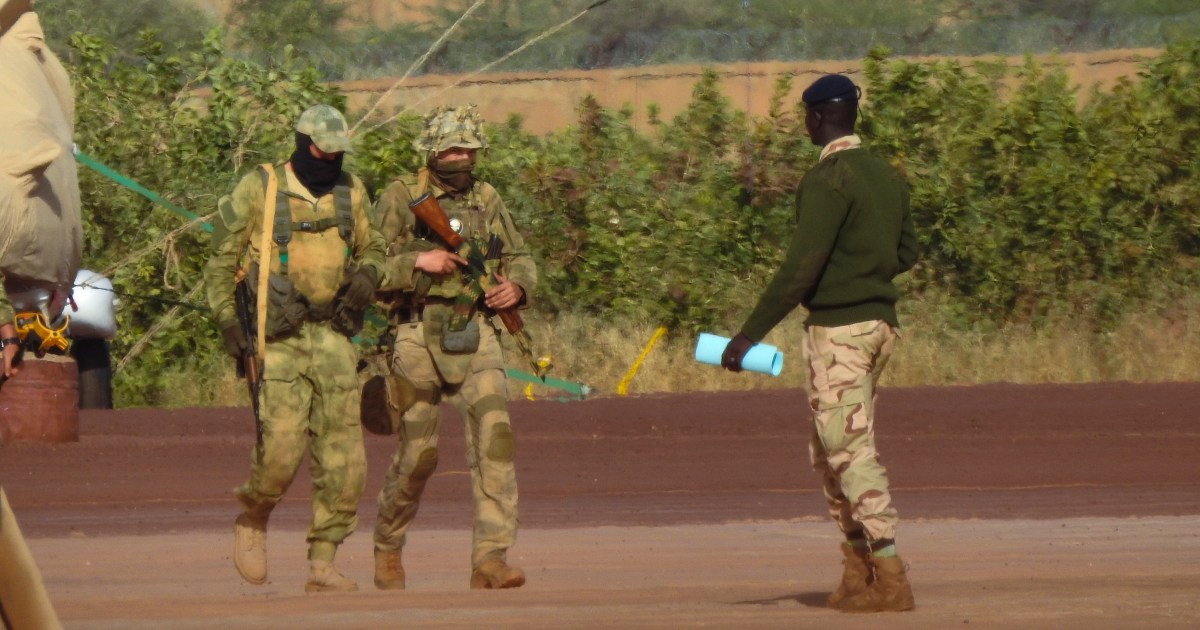
Following recent large-scale assaults on Malian Armed Forces’ bases, military leader Assimi Goita asserted on Tuesday that the situation was “under control.” This declaration came as Russian security elements reportedly offered vital air support, preventing rebel forces from seizing critical locations, including the presidential palace in Bamako, the capital. However, the security landscape across this West African nation remains highly unstable, with the government struggling to reclaim control of towns and cities from Tuareg and al-Qaeda-linked combatants who have threatened a complete blockade of Mali’s capital.
The coordinated offensive launched on Saturday across multiple urban centers, including Bamako, sent shockwaves throughout the region. The attacks tragically resulted in the death of Mali’s Defence Minister, Sadio Camara, and led to the capture of several cities, notably the northern stronghold of Kidal, by the insurgent groups. While the Malian military government reported eliminating over 200 attackers, analysts are now scrutinizing the efficacy of Bamako’s military collaboration with Russia, particularly after reports surfaced detailing the withdrawal of Russian forces from Kidal. These mercenary combatants, operating under the Russian state-affiliated Africa Corps, had previously been deployed alongside the Malian military in the area.
On Monday, Africa Corps officially confirmed its withdrawal from Kidal, asserting that this decision was made in conjunction with the Malian government. This development has prompted conflict experts and Malians on social media to question the robustness of Russia’s defense assistance to Sahelian nations, including military-governed Burkina Faso and Niger, both of which have witnessed a significant escalation in armed conflicts in recent years. Africa Corps, a unit of the Russian Defence Ministry, was established to replace the private Wagner Group and deployed to Mali after Goita requested the departure of French forces in 2022. France had previously maintained a presence of over 4,000 troops in the region. In 2023, Mali, Burkina Faso, and Niger formed the Alliance of Sahel States (AES) amidst worsening security conditions, following their withdrawal from the Economic Community of West African States (ECOWAS) bloc, which had criticized the coups in these Sahelian countries.
What transpired with Russian forces during the recent Mali attacks?
The Saturday assaults were a joint operation by the separatist, Tuareg-led Azawad Liberation Front (FLA) and the al-Qaeda-affiliated Jama’at Nusrat al Islam wal Muslimin (JNIM). These groups targeted several cities, including Kidal, Gao, Sevare, and Kati, all critical sites hosting major military installations. Mali has been grappling with armed violence since 2012. Approximately 2,000 Russian fighters have been present in the country since 2021, arriving after the departure of thousands of French and United Nations troops.
Initially deployed under the Wagner paramilitary group, these Russian personnel were subsequently integrated into Africa Corps, a direct arm of the Russian Ministry of Defence, following the death of Wagner’s founder, Yevgeny Prigozhin, in 2023. While many former Wagner fighters remained with Africa Corps, analysts note a distinct shift in their operational approach: Wagner was characterized by aggressive, risk-taking tactics, whereas Africa Corps has adopted a more defensive posture. Accusations of targeting civilians, potentially constituting war crimes, have been leveled against Russian fighters, the Malian army, and the armed groups by various human rights organizations.
During the intense attacks on Saturday, Russian combatants were observed departing the captured city of Kidal in trucks. Reports suggest their exit was facilitated through negotiations mediated by neighboring Algeria. Furthermore, some Malian soldiers were disarmed and taken captive by the fighters, though Mali’s military has not disclosed the exact number of prisoners.
Statements from the Russian government regarding the situation
In a Telegram statement issued on Monday, Africa Corps affirmed that its decision to withdraw from Kidal was a joint agreement with Bamako. The statement read: “In accordance with a joint decision by the leadership of the Republic of Mali, units of the African Corps that were stationed and engaged in combat in the town of Kidal have withdrawn from the area alongside Malian Army personnel.” It further added: “Wounded servicemen and heavy equipment were evacuated first. Personnel continue to carry out their assigned combat mission. The situation in the Republic of Mali remains difficult.”
Africa Corps also claimed to have provided air support to Malian troops and to have played a role in thwarting attacks on the presidential palace in Bamako. The Russian Defence Ministry echoed these sentiments, asserting that approximately 12,000 fighters participated in the Saturday attacks, and alleged, without providing evidence, that these combatants received training from Ukrainian and European mercenaries. The Malian military, however, has refrained from commenting on Russia’s assertion that the withdrawal was a mutual decision. A senior Malian official reportedly told French publication RFI that the regional governor in Kidal had issued warnings to the Russian mercenaries three days prior to the attack, but “they did nothing,” suggesting that Africa Corps might have pre-negotiated their departure.
The impact of the attacks on Russia’s standing in the Sahel
As French forces began their withdrawal in 2021, Russia positioned itself as a non-colonial liberating power in the Sahel, a narrative that accompanied the arrival of its mercenaries in the region. Analysts suggest that Moscow has consistently leveraged groups like Wagner, and subsequently Africa Corps, as instruments to exert influence over African governments. Russian fighters have maintained a long-standing presence in the Central African Republic and are also reported to be active in Libya and Sudan. In Mali’s Sahelian neighbors, Niger and Burkina Faso, where violence from al-Qaeda and ISIL-affiliated groups has intensified, Africa Corps members are present in smaller numbers, primarily in a supervisory capacity. Approximately 100 Russian soldiers are stationed in Niger, with 100 to 300 in Burkina Faso.
While Wagner’s performance in Mali yielded mixed results, its mercenaries were credited with successes, including aiding in repelling fighters and establishing government authority in the Tuareg stronghold of Kidal in 2023. However, the audacious Saturday attacks, the subsequent capture of Kidal, and the assassination of Defence Minister Camara — a key architect of the Russia partnership — are viewed by analysts as a significant blow to Russia’s broader Sahel campaign. Military leader Goita made his first public appearance in a video on Tuesday after concerns about his well-being, defiantly stating: “Security measures are stepped up … and security operations are ongoing,” though he made no direct mention of the Russian fighters.
Ulf Laessing, the Bamako-based West Africa program lead at the Konrad-Adenauer Stiftung think tank, conveyed to Al Jazeera that “Africa Corps has really lost credibility.” He elaborated, “They didn’t put up a fight on Saturday and have left Kidal, which is a highly symbolic Tuareg stronghold … they left behind a lot of equipment, a whole drone station. This gives the impression that they don’t really care – but they were probably outnumbered.” Reports indicate that the remaining Malian troops and civilian officials have since relocated from Kidal to Gao, the largest city in the north. The precise positions Russia intends to defend next remain uncertain, especially following JNIM’s announcement of a siege on Bamako. While Russia’s Defence Ministry maintains that operations against armed groups are continuing, releasing videos purportedly showing Africa Corps engaging fighter positions, these actions have not dispelled widespread skepticism regarding Russia’s overall effectiveness in the region. Laessing concluded that “Russia will struggle to attract new clients for the Africa Corps because they just didn’t do their job – it’s reputational damage, what has happened.”