

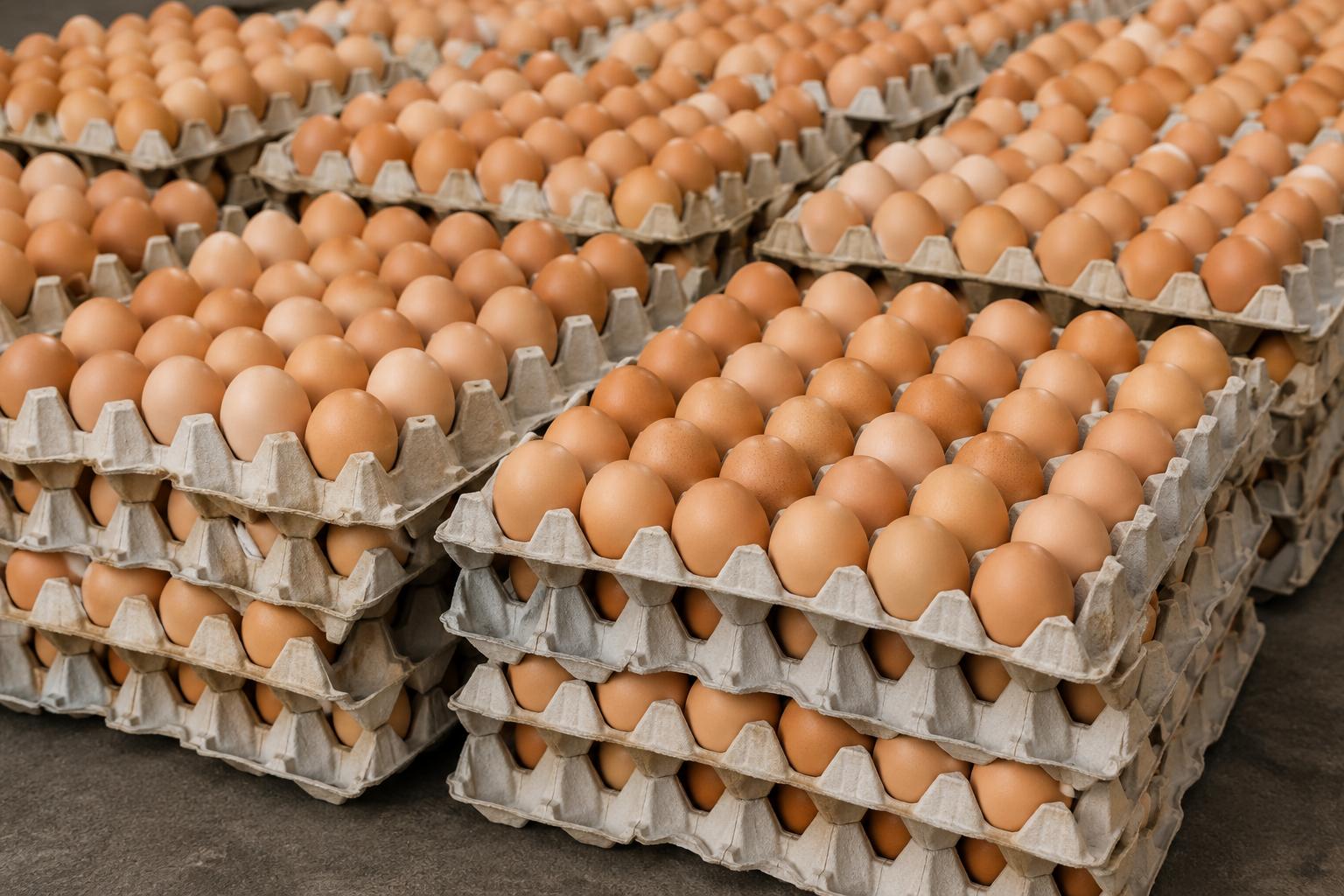
Government price freeze on eggs sparks backlash from Burkina Faso’s poultry sector
The poultry industry in Burkina Faso is reeling from a sudden government decision to cap the price of eggs at 100 F CFA per unit for consumers. This directive, issued jointly by the Ministry of Trade and the Ministry of Animal Resources, sets wholesale prices at 2,600 F CFA per crate and retail prices at 2,750 F CFA. While framed as a measure to ease household budgets, the policy is widely seen as a direct assault on entrepreneurship and the survival of an already struggling sector.
The cost-price paradox: A one-sided equation
Attempting to freeze the final price of a product without addressing the soaring costs of its raw materials is a flawed economic strategy. The backbone of poultry farming—feed for laying hens—relies heavily on ingredients like maize, soybean and cottonseed meal, and mineral supplements. Over recent months, these feed inputs have seen runaway price increases, driven by inflation, transport costs, and supply chain disruptions.
By imposing a fixed retail price on eggs without subsidizing feed production, the government has effectively forced poultry farmers into an untenable position. Selling eggs below production costs—or at break-even—threatens the viability of farms across the country, pushing many toward financial collapse.
Freedom of enterprise under threat
At its core, free enterprise thrives when businesses operate within a framework of self-determined pricing, responding to market forces and internal cost structures. When the state intervenes to dictate pricing based on political rather than economic logic, it doesn’t regulate—it stifles innovation and growth.
Why would an investor risk millions in infrastructure, take out bank loans, or hire local workers, only to have the state arbitrarily cap revenues at a level that ignores real operational costs? Such an approach discourages investment, undermines business confidence, and sends a chilling signal to entrepreneurs throughout Burkina Faso’s agricultural sector.
Predictable consequences: Shortages and black markets
History offers clear lessons: artificially capping prices rarely achieves its intended goals and often produces unintended, damaging effects. In this case, several immediate risks loom large:
- Collapse of small-scale producers: Unlike large industrial farms, small poultry farmers lack the financial cushion to absorb losses. Many will be forced to shut down, eliminating thousands of jobs.
- Reduced production: To cut losses, farmers may scale back their flocks, lowering overall egg output.
- Emergence of an underground market: As official supplies dwindle, eggs will disappear from store shelves—only to reappear in unregulated markets at prices well above the capped 100 F CFA, harming consumers even further.
A smarter path to affordability
Ensuring that all Burkinabè can access affordable eggs is a valid goal, but it must not come at the expense of those who produce the nation’s food. True accessibility begins upstream—by reducing the cost of production. This can be achieved through targeted subsidies on feed, tax exemptions on poultry inputs, or easier access to low-interest credit for farmers.
Fixing the price of eggs while ignoring the skyrocketing cost of feed is not regulation—it’s economic misalignment. It signals to the business community that entrepreneurship in Burkina Faso remains hostage to top-down decrees that fail to reflect ground realities. To rescue the poultry sector and secure the country’s food sovereignty, urgent action is needed: lift price controls and support production.