
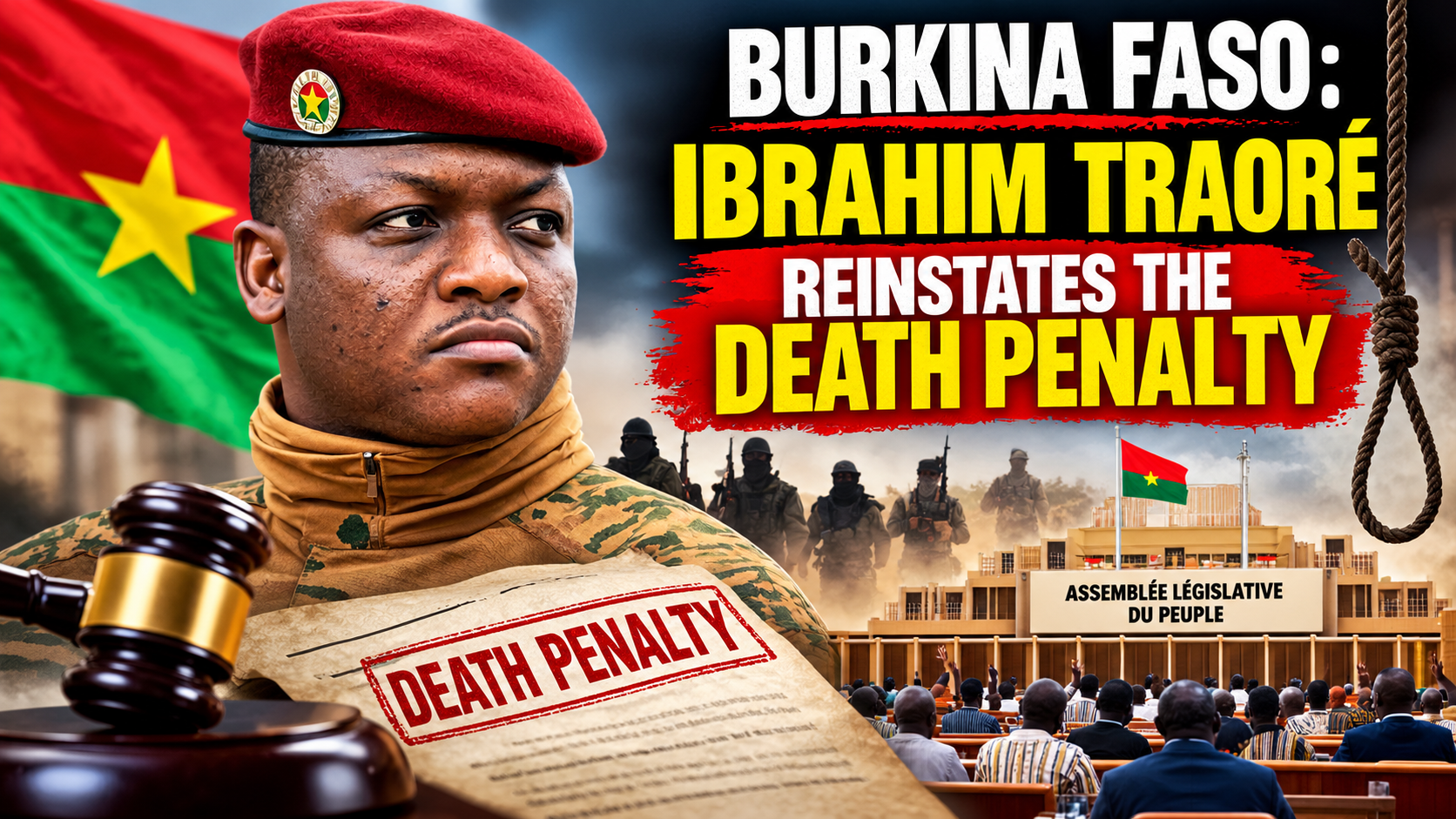
As Burkina Faso grapples with a relentless jihadist insurgency, the military-led government has made a seismic shift in its approach to justice. On October 20, 2026, the National People’s Assembly adopted a sweeping new penal code reintroducing the death penalty, abolished just eight years prior. While authorities frame the move as a necessary deterrent to restore order, critics warn that extreme penalties risk entrenching a climate of fear in a society already straining under authoritarian tendencies.
From abolition to execution: the politics of state terror
The revival of capital punishment marks the latest escalation in a broader crackdown on dissent. The new legislation, passed unanimously by 71 legislators, imposes the death penalty for terrorism, treason, espionage, parricide, and even the importation of expired or banned goods that result in death. For a regime facing mounting pressure to curb violence, the logic appears straightforward: severe consequences will deter future atrocities.
Yet the question remains: does a harsher penal code truly translate into greater public safety, or does it merely weaponize fear to consolidate state power? The answer may lie not in the severity of the sentence, but in the government’s ability or inability to protect civilians from attacks in the first place.
Security theater vs. real protection: what the new law actually secures
The Burkinabè state has long struggled to curb jihadist violence, which has displaced over two million people and left entire regions under de facto militant control. In this context, the death penalty is framed as a moral and judicial response a way to punish the worst crimes and restore public trust. But can a single sanction address the root causes of insecurity?
The answer is no. Effective counterterrorism requires a multifaceted strategy: robust intelligence, rapid response forces, localized governance, and above all, a population willing to cooperate with authorities. A death sentence, once carried out, is irreversible. It cannot undo a bombed village, return a murdered child, or rebuild a destroyed school. The real test of security lies not in the courts, but in the streets where civilians still live under the shadow of ambushes and raids.
The new law’s stated targets terrorism and treason are serious, but its deterrent value remains theoretical. Without tangible improvements in defense capabilities or community resilience, the death penalty risks becoming just another empty symbol of state defiance.
Ibrahim Traoré’s gamble: justice without mercy or accountability without limits?
Captain Ibrahim Traoré has positioned himself as a leader uncompromising in his stance against both external threats and internal dissent. His public declarations have left little room for ambiguity: those accused of treason or espionage will face “no mercy,” he has stated. Such rhetoric frames firmness as a virtue and dissent as treason—blurring the line between national security and political orthodoxy.
This approach raises a critical concern: can justice be both swift and fair in a system where military authorities dominate both the executive and judiciary? Capital punishment demands absolute certainty in guilt and due process. Yet in regions where state presence is weak and armed groups operate with impunity, miscarriages of justice are more than a risk they are a likelihood. Once an execution is carried out, there is no recourse. No appeal. No correction. Only finality.
The regime’s emphasis on punitive measures also risks overshadowing structural weaknesses. If the goal is deterrence, then prevention must come first. But deterrence through fear is a fragile foundation. It silences opposition, but it does not build trust. And without trust, no population will risk providing the intelligence needed to dismantle militant networks.
Press freedom under siege: when crime fighting becomes censorship
The new penal code doesn’t just revive the death penalty it also introduces stricter penalties for press offenses, according to official summaries. While the government has not detailed specific provisions, the signal is clear: critical reporting on security operations could now carry severe consequences.
This development cannot be viewed in isolation. Since the 2022 coup, Burkina Faso has witnessed a steady erosion of civic space: forced conscriptions, disappearances of critics, and restrictions on civil society organizations have all been documented. The re-criminalization of dissent, even indirectly through media laws, risks turning the fight against terrorism into a pretext for silencing opposition.
In a functioning democracy, the state’s legitimacy rests on its ability to withstand scrutiny. When leaders equate criticism with treason and dissent with crime, they undermine the very institutions meant to protect citizens. The death penalty and the shrinking of free speech are not separate issues they are two sides of the same coin: a state increasingly defined by control rather than consent.
Fear as policy: the long-term cost of governing through terror
There is a paradox at the heart of this strategy. A government that rules through fear may temporarily suppress dissent, but it does not create safety. On the contrary, fear can paralyze cooperation. Villagers may stop reporting suspicious activity out of fear of reprisal. Journalists may self-censor to avoid prosecution. Communities may turn inward, trusting no one not the militants, not the military, not even their neighbors.
The people of Burkina Faso do not need more punishment. They need more protection. They need functioning schools in safe villages. They need markets where they can buy food without fear. They need courts that deliver justice, not just executions. They need a government that listens as much as it punishes.
The death penalty may satisfy a political narrative of zero tolerance, but it cannot replace the hard work of building institutions that protect and serve. If Ibrahim Traoré’s government is serious about ending the violence, it must prove that its reforms deliver results not just in courtrooms, but in the lives of ordinary Burkinabè.
Beyond punishment: can Burkina Faso afford a justice system it cannot trust?
The restoration of capital punishment is more than a legal reform it is a statement of intent. It signals a preference for retribution over rehabilitation, for authority over accountability, for finality over due process. But in a country where state authority is already contested, such a choice carries grave risks.
For Burkina Faso to emerge stronger from this crisis, its leaders must recognize that security and freedom are not opposing forces. A nation that executes its enemies without fair trials is not a nation that secures its future. It is a nation that has surrendered to the very extremism it claims to fight by imitating its brutality.
The real challenge ahead is not to punish more harshly, but to govern more wisely. The death penalty may be the law of the land, but the true measure of justice will be seen in the markets, the schools, and the villages where people live, not where they die.
By Henri Nkeng — Journalist