
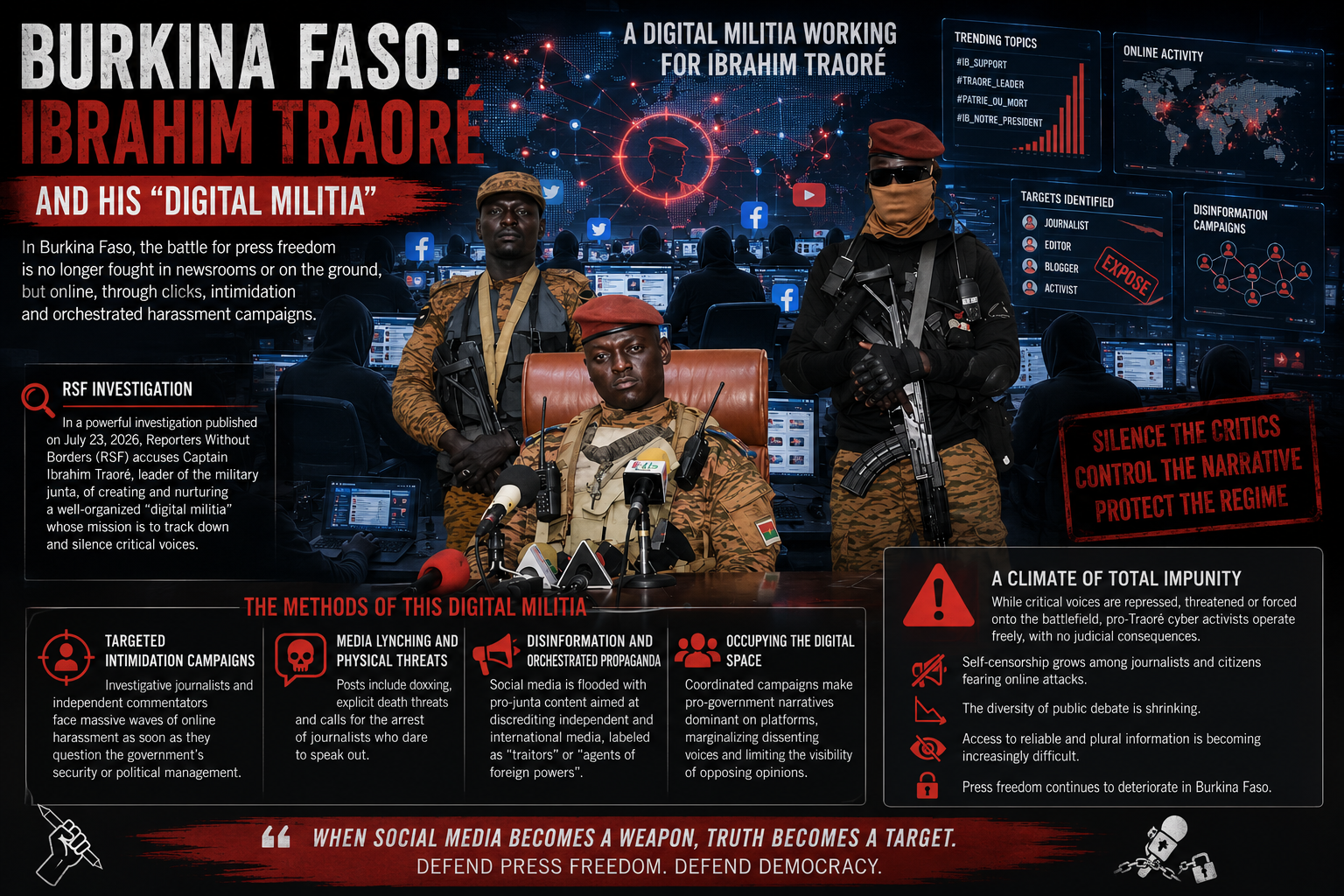
The struggle for press freedom in Burkina Faso has evolved beyond traditional media battlegrounds, shifting into the digital realm where dissent is systematically crushed through coordinated online campaigns.
Cyber-militias and their tactics of repression
Recent investigations reveal the existence of a structured network of digital activists operating under the name Rapid Communication Intervention Battalions (BIR-C), directly linked to the military leadership. These groups, acting at the behest of Captain Ibrahim Traoré, have developed sophisticated methods to silence critical voices across social media platforms.
The blueprint of online intimidation
The BIR-C’s operations follow a systematic approach:
- Targeted harassment campaigns: Investigative journalists and independent commentators face coordinated waves of abuse whenever they challenge government policies or security management.
- Doxxing and physical threats: Opposition figures often endure the public release of personal data, explicit death threats, or calls for their arrest, transforming digital spaces into platforms for real-world intimidation.
- Disinformation and propaganda: Pro-regime narratives flood social media to discredit independent and international outlets, frequently labeling them as traitors or foreign agents.
- Digital occupation: Through coordinated efforts, pro-government content dominates trending topics, systematically drowning out dissenting perspectives and restricting access to alternative viewpoints.
The culture of impunity shielding cyber-activists
Despite the severity of these actions, legal repercussions remain virtually nonexistent. While critics face immediate suppression or forced conscription into military service, those orchestrating online campaigns operate with impunity, protected by implicit state backing.
Observers warn this environment fosters self-censorship. Journalists, bloggers, and netizens increasingly avoid sensitive topics—particularly those related to governance, security, or military operations—due to the risk of harassment. This psychological pressure functions as an indirect censorship mechanism, reducing public discourse without explicit bans.
Eroding democratic discourse through digital dominance
Political communication experts emphasize that when social media spaces are monopolized by coordinated campaigns, public debate loses its pluralism. Divergent opinions fade into obscurity while pro-regime narratives dominate online conversations.
In a country grappling with persistent security crises, this polarization further restricts citizens’ access to balanced information—a critical component for evaluating national policies and leadership decisions.
A broader pattern of authoritarian control
These digital repression tactics mirror strategies employed in other authoritarian or hybrid regimes, where cyber-militias are deployed to defend state narratives, undermine independent media, and manipulate public opinion. International press freedom organizations now classify such campaigns as a covert but potent form of censorship, often as effective as traditional suppression methods.
A multi-layered crackdown on dissent
Digital warfare does not exist in isolation. It complements administrative restrictions, security intimidation, and media bans that have intensified since the junta’s rise to power. International outlets have faced suspensions, while local journalists report arbitrary summons, detentions, and enforced disappearances.
For press freedom advocates, this convergence of tactics signals a dangerous erosion of democratic space. The junta’s reliance on digital coercion—transforming social media into an instrument of political control—has made independent journalism increasingly perilous in Burkina Faso.
Global implications of Burkina Faso’s digital repression
The findings underscore a troubling trend in information warfare, where social media’s speed and algorithms amplify state-sponsored narratives while marginalizing opposing viewpoints. This shift presents one of the most pressing challenges to press freedom and democratic debate in politically unstable nations.
As international partners assess Burkina Faso’s governance and institutional environment, sustained deterioration in press freedom indicators could tarnish the country’s reputation, potentially impacting foreign investment and development partnerships.