
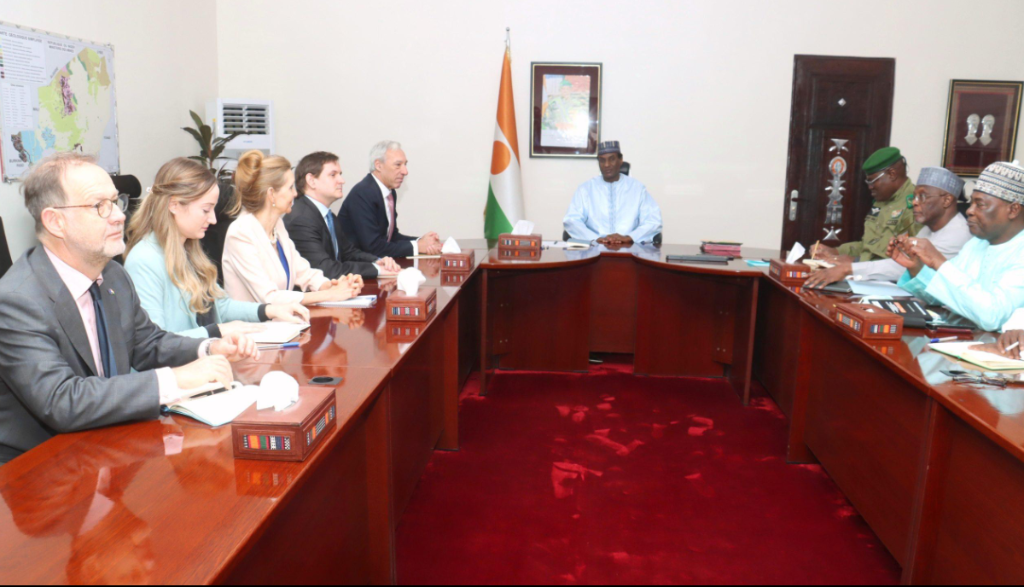
After years of strained relations with the European Union, Niger has taken a notable diplomatic step. On Thursday, 22 October, Nigerian diplomat Adamou Moumouni presented his credentials to António Costa, president of the European Council, and Ursula von der Leyen, president of the European Commission. This formal move comes amid ongoing political disagreements, a dispute over humanitarian aid, and persistent divisions regarding the status of former president Mohamed Bazoum. But does this signal a genuine shift in Niger’s approach—or merely a tactical effort to keep diplomatic channels alive?
Strained ties since the 2023 coup
The military takeover on 26 July 2023, which ousted Mohamed Bazoum, marked a turning point in Niger’s relationship with its Western partners, including the EU. Disputes have since centred on political governance, humanitarian cooperation, and the treatment of the former head of state. Despite these tensions, official diplomatic channels remain open.
Moumouni’s accreditation represents a new phase in EU-Niger relations. By presenting his credentials, he formalises his role as Niger’s representative to the European institutions. However, confirmed by the European Council, this ceremony does not imply that underlying disagreements have been resolved.
In diplomacy, maintaining official representation allows a nation to safeguard its interests and sustain dialogue, even when political ties are fractured. The key question remains: can this institutional continuity pave the way for a deeper shift in relations between Niamey and Brussels?
The humanitarian aid dispute: 1.3 million euros at the heart of a crisis
In November 2024, a conflict over aid for victims of severe flooding in Niger triggered another diplomatic standoff. At the centre of the controversy was a €1.3 million EU package intended to support affected communities.
According to Niger’s foreign ministry, this assistance had not been requested by the transitional government, which claimed it had chosen to address flood damage using its own resources. Authorities criticised the EU delegation for announcing the aid before formally notifying Nigerien officials. A 24 November 2024 statement highlighted that the funds were allocated to international NGOs—including the International Committee of the Red Cross (ICRC), the Danish Refugee Council, and Cooperazione Internazionale—without what Niger deemed sufficient prior consultation.
Niamey condemned what it saw as a unilateral approach, arguing that its foreign ministry should have been involved in the process. Authorities also stated they had demanded a halt to operations during a 14 October 2024 summons of the EU ambassador, Salvador Pinto da França. As a result, the government called for the diplomat’s recall and replacement, asserting that continued collaboration was no longer viable.
The EU, in response, expressed its “strong disagreement” with the transitional government’s accusations. In a 23 November 2024 statement, Brussels defended its intervention methods, emphasizing that humanitarian aid was implemented by UN agencies and international NGOs in accordance with principles of neutrality, impartiality, and independence. The EU also warned against the politicisation of humanitarian assistance and subsequently announced the recall of its ambassador to Niamey for consultations.
This dispute underscores two conflicting perspectives on aid management: Niger’s demand for inclusion in decisions affecting its territory versus the EU’s commitment to independent humanitarian mechanisms, free from political considerations.
Beyond the diplomatic confrontation, the stakes were high for flood-affected populations, for whom assistance remained critical.
Bazoum’s detention: another fault line
In March 2026, tensions resurfaced over the detention of Mohamed Bazoum. On 12 March, the European Parliament adopted a resolution condemning his continued imprisonment and demanding his immediate, unconditional release. The motion, passed with 524 votes in favour, two against, and 29 abstentions, reflected Europe’s concerns over Bazoum’s situation and Niger’s political trajectory.
For EU institutions, Bazoum’s fate and the restoration of democratic order remain pressing issues. Niger’s authorities, however, reject external interference in what they consider matters of national sovereignty.
This disagreement extends beyond the former president’s case. It highlights the broader divide between the two parties on Niger’s governance since July 2023 and presents another obstacle to full normalisation of relations.
Niger’s diplomatic balancing act
Against this backdrop, Moumouni’s credential presentation can be seen as an effort to preserve a space for dialogue. Yet it does not, on its own, signal a broader policy shift.
Niger operates in a region facing significant security, economic, and humanitarian challenges. Maintaining international partnerships may thus serve its interests, even amid deep political differences. Meanwhile, the EU remains concerned about Sahel stability and the regional implications of insecurity.
For Niamey, having a representative in Brussels ensures continued engagement and the ability to advocate for its interests. For the EU, diplomatic dialogue provides a framework to address sensitive issues, even without broader political alignment.
However, a true rapprochement would require tangible progress: more substantive discussions, better coordination on humanitarian matters, or shifts in stance on the most contentious issues.
A diplomatic gesture—but what comes next?
So, is Niger reversing course after years of tension? The answer remains unclear. Moumouni’s accreditation is neither a surrender nor proof of reconciliation. It primarily reflects the maintenance of official diplomatic relations between Niamey and Brussels.
Future developments will reveal the true significance of this step. Will both sides move beyond their differences to rebuild more consistent cooperation? Or will they continue to uphold official contacts while remaining at odds on fundamental political questions?
Beyond the diplomatic formality, the next phase will determine the real impact of this accreditation. For Niger, the challenge lies in upholding its positions while sustaining beneficial relationships. For the EU, the goal is to preserve cooperation opportunities while addressing its political and humanitarian concerns.
Ultimately, Moumouni’s arrival in Brussels marks a new chapter in Niger-EU relations. It opens a dialogue window—but does not guarantee reconciliation. Between maintaining contact and political normalisation, the path ahead remains uncertain.