
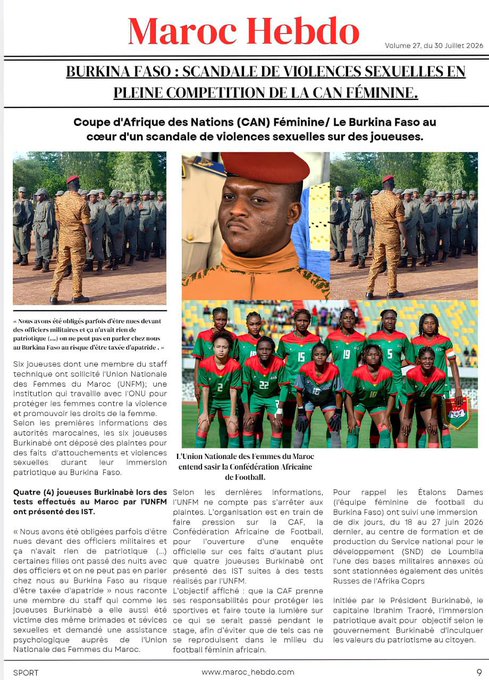
Patriotic rhetoric meets serious allegations
What was promoted as a patriotic initiative to instill discipline and national values among athletes has instead become a source of grave concern in Burkina Faso. The Burkina Faso women’s national football team was sent to a military camp for what officials described as a patriotic immersion stage. The stated goal was to foster teamwork, sacrifice, and commitment to national pride ahead of an upcoming continental tournament.
However, the experience has taken a distressing turn. According to a complaint filed with Morocco’s National Union of Moroccan Women (UNFM), six players and one technical staff member allege they were subjected to sexual violence by military officers during their stay. If substantiated, these allegations would represent a severe breach of human rights and expose the dangers of unchecked military authority in civilian spheres.
From discipline to domination: the expanding role of the military
The incident is not an isolated case but part of a broader pattern. Since assuming power, Captain Ibrahim Traoré has systematically integrated the military into areas far beyond traditional defense roles. The armed forces now influence education, youth programs, cultural initiatives, political messaging, and even sports. This militarization reflects an attempt to position the army as the cornerstone of national reconstruction.
Yet this shift raises critical questions. When military structures replace civilian institutions in non-defense sectors, essential safeguards—such as oversight, accountability, and legal protections—often erode. Human rights organizations have repeatedly warned that the shrinking space for independent control mechanisms could normalize abuses without consequences.
Impunity thrives in the absence of checks and balances
A functioning democracy relies on the separation and balance of powers. When the judiciary, independent media, civil society, and political parties face restrictions, the ability to expose wrongdoing weakens. In such an environment, victims of abuse may hesitate to come forward, fearing professional retaliation, social ostracization, or even physical harm.
This case underscores that fear. Reports indicate the complainants only pursued action after leaving Burkina Faso, raising urgent concerns about the reliability and safety of domestic reporting mechanisms for victims of sexual violence.
The chilling effect on dissent
Criticizing military actions in Burkina Faso today is increasingly risky. Dissent is often framed as disloyalty or tacit support for armed groups, creating a climate of fear. Journalists, activists, and civil society leaders report facing intimidation or coercive measures for speaking out. Independent media outlets have also come under pressure, reducing their capacity to investigate and publish critical reports. Meanwhile, security priorities often overshadow human rights concerns, leaving victims without adequate protection or recourse.
Such a climate makes silence a survival strategy, not necessarily a sign of support for the current leadership.
Beyond the pitch: systemic implications of military control
This is not just a sports scandal. It reflects deeper issues about the role of the military in a nation at war and the boundaries between military and civilian life. It also tests the state’s ability to protect its citizens—especially women—when they participate in programs under official authority.
While the fight against terrorism is undeniably vital, it cannot justify eroding judicial guarantees, public freedoms, or institutional accountability over the long term.
Seeking justice beyond borders
The decision to file the complaint outside Burkina Faso sends a powerful message. It signals a profound lack of trust in national institutions to handle such sensitive cases fairly and transparently. For the victims, seeking international support may be the only path to impartiality and protection.
This internationalization of the case could pressure authorities to conduct a credible, transparent investigation—one that identifies responsibilities, supports victims, and, if necessary, holds perpetrators accountable.
Accountability cannot be an afterthought
These allegations serve as a stark reminder: no political project, no matter how ambitious, can endure without adherence to the rule of law. Patriotism must never be used to justify the suppression of oversight mechanisms or to block the pursuit of truth when grave human rights violations are alleged. If proven, this case would mark a pivotal moment in assessing Burkina Faso’s governance, revealing the dangers of unchecked power concentration and the erosion of protective institutions.