
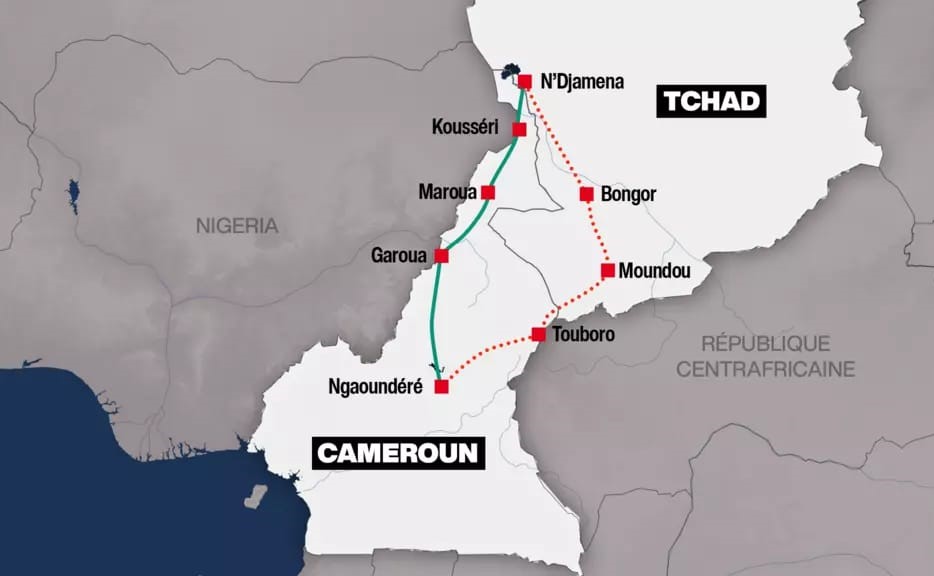
The ambitious plan to link Cameroon and Chad by rail has hit a major snag after N’Djamena formally rejected the route proposed by Yaoundé, exposing deep-seated tensions in cross-border infrastructure planning.
The controversy erupted when Cameroon’s leadership announced the completion of a 900-kilometer railway corridor connecting Ngaoundéré to Chad’s capital, N’Djamena, via key northern cities including Garoua, Figuil, Maroua, and Kousséri. While Yaoundé framed the route as the most economically viable option, Chadian officials immediately pushed back, asserting that no final agreement had been reached between the two nations.
In a sharply worded statement, Chad’s Ministry of Transport emphasized that bilateral consultations were still ongoing and that premature announcements risked undermining the project’s long-term viability. The disagreement transcends mere technicalities, revealing fundamental differences in how each country perceives the railroad’s strategic and economic value.
a strategic project with regional ambitions
The proposed railway is positioned as a transformative infrastructure linking two Central African nations. For landlocked Chad, which relies heavily on Cameroon’s ports for over 80% of its external trade, the project promises reduced logistics costs and faster cargo movement. The corridor would facilitate the transport of hydrocarbons, cotton, livestock, cereals, construction materials, and containerized goods from Douala and Kribi ports, potentially reshaping trade dynamics across the subregion.
For Cameroon, the venture offers more than just economic benefits. The railway would extend the national rail network into the Sahel, strengthening its role as a maritime gateway for Central Africa. Officials envision the project as a catalyst for industrial development, attracting investments and fostering local value addition through trade and logistics hubs along the route.
economic stakes and territorial claims
The disagreement over the route highlights a deeper struggle over who will benefit most from the infrastructure. Cameroon’s proposed path prioritizes northern regions like Garoua and Maroua, aiming to unlock their economic potential and improve connectivity within the country. However, Chad argues that the current alignment fails to adequately serve its agricultural and productive zones, favoring N’Djamena at the expense of other key areas.
This divergence reflects a common challenge in regional projects: each country seeks to maximize gains within its borders. The chosen route will determine the location of future logistics platforms, industrial zones, and service activities for decades to come, making the dispute far from trivial.
lessons from failed regional integration
The spat underscores persistent weaknesses in Central Africa’s approach to cross-border projects. Despite rhetoric about regional cooperation, many large-scale initiatives are still driven by national interests rather than shared vision. International best practices in regional infrastructure emphasize the need for joint governance from the outset—including coordinated financing, technical standards, and operational frameworks—to ensure broad-based political and economic buy-in.
Without such collaboration, the risks of stalled progress, cost overruns, and unmet expectations grow significantly. The Cameroon-Chad railway dispute serves as a cautionary tale for other transboundary ventures in the region, where sovereignty concerns often clash with the collective need for integration.