
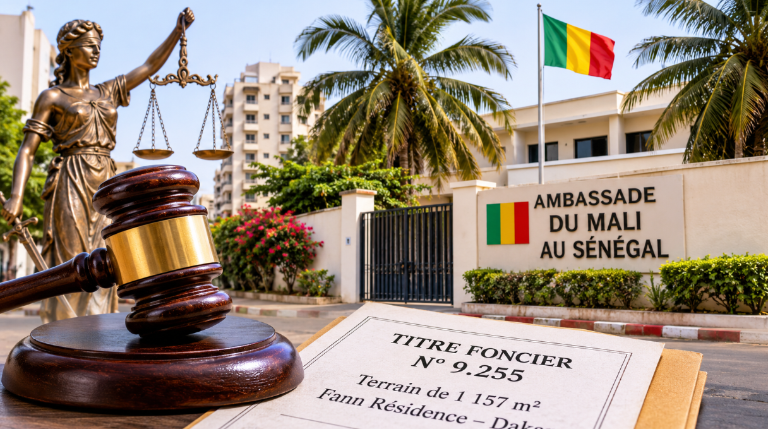
Diplomatic immunity vs. property rights: a high-stakes legal battle in Dakar
Can a Senegalese court legally compel a foreign embassy to vacate a disputed plot of land in the heart of Dakar? This question now looms large over a contentious property dispute involving the Malian embassy and a local developer, raising complex legal and diplomatic questions that could reshape how such cases are handled in West Africa.
The controversy centers on a 1,157 square meter parcel in the upscale Fann Résidence neighborhood, where the Malian diplomatic mission has operated for years. But a recent court ruling has thrown the future of the embassy’s presence on the land into question, setting the stage for a potential showdown between property rights and diplomatic immunity.
Who owns the disputed land? The developer’s claim takes center stage
The legal battle began when Immoland SARL, a Senegalese real estate company, filed a lawsuit asserting full ownership of the plot based on land title number 9.255. The company argued that the Malian embassy had been occupying the land without legal justification, effectively denying Immoland its rightful property.
The court, after reviewing the evidence, sided with the developer, ruling that the embassy’s presence on the land lacked any legal foundation. According to the judgment, the diplomatic mission was occupying the property “without right or title,” a critical finding that paved the way for the expulsion order.
While the ruling itself is clear, the broader implications are anything but. The case underscores a growing tension in Senegal’s urban property market, where high demand for land and complex ownership histories often lead to protracted legal disputes.
What does the expulsion order actually mean for the Malian embassy?
The court’s decision doesn’t just target the embassy itself—it also mandates the removal of all personnel, assets, and dependents currently occupying the premises. In practical terms, this means the Malian diplomatic mission would be required to vacate not only the land but also any structures or belongings situated on it.
However, it’s important to distinguish between a court order and its actual enforcement. At this stage, there is no public confirmation that the embassy has complied with the ruling or that the eviction process has begun. The gap between legal judgment and physical action leaves room for further legal maneuvering or even diplomatic intervention.
Diplomatic immunity vs. property rights: where does the law draw the line?
This case is unique because it involves a foreign embassy—a sovereign entity operating under international law. While the Vienna Convention on Diplomatic Relations (1961) grants embassies significant protections, including inviolability of mission premises, it does not confer automatic ownership rights over the land they occupy.
The court’s ruling suggests that diplomatic immunity does not extend to property disputes where ownership is contested. But the enforcement of such an order raises critical questions: Can Senegalese authorities forcibly remove a diplomatic mission from land it claims as its own? What happens if the embassy refuses to comply? And how might this decision impact future disputes involving foreign missions in Dakar?
Without full access to the court’s reasoning or the embassy’s legal arguments, it remains unclear whether diplomatic channels will play a role in resolving the dispute—or if the matter will escalate into a full-blown diplomatic incident.
What’s next? Unanswered questions and potential consequences
The Malian embassy has not yet publicly indicated whether it plans to appeal the ruling or challenge the court’s jurisdiction. Similarly, Senegalese authorities have not detailed how—or if—the expulsion order will be enforced, leaving many key questions unanswered:
- Will the Malian government file an appeal or seek international arbitration?
- What steps will Senegal take to enforce the eviction, if necessary?
- Could this case set a precedent for future property disputes involving foreign embassies in Senegal?
- How might this impact Senegal-Mali bilateral relations, particularly in the context of regional security and economic cooperation?
The answers to these questions will determine whether this becomes a purely legal matter—or a flashpoint in Senegal’s diplomatic landscape. One thing is certain: the court’s decision has already shifted the ground beneath this long-simmering dispute, leaving both sides to navigate uncharted legal and political territory.
Why this case matters beyond Dakar’s courtrooms
At its core, this is more than a property dispute—it’s a test case for how Senegal balances its commitment to property rights with its obligations under international law. For foreign investors, embassies, and local developers alike, the outcome of this case could have far-reaching consequences.
If the expulsion order stands, it may embolden other property owners to challenge diplomatic missions occupying disputed land. Conversely, if the embassy successfully resists the ruling, it could reinforce protections for foreign missions, even in cases where ownership is unclear.
The coming weeks and months will reveal whether this case remains a legal footnote—or becomes a defining moment in Senegal’s approach to property rights and diplomatic sovereignty.