
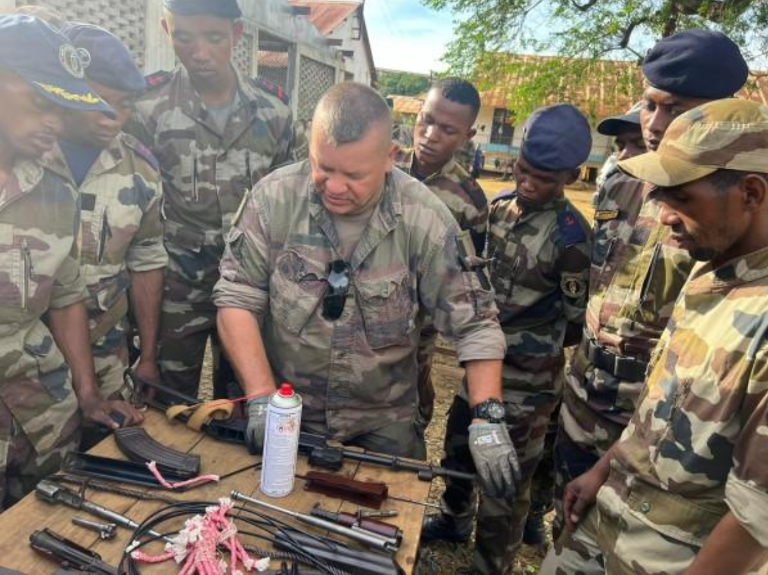
As Madagascar strengthens its military ties with Russia, Washington is raising a critical question: is the island nation unknowingly setting itself up for the same instability that has plagued the Sahel following Moscow’s security model?
Why Washington is sounding the alarm on Madagascar’s military cooperation with Russia
The United States has issued a stark warning to Madagascar regarding its deepening defense partnership with Russia, citing concerns that Antananarivo may be adopting a model that has failed to deliver long-term stability in the Sahel. At the center of this warning is the fear that Russia’s approach—which has struggled to curb jihadist violence in Mali, Burkina Faso, and Niger—could similarly falter in the Indian Ocean region.
During a November 2026 virtual press briefing following a high-level visit to Madagascar and Mozambique, Lieutenant General John Brennan, Deputy Commander of the U.S. Africa Command (AFRICOM), emphasized that Washington opposes the replication of Russia’s Sahel security strategy elsewhere on the continent. His remarks followed a week-long tour of the region, during which he assessed evolving security dynamics and diplomatic engagements.
“Our concern is the model that Russia has employed in the Sahel and its apparent willingness to extend that model to other parts of Africa,” Brennan stated. He specifically highlighted Madagascar and Mozambique as areas where such an approach could prove counterproductive.
What does the failed Sahel model look like?
The U.S. critique is rooted in the outcomes observed in Mali, Burkina Faso, and Niger—three countries that have distanced themselves from Western partners in favor of closer ties with Moscow. Russia’s military support in these nations is channeled through the Africa Corps, a formalized structure under the Russian Ministry of Defense that has absorbed elements previously associated with the Wagner Group.
Despite Russia’s growing footprint, violent extremist attacks have continued unabated in large parts of these countries. Washington argues that this persistent insecurity exposes the fundamental shortcomings of Russia’s security approach—which relies heavily on military assistance and private contractors rather than sustainable governance or local capacity-building.
Brennan went so far as to describe the Russian model in the Sahel as “largely ineffective,” warning that its expansion could further destabilize regions where it is adopted.
Note: This assessment reflects a U.S. strategic perspective based on observed outcomes and does not imply blanket criticism of all Russian military engagements across Africa.
From diplomacy to defense: how relations between Madagascar and Russia have evolved
Washington’s warnings come against the backdrop of a rapidly warming relationship between Madagascar and Russia, catalyzed by political shifts on the island. Since Colonel Michaël Randrianirina assumed power in 2025, Madagascar has moved to strengthen its partnership with Moscow across multiple domains.
Russian military support has materialized in tangible ways: drone systems, arms supplies, and training programs delivered by Russian instructors. These initiatives were further formalized in early 2026 when President Randrianirina traveled to Moscow for a high-profile meeting with Russian President Vladimir Putin—a trip that culminated in expanded agreements on defense, tourism, and trade during the Russia-Africa Summit in October of the same year.
The timing of these developments has not gone unnoticed in Washington. With Madagascar occupying a pivotal position in the Indian Ocean, its strategic choices carry implications for regional stability, maritime security, and global trade routes.
The geostrategic stakes: why Madagascar sits in the crosshairs of global powers
Beyond military cooperation, the U.S. is deeply concerned about the geopolitical dimensions of Madagascar’s pivot toward Russia. The island nation sits astride the Mozambique Channel, a critical maritime corridor through which a substantial share of global energy and commercial shipments pass annually.
This narrow strip of water between Madagascar and the African mainland is more than a trade route—it’s a flashpoint. The U.S. has voiced concerns over the growing maritime capabilities of Islamic State-affiliated groups operating in northern Mozambique. These organizations, increasingly adaptive and well-funded, pose a rising threat not only to regional security but also to international shipping and energy supplies.
In response, Washington is actively seeking to deepen its collaboration with Madagascar and Mozambique, focusing on maritime surveillance, intelligence-sharing, and military training. The November visit by U.S. officials to Antananarivo was part of this broader effort to reinforce ties and counterbalance external influences perceived as destabilizing.
Can Madagascar navigate between Moscow and Washington without losing its way?
While the U.S. has criticized the risks posed by closer military ties with Russia, American officials have stopped short of imposing sanctions or coercive measures. Instead, the message has been framed as a cautionary advisory—one that urges Madagascar to carefully weigh the long-term consequences of its security partnerships.
This puts Antananarivo in a delicate position. The island nation must balance its historical ties with Russia, preserve its strategic autonomy, and maintain beneficial partnerships with Western powers. The challenge is not simply about choosing sides but about avoiding entanglement in a proxy-driven geopolitical rivalry that could compromise national sovereignty and regional stability.
So far, no retaliatory actions have been taken against Madagascar, suggesting that Washington is attempting a delicate balancing act of its own: preserving influence in the Indian Ocean while dissuading a shift toward Moscow’s security model. The question now is whether Madagascar can chart a course that protects its interests without becoming a theater in a larger power struggle.
What’s next for Madagascar’s foreign policy?
- Diversification without fragmentation: Expanding ties with multiple partners while avoiding over-reliance on any single external actor.
- Local security over foreign models: Prioritizing solutions tailored to Madagascar’s unique challenges rather than importing untested security frameworks.
- Transparency and accountability: Ensuring that all defense agreements are aligned with national development goals and public interest.
One thing is certain: Madagascar’s foreign policy choices are no longer just bilateral—they are part of a broader contest for influence in a region where the stakes are rising. And in that contest, the Indian Ocean is becoming the new frontier of global power dynamics.