
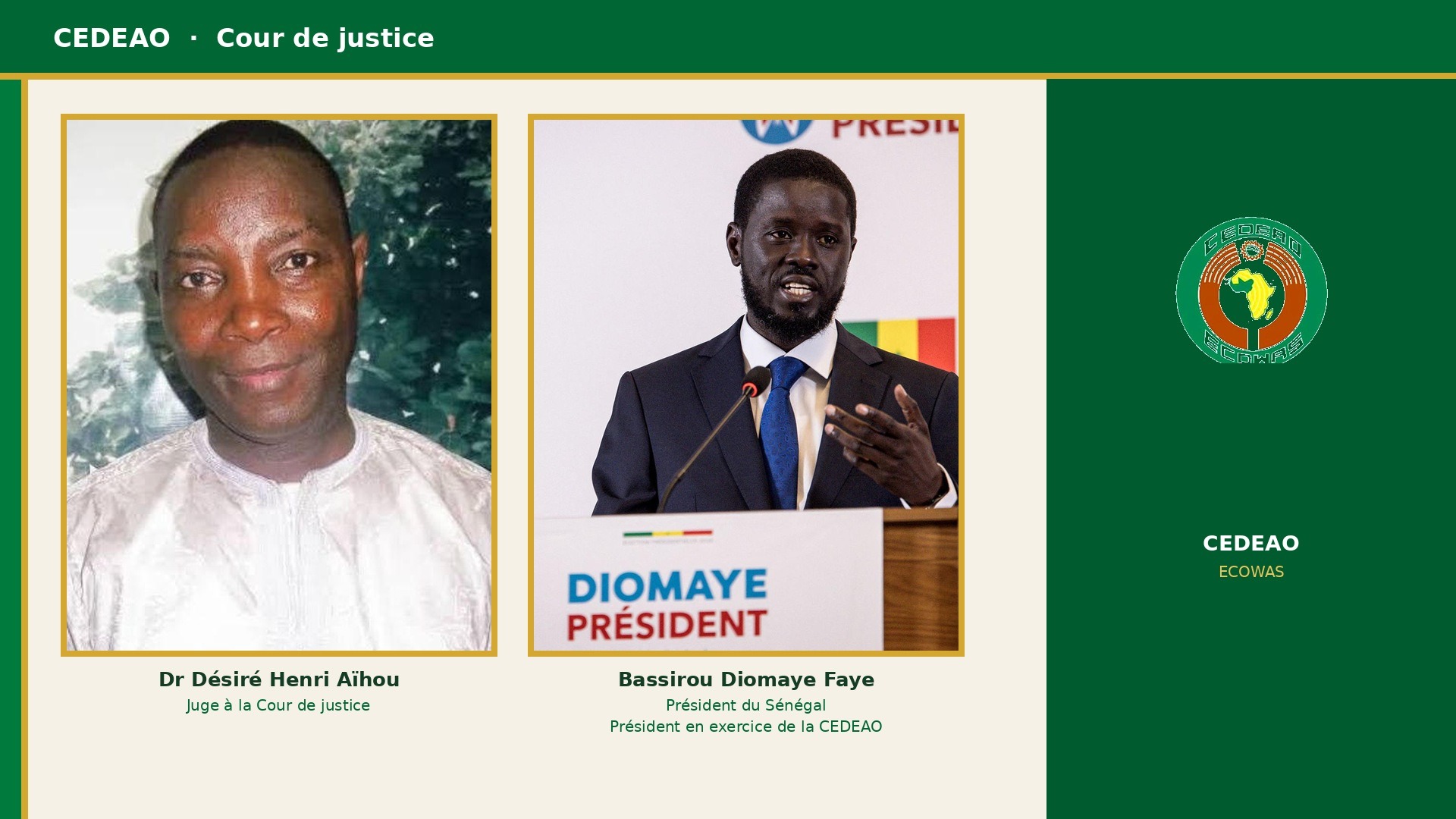
In a move watched closely across the region, Benin has taken a strategic step to reinforce the rule of law in West Africa by nominating Judge Désiré Henri Aihou to the ECOWAS Court of Justice in Abuja. His swearing-in on October 6, 2026, signals more than a personnel change—it represents a bold assertion of judicial independence in an era when regional courts face mounting scrutiny over their enforcement power and political neutrality.
What Désiré Henri Aihou’s appointment means for West African justice
As one of five new judges sworn into the ECOWAS Court of Justice—alongside counterparts from Gambia, Liberia, Nigeria, and Togo—Aihou brings more than legal expertise. His appointment arrives at a pivotal moment as the court’s role expands from adjudicating inter-state disputes to addressing human rights violations and constitutional challenges that directly impact millions of citizens across the region.
The mandate is clear: ensure that legal commitments made by states—from freedom of speech to fair electoral processes—are not just aspirational ideals but enforceable realities. But with rising skepticism about the court’s authority to compel compliance, every ruling now carries greater symbolic and practical weight.
Inside the ECOWAS Court of Justice: powers, promises, and persistent challenges
The ECOWAS Court of Justice is not merely a forum for dialogue—it is the region’s only binding judicial institution empowered to interpret and enforce the bloc’s founding treaties. Its jurisdiction extends beyond disputes between member states to include cases involving citizens against their governments, particularly concerning violations of human rights or democratic principles.
Yet, despite this broad mandate, the court has historically struggled with execution. States often delay or ignore rulings, undermining its credibility. Recent reforms, including a 2024 assessment by the Court’s Judiciary Council, have targeted enforcement mechanisms, but success hinges on the resolve of judges and the political will of member states.
Against this backdrop, Aihou’s role takes on added significance. As a judge from a nation with a legacy of constitutional reform—rooted in the landmark 1990 National Conference in Cotonou—he embodies a model of institutional accountability that the regional court now seeks to emulate.
Benin’s democratic roots: a model for regional governance?
The story of Benin’s judicial appointment begins not in Abuja, but in Cotonou, where in February 1990, a historic gathering of civil society, political leaders, and traditional authorities redefined the nation’s political future. The National Conference of February 19–28, 1990, emerged as a turning point, establishing a constitutional framework rooted in separation of powers, human rights, and judicial independence.
This constitutional engineering—consolidated in December 1990 with the adoption of a new constitution—created a system where no branch of government could dominate, and where courts could serve as guardians of the rule of law. The establishment of the Constitutional Court in 1993 was a direct expression of that vision.
Now, three decades later, Benin’s democratic DNA is being exported to a higher level: the ECOWAS Court. Judge Aihou’s presence strengthens the argument that West Africa’s journey toward constitutional democracy is not just a national project, but a regional imperative.
From Abuja to Cotonou: a shared vision for judicial credibility
The principles that define Benin’s domestic judiciary—transparency, separation of powers, and judicial independence—are now being applied to the regional stage. The ECOWAS Court, like Benin’s own constitutional institutions, faces the same challenge: ensuring that legal decisions are respected, not ignored. This is the litmus test for the court’s legitimacy.
For Aihou, the task is not diplomatic representation—it is judicial leadership. His role is to uphold the integrity of the court’s rulings, even when political pressures arise. As the first Beninese judge to serve on the ECOWAS bench, his appointment carries symbolic weight, but it is the substance of his decisions that will ultimately define its impact.
In a region grappling with political instability, unconstitutional changes of government, and growing public distrust in institutions, a credible regional court could serve as a vital bulwark for democratic governance. But only if it can deliver justice that is both fair and enforceable.
What’s at stake for West Africa in the next four years
The four-year, non-renewable mandate of the new ECOWAS judges is more than a professional challenge—it is a test of the court’s viability. With Aihou and his peers now in place, the institution stands at a crossroads. Will it become a respected guardian of regional law, or remain constrained by political hesitancy and weak enforcement?
West Africa’s future stability depends not only on economic integration or free movement, but on a shared commitment to legal accountability. A robust, independent judiciary—championed by judges like Aihou—could be the key to unlocking that future.
For Benin, the stakes are personal. The nation’s democratic identity is on trial in Abuja. And for 400 million West Africans, the outcome may well determine whether justice is just a word—or a lived reality.
A new chapter in regional justice—or the same old story?
The swearing-in ceremony in Abuja was more than symbolic. It was a declaration: that the rule of law is not optional, and that no government—however powerful—should be above scrutiny. It was a reminder that democracy is not a finished project, but an ongoing struggle, fought in courts as much as in parliaments.
Now, as Judge Désiré Henri Aihou takes his seat, the region watches. Will West Africa’s highest court rise to the challenge? Or will it be remembered only as a court in name, not in effect?
One thing is certain: the next four years will reveal whether Benin’s democratic spirit can transcend borders—and whether the ECOWAS Court can fulfill its promise as a true engine of justice.