
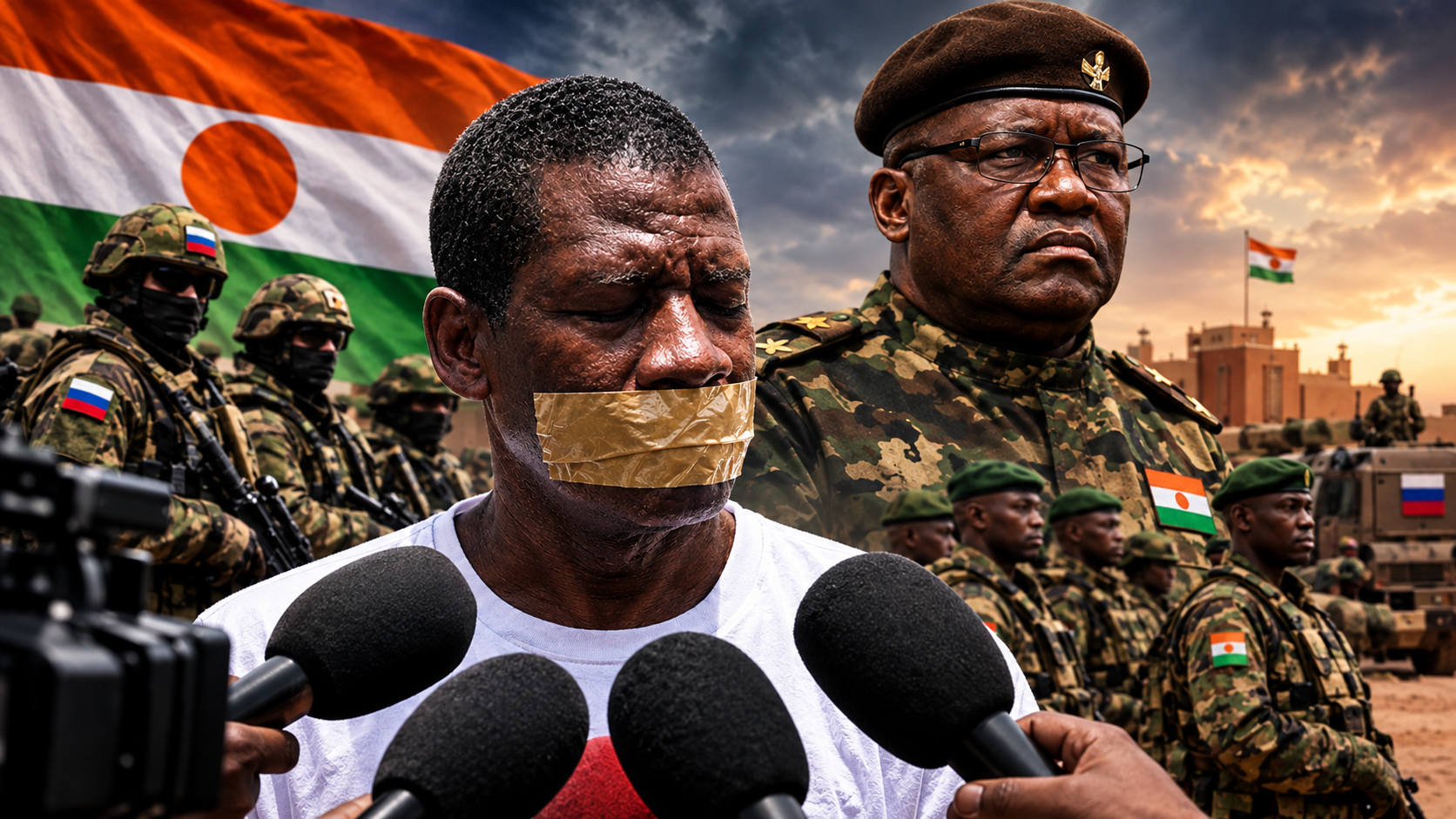
After weeks of uncertainty, Niger’s military leadership has finally acknowledged that investigative journalist Moussa Kaka remains alive and in state custody. The announcement, made on October 6 by the country’s justice minister in response to a formal inquiry, marks a critical but incomplete turning point in a case that has sparked national and international concern.
The authorities have yet to disclose where he is being held, the legal grounds for his detention, or the specific charges against him. Without these clarifications, the junta’s claims of transparency and legal process ring hollow, fueling broader questions about the state’s commitment to accountability.
Kaka, an experienced reporter and former bureau chief for an international broadcaster, was last seen leaving the premises of Radio Télévision Saraounia in Niamey over a month ago. His disappearance immediately drew condemnation from press freedom organizations, including the International Federation of Journalists and the World Organisation Against Torture, both of which called for his prompt release and a transparent account of his whereabouts.
What is the junta trying to hide?
The central question now is not only where Kaka is being held, but why. The information he possessed particularly on internal military affairs may pose a direct threat to a regime attempting to project an image of control despite persistent instability.
While no public evidence confirms that his detention is linked to specific revelations, the timing and circumstances suggest a deeper agenda. Niger’s security narrative, often framed as a return to stability, continues to face serious challenges on the ground.
Recent events underscore these contradictions:
Deadly insurgent attacks persist across multiple regions
August’s military mutiny in Niamey revealed fractures within the armed forces
Soldiers continue to criticize inadequate equipment and logistical shortcomings
The growing shadow of external security partners
Another dimension complicating the junta’s security posture is the expanding role of foreign forces. The Russia-backed Africa Corps, integrated into Niger’s defense apparatus, played a visible role during the mutiny, reportedly aiding loyalist troops. While not replacing the national army, their presence focused on protecting key figures rather than civilians has become a defining feature of the country’s security landscape.
Rumors persist that recent arms acquisitions have prioritized these foreign units over domestic soldiers, leaving frontline units under-resourced and exposed. Such perceptions further erode public trust in a government that claims to restore stability and sovereignty.
A test of credibility for the junta
Moussa Kaka’s detention is no longer an isolated incident. It reflects a pattern of opacity, legal ambiguity, and reliance on external actors all of which challenge the junta’s stated goals of transparency and national resilience.
The survival of a critical voice in public discourse now hinges on the junta’s willingness to reveal the full truth. Until then, the world will continue to question what Niger’s leadership is trying so desperately to conceal and at whose cost.
Where does this leave Niger’s future?
As the junta navigates internal dissent, external dependencies, and mounting security failures, the case of Moussa Kaka serves as a barometer of its willingness to govern with accountability. A government that cannot or will not explain the detention of a journalist without charge for over a month forfeits its moral authority to speak of national unity or reform.
The path forward remains unclear. What is certain is that until Kaka’s fate is clarified and addressed within a legal and ethical framework, the shadow over Niger’s democratic aspirations will only grow darker.
By Henri Nkeng — Journaliste / Rédacteur