
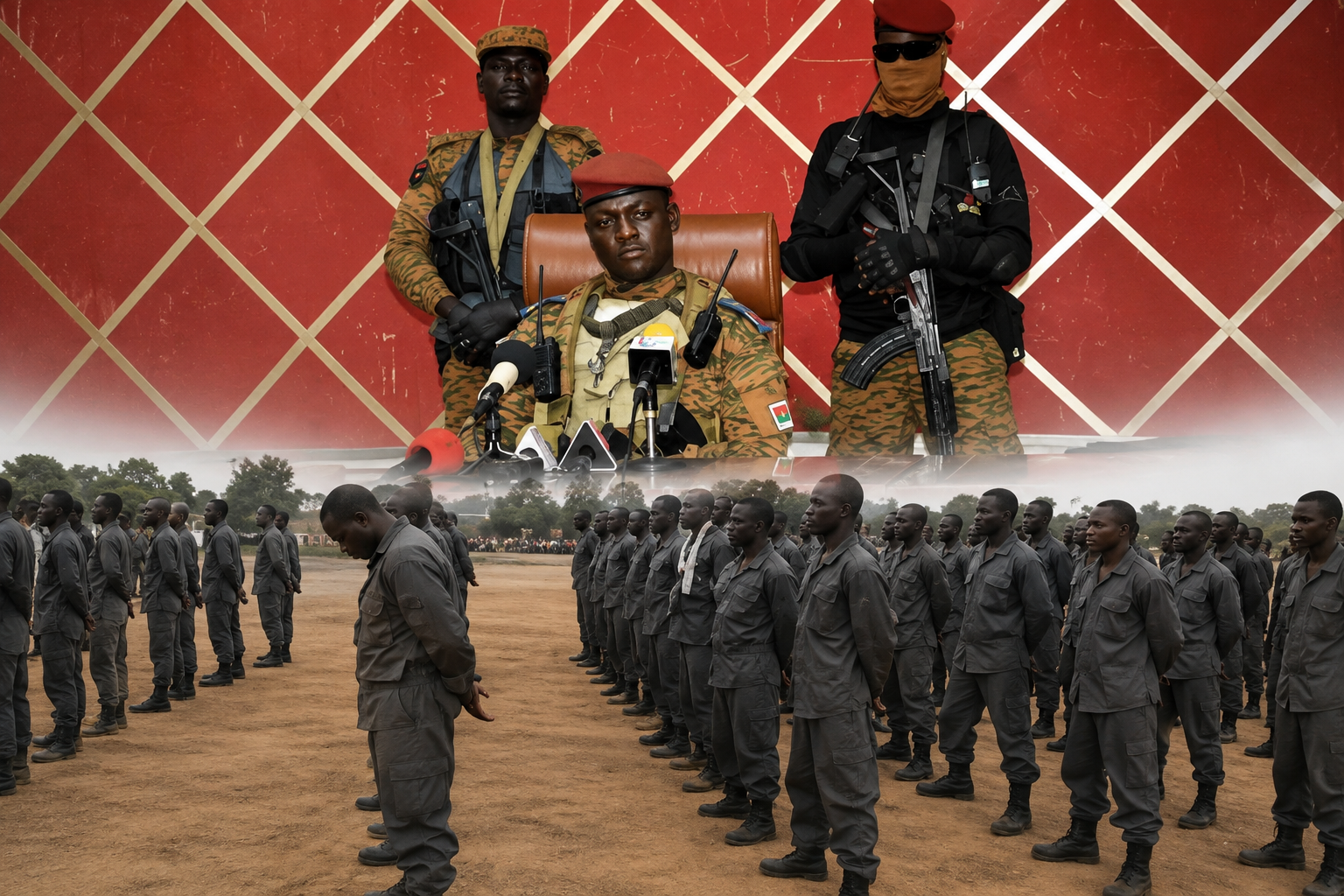
From Supporters to Suspects: A Regime’s Unwavering Hunger for Control
Burkina Faso’s political landscape has taken a troubling turn under the leadership of Captain Ibrahim Traoré. What began as a clampdown on traditional critics—opposition figures, human rights activists, and independent journalists—has now expanded to include voices that once stood firmly behind the transition. The same tools of repression designed to silence adversaries are increasingly being deployed against former allies, underscoring a harsh truth: in authoritarian systems, loyalty is a fleeting currency.
The crackdown is not a series of isolated incidents but part of a broader strategy. As the regime consolidates power, shrinks civic space, and equates dissent with national betrayal, the lines between friend and foe blur. No longer is past allegiance enough; today, Burkina Faso demands perpetual obedience, and even the most steadfast supporters find themselves walking a precarious tightrope.
The Illusion of Safety in Unquestioning Support
Captain Traoré’s legitimacy rests on a narrative of sovereignty, patriotism, and security—one that has been amplified by a network of online supporters. In this environment, criticism is framed as a foreign-backed plot, a political ploy, or an act of treason. Those who once defended the regime’s every move now face the consequences of a system where dissent is criminalized and compliance is the only currency.
What started as tacit acceptance of emergency measures—arbitrary arrests, forced disappearances, media closures, and coercive summons—has evolved into a culture where skepticism is met with suspicion. The public debate has narrowed to a binary choice: unconditional loyalty to Ibrahim Traoré or immediate labeling as an enemy of the state. Nuance has vanished, and with it, the possibility of constructive criticism.
The Personalization of Power: A Breeding Ground for Paranoia
At the heart of Burkina Faso’s political crisis lies the hyper-personalization of authority around Captain Traoré. Decisions are no longer debated on their merits but justified—or condemned—as reflections of his personal leadership. Questioning a policy is often interpreted as an attack on his person, fostering an atmosphere where fear replaces reasoned discourse.
As security challenges mount—terrorist attacks, economic strain, social unrest—the regime’s response has been to seek internal scapegoats. Failures are attributed not to flawed strategies but to hidden conspiracies, turning allies into potential traitors and critics into saboteurs. This logic inexorably expands the circle of suspects, from opposition leaders to journalists, lawyers, academics, religious figures, and even erstwhile allies whose influence is deemed too great or insufficiently aligned.
Fear as a Governing Tool: The Chilling Effect on Society
The regime’s tactics—high-profile arrests, public summons, smear campaigns, coercive requisitions, and administrative sanctions—serve a dual purpose. While they neutralize specific individuals, their broader aim is to instill fear across society. Each arrest sends a message. Each unexplained disappearance breeds uncertainty. Each summons reinforces the message that no one is beyond the reach of the state. The result is a society gripped by self-censorship, where intellectuals hesitate to publish, journalists avoid sensitive investigations, religious leaders soften their sermons, and citizens remain silent in public debates. A nation governed by fear loses its capacity for innovation, self-correction, and collective problem-solving.
The Erosion of Checks and Balances
This trend is particularly alarming given the weakening of institutional safeguards. The judiciary’s independence is increasingly questioned as legal processes appear to bend to political imperatives. Independent media face suspensions or restrictions, shrinking the diversity of information available to the public. Civil society organizations operate in an ever-shrinking space, while political parties find their activities heavily constrained. When no institution can effectively hold the executive to account, the rights of citizens become dangerously vulnerable. The power is no longer restrained by law but by the whims of those in charge.
A Historical Pattern: When Regimes Consume Their Own
Burkina Faso is not alone in this trajectory. History shows that regimes built on centralized power follow a predictable path. Revolutionaries turn on their former comrades. Military leaders distrust their own officers. Political movements exclude their founders. Ideologues are accused of betrayal. The logic is simple: when loyalty to an individual becomes the primary criterion for survival, no level of devotion is ever enough. The pursuit of absolute purity leads to purges, expulsions, and accusations that spiral out of control.
Fundamental Freedoms Are Not Negotiable
The current situation in Burkina Faso highlights a critical truth: fundamental rights are not privileges granted to the faithful. Fair trials, freedom of expression, press freedom, the presumption of innocence, and protection against arbitrary detention are universal guarantees—not rewards for political allegiance. Supporting the unjust arrest of an opponent sets a dangerous precedent: once arbitrariness is normalized, it can be applied to anyone, regardless of their past loyalty.
Many who once championed Ibrahim Traoré’s rise now find themselves targets of the very system they helped legitimize. The mistake was believing that proximity to power would offer lasting protection. In authoritarian systems, loyalty is not a contract; it is a precarious relationship, constantly reassessed based on shifting interests.
Security Cannot Justify Endless Exceptions
Burkina Faso faces a real and urgent terrorist threat that demands a robust state response. However, the effectiveness of counterterrorism efforts cannot be measured solely by the volume of coercive measures. It also depends on the trust between citizens and their institutions. When people fear the state more than the terrorists, that trust erodes, and the foundations of long-term security weaken.
History demonstrates that insurgencies cannot be defeated without credible institutions. A state that combats terrorism while upholding the rule of law strengthens its legitimacy. Conversely, when exceptional measures become permanent, the fight against terror risks becoming a justification for totalitarian control. Security and justice are not opposing goals; they are complementary pillars of a stable society.
The Regime’s Self-Destructive Logic
The predicament faced by former regime supporters today is a microcosm of a larger political phenomenon. In a system where institutions are hollowed out and power relies on fear, no one is safe—not even the most ardent allies. Today’s staunchest defender may tomorrow be accused of disloyalty. The most vocal communicators may be sidelined or replaced. Religious leaders may be reprimanded if their messages stray from the official line.
The system does not merely punish its critics; it devours its own. But beyond individual fates, the real cost is borne by society as a whole. When a regime extends suspicion to its own supporters, it reveals that the problem is not the people but the system itself. Lasting security and stability do not come from proximity to the leader or ideological conformity; they come from strong institutions, an independent judiciary, a free press, and laws applied equally to all.