
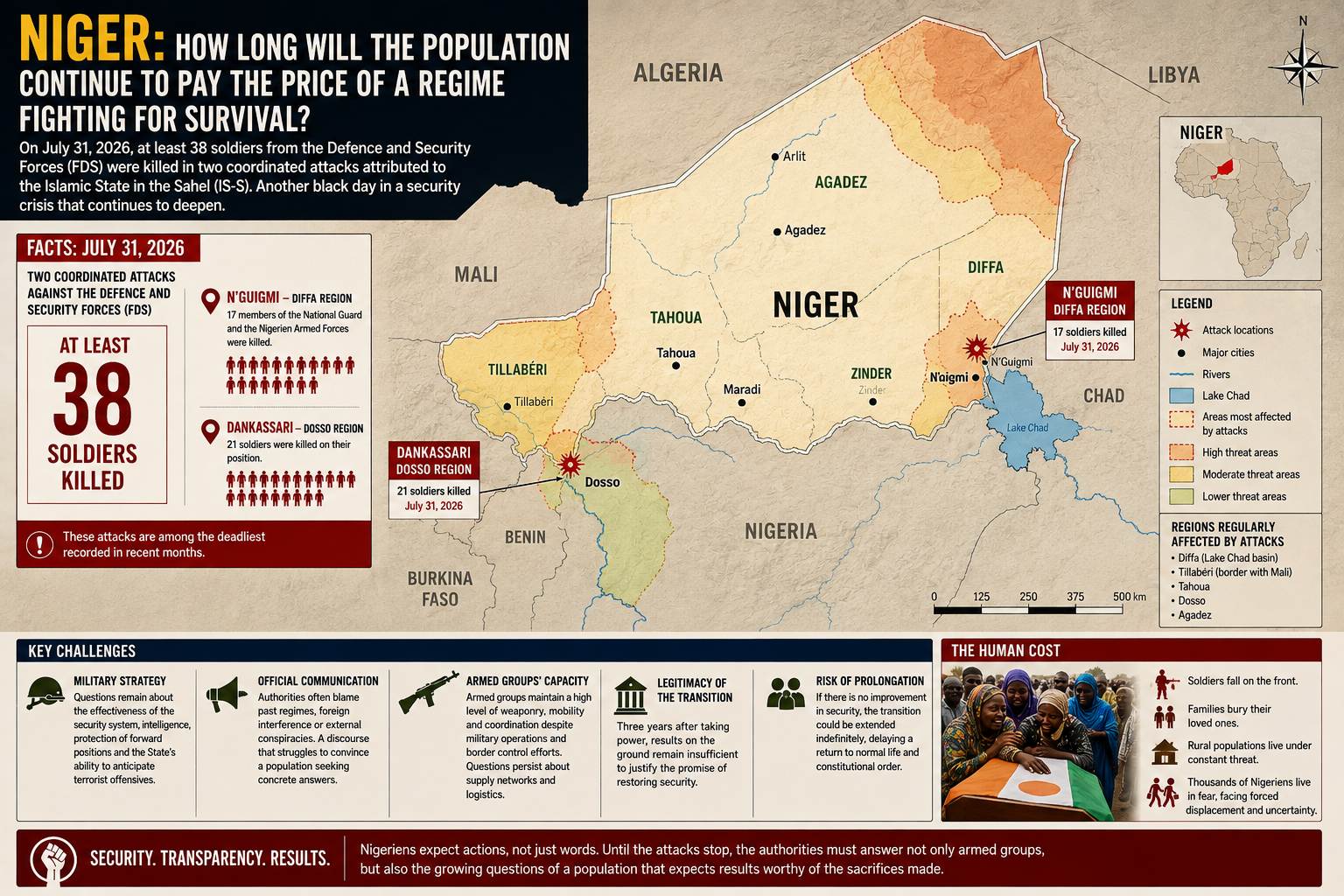
Two deadly coordinated assaults mark a grim milestone
July 31, 2026, entered Niger’s history as one of its darkest days when coordinated attacks by the Islamic State in the Sahel (IS-Sahel) claimed the lives of at least 38 soldiers. The assaults, executed with precision, targeted two remote military outposts: N’Guigmi in the Diffa region and Dankassari in Dosso.
In N’Guigmi, 17 members of the National Guard and Nigerien Armed Forces were killed, followed hours later by 21 fatalities in Dankassari. These incidents stand among the deadliest in recent months, underscoring a troubling trend: the escalation of terrorism and the mounting human cost of an unrelenting security crisis.
From crisis management to growing skepticism
When General Abdourahamane Tiani assumed leadership three years ago, the primary justification for the military takeover was the urgent need to address what was described as an uncontrollable deterioration of security under civilian rule. The pledge was clear: restore order, reclaim territorial control, and safeguard the population.
Yet today, the reality paints a far grimmer picture. Attacks persist across critical regions, including the Lake Chad basin, Tillabéri, Tahoua, and Dosso. Armed groups continue to execute large-scale operations against military positions, despite repeated announcements of force restructuring and redeployment. This persistent vulnerability raises a pressing question: Are the stated objectives of the military leadership being met on the ground?
Military strategy under scrutiny
Each deadly attack is no longer just a humanitarian tragedy—it is a litmus test for the effectiveness of Niger’s defense apparatus. Concerns now focus on the reliability of intelligence, the vulnerability of forward operating bases, and the state’s ability to preempt terrorist offensives. As attacks multiply, public skepticism grows over the coherence of the current military strategy.
Citizens and analysts alike are questioning whether the heavy investment in political consolidation has come at the expense of urgent military imperatives. A leadership that derives its legitimacy from security promises must now demonstrate tangible results—or risk eroding public trust irreversibly.
Communication that fails to reassure
Following each attack, authorities frequently cite historical governance failures, foreign interference, or geopolitical complexities as contributing factors. While these elements may play a role in a broader regional context, they do little to address the immediate concerns of grieving families and affected communities.
What is urgently needed are concrete responses: clear explanations of operational shortcomings, corrective measures, and tangible steps to prevent future tragedies. Without visible progress, official narratives risk sounding increasingly hollow to a population desperate for security.
A conflict that refuses to abate
One of the most alarming aspects of the current crisis is the sustained operational capacity of armed groups. Despite ongoing military operations and border enforcement efforts, these organizations continue to mount large-scale attacks. This persistence fuels concerns about the effectiveness of arms trafficking interdiction, terrorist logistics networks, and intelligence-gathering mechanisms.
The lack of transparent public information only exacerbates distrust, allowing rumors to spread and deepen the rift between citizens and state institutions.
Transition at a crossroads
The military’s legitimacy hinges on its ability to restore security—a promise that grows increasingly fragile with each attack. The prolonged crisis not only delays a return to normalcy but also weakens local communities and prolongs the uncertainty surrounding the transition to civilian rule.
In this climate of doubt, observers warn that the absence of visible improvement may further entrench the current political transition. The path forward demands greater transparency, demonstrable results, and a credible roadmap for resolving the crisis.
The human toll of an endless emergency
The true cost of this crisis is measured not in policy debates, but in lives lost. Soldiers continue to fall in combat. Families mourn their dead. Rural communities live under the constant shadow of violence. Thousands of Nigeriens endure displacement, fear, and uncertainty as their daily lives remain hostage to the whims of armed groups.
The promise of security was the cornerstone of the military transition. Today, it remains its most critical test. Until attacks subside and tangible protection is delivered, the leadership must answer not only to armed factions—but to a weary population demanding accountability and results.