
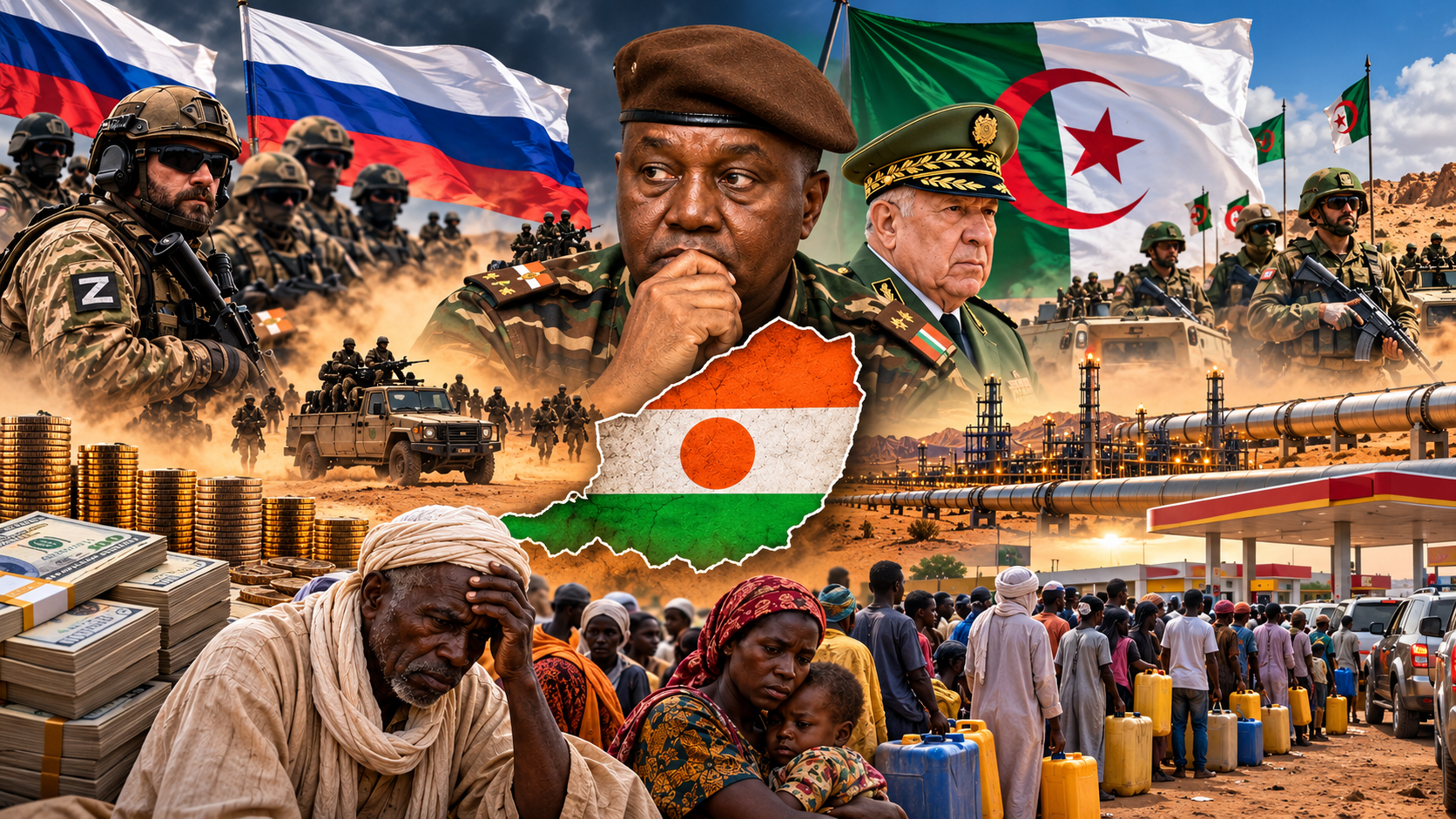
As the regime of General Abdourahamane Tiani grapples with mounting security challenges, Niamey has increasingly turned to foreign military partnerships first with Russia, and now with Algeria. But with public budgets under strain and civilians bearing the brunt of insecurity, a critical question emerges: is outsourcing national defense to foreign powers sustainable, or will it only deepen the burden on Niger’s population?
From Russian mercenaries to Algerian troops: why is Niamey seeking new military allies?
The decision to pivot from Russian security contractors to Algerian military support marks a notable shift in Niger’s defense strategy. On October 25, 2026, Algeria’s Parliament approved the deployment of units from the National People’s Army (ANP) to Niger, a move hailed as a historic step by Algiers. While the Algerian government frames this cooperation as part of a broader commitment to regional stability, the motivations behind Niamey’s shift remain shrouded in ambiguity.
Officially, Algeria cites shared security concerns and bilateral cooperation agreements as the foundation for its intervention. Unofficially, analysts point to Algeria’s vested interests in Niger’s energy sector particularly oil fields and the proposed trans-Saharan gas pipeline as key drivers of this engagement. Yet, the precise terms of this military cooperation, including operational scope and financial arrangements, remain undisclosed, leaving citizens with more questions than answers.
What did the Russian military partnership actually deliver?
Since the July 2023 coup, Niger’s military leadership has leaned heavily on Russian security contractors, notably those linked to the Africa Corps. The government justified this partnership as essential to restoring order and combating armed groups. But three years later, with attacks persisting and civilian displacement continuing, the efficacy of this arrangement is increasingly questioned.
Reports suggest that each Russian contractor costs approximately $10,000 per month a figure that, while unverified, underscores the financial toll of this partnership. With no public contracts available to corroborate this expense, the true cost to Niger’s treasury remains unknown. Yet, even if these figures are accurate, they raise a pressing concern: for what tangible security gains are these funds being allocated?
The problem is not the principle of foreign military support, but the lack of accountability. A sovereign state must be able to demonstrate that its security investments yield real protection for its people not just symbolic alliances or vague promises of stability.
Algeria’s intervention: a lifeline or a new dependency?
Algeria’s military engagement introduces a new dynamic into Niger’s security calculus. Beyond border surveillance and counterterrorism, Algerian forces may also be tasked with protecting critical infrastructure, including energy projects that are vital to both nations. While this could theoretically bolster Niger’s security, it also risks entrenching a cycle of foreign dependence.
Critics argue that if Algeria’s deployment is primarily motivated by its own strategic interests such as securing oil supplies or pipeline routes then the benefits to ordinary Nigeriens may be incidental at best. And without clear, publicly available agreements outlining responsibilities, costs, and expected outcomes, citizens have little recourse to demand transparency or accountability.
Who foots the bill for Algeria’s military presence?
One of the most pressing concerns is financial: who will bear the cost of Algeria’s military operations in Niger? Will Algiers cover the expenses outright, or will Niamey shoulder the burden through bilateral agreements or resource concessions? While no definitive answers have emerged, the precedent set by previous foreign military partnerships suggests that the financial responsibility may ultimately fall on Niger’s already strained public finances.
For a country grappling with economic hardship, rising debt, and urgent social needs, every dollar spent on foreign security contractors or foreign troops must be justified by measurable improvements in safety and stability. Otherwise, the cost of this cooperation could far outweigh its benefits.
Transparency as the litmus test of sovereignty
Niger’s military leadership has long framed sovereignty as a cornerstone of its legitimacy. Yet the repeated recourse to foreign military partnerships first with Russia, now with Algeria paints a contradictory picture. Sovereignty, after all, is not merely about rejecting certain alliances or embracing new ones; it is about demonstrating that those alliances serve the nation’s best interests.
If the Russian partnership has failed to deliver on its promises, the government must acknowledge this and adjust its strategy. If Algeria’s intervention is necessary, its objectives, costs, and expected outcomes must be made public. And if these partnerships come at a steep financial or political price, citizens deserve to know how those costs will be mitigated and what alternatives are being pursued.
The ultimate measure: will this cooperation protect Niger’s people?
At its core, the debate over Niger’s military partnerships boils down to a single question: will these arrangements result in tangible improvements in security for the population?
So far, the evidence is thin. Despite the presence of foreign forces Russian contractors and now Algerian troops attacks by armed groups continue to destabilize large swaths of the country. Roads remain unsafe. Civilians in rural areas face persistent threats. And the government’s ability to assert authority in contested regions has yet to be convincingly demonstrated.
If Algeria’s deployment is to be more than a short-term fix, it must be integrated into a broader, transparent security strategy. This means clear operational mandates, measurable benchmarks for success, and rigorous oversight to ensure that public funds are not squandered on empty promises.
For the people of Niger, the stakes could not be higher. They deserve a government that prioritizes their safety not just its alliances.
By Henri Nkeng — Journalist