
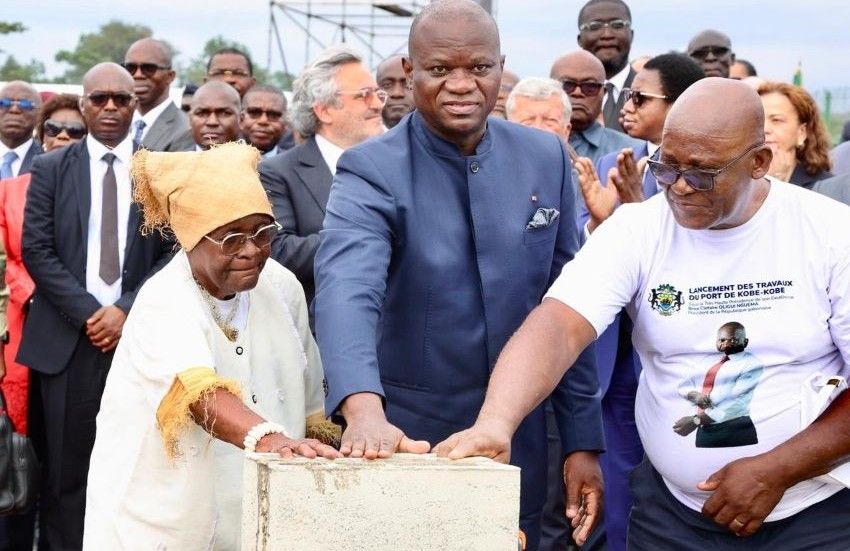
The official commencement of the Kobe-Kobe deep-water port construction on Monday, June 8, represents far more than a typical infrastructure milestone.
This event signals Gabon’s transition into a fresh chapter of its economic narrative. Beyond the technical surveys and heavy machinery lies a national transformation strategy designed to permanently alter the country’s standing in both African and global commerce.
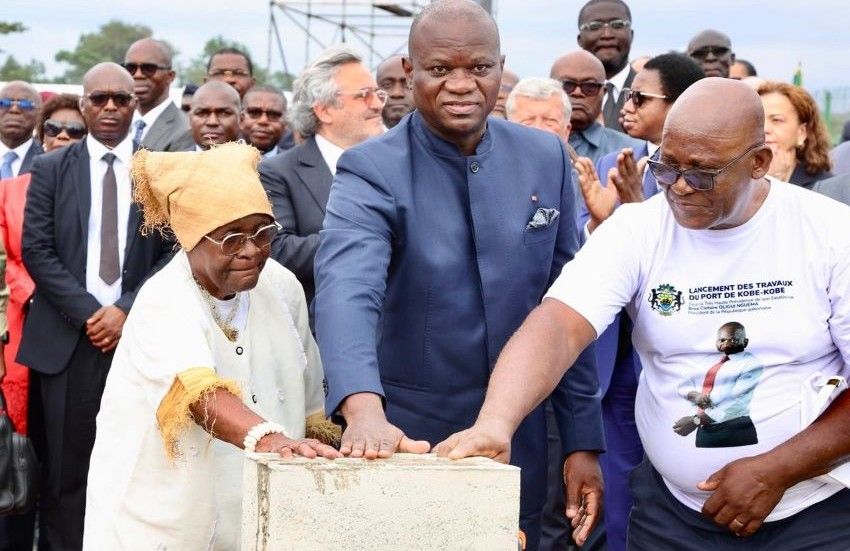
In Nyonié, located along the Atlantic coast of the Estuaire province, President Brice Clotaire Oligui Nguema inaugurated a program that integrates several high-level strategic goals. The project unites ambitions for industrialization, economic independence, post-oil diversification, and regional job creation into a single, cohesive objective.
It is rare for a single development to attract such a diverse array of international stakeholders while generating such high expectations among the Gabonese people.
The foundation of a modern economic framework
Viewing Kobe-Kobe merely as a maritime facility would be an oversight. The complex is built upon four interconnected pillars: the Belinga iron ore deposit—one of the world’s most significant untapped high-grade mineral reserves; a new 535-kilometer railway connecting mining sites to the coast; a deep-water mineral terminal featuring four berths; and a 400-megawatt hydroelectric plant at Booué to power the entire operation.
This integrated model departs from the traditional patterns of resource extraction in Africa. For too long, raw materials were shipped abroad for processing. Conversely, the Kobe-Kobe initiative aims to retain and maximize value within Gabon.
The government’s mandate is precise: utilize Gabon’s natural wealth as a catalyst for industrial growth rather than just an export commodity.
A partnership established in April 2026 between the Gabonese state, Africa Global Logistics, and Algest Investment Bank highlights this commitment to managing the entire economic chain, from mining to international distribution.
A strategic logistics hub for Central Africa
The implications of this project extend well beyond the mining sector. With a water depth of 14 to 16 meters, Kobe-Kobe offers a significant natural edge in a region where many existing ports are reaching their limits.
Large-capacity vessels will be able to dock directly, lowering shipping costs and making the country more attractive to global investors. As Central African nations strive to improve their trade competitiveness, controlling such vital logistics infrastructure becomes a game-changing advantage.
Gabon is positioning itself as a regional gateway, ready to serve its domestic market and manage a substantial portion of Central Africa’s trade traffic.
This strategy reflects the broader vision of Brice Clotaire Oligui Nguema to prepare the nation for a future beyond petroleum, leveraging mineral wealth, energy potential, and a strategic geographical location. The involvement of global players like China Railway, EDF-Sinohydro, Trafigura, Fortescue, and Africa Global Logistics underscores the international confidence in this roadmap.
Social progress through industrial development
While the investment figures are staggering, the human impact is the most anticipated outcome. Official forecasts predict over 9,000 direct jobs and as many as 100,000 indirect roles by 2030. Some developers suggest that the industrial corridor could eventually support up to 160,000 total positions as it reaches full capacity.
For the residents of Nyonié, Komo-Océan, and the regions along the new rail lines, this project offers an unprecedented chance for economic renewal. Improved transport networks, new service sectors, and the growth of industrial activities will likely reshape the socio-economic environment of several provinces.
Ultimately, the success of Kobe-Kobe will be judged by its ability to turn massive infrastructure into tangible prosperity for the citizens of Gabon. The core challenge remains converting natural assets into sustainable development, skilled employment, and economic sovereignty.
If these targets are met, Kobe-Kobe will transcend its status as a port to become a symbol of a new Gabonese model focused on local value creation and industrial maturity. It stands as a clear example of an Africa that is no longer just exporting resources but is building the foundations for its own future.