
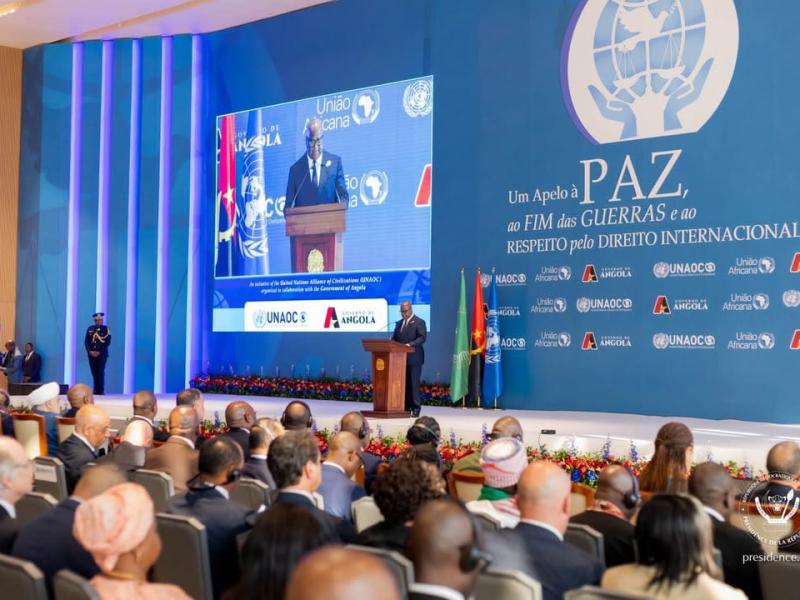
The United Nations Alliance of Civilizations (UNAOC) and the Angolan government jointly organized the third edition of the international initiative « A Call for Peace, an End to Wars, and Respect for International Law » in Luanda on July 16-17, 2026. This high-level forum, following previous editions in Gernika, Spain and Sarajevo, Bosnia-Herzegovina, brought together global leaders to strengthen multilateral cooperation and promote peaceful conflict resolution.
The two-day summit focused on restoring the credibility of international law, protecting civilians in conflict zones, and preventing the escalation of violence worldwide. Among the key speakers, Félix Tshisekedi, President of the Democratic Republic of the Congo (DRC), delivered a powerful address highlighting the urgent need for tangible peace in eastern DRC.
DRC’s eastern crisis: a litmus test for global stability
Addressing the assembly, President Tshisekedi emphasized that the ongoing violence in eastern DRC is not merely a national challenge but a regional and global test. He described the human cost of the conflict, which has displaced millions, subjected women to systematic violence, orphaned children, and turned the region’s natural resources into tools of war rather than instruments of development.
The Congolese leader condemned the selective application of international law, stating:
« We cannot invoke state sovereignty in some crises while undermining it in others. The international community must uphold the law consistently—without exception. »
He underscored that the crisis in eastern DRC has persisted for years due to armed group activity, foreign interference, and the failure to implement existing peace agreements, including the Washington and Doha processes supported by the African Union.
From promises to action: the demand for verifiable peace
While acknowledging diplomatic efforts, President Tshisekedi insisted that peace cannot remain a theoretical promise. He called for concrete, on-the-ground actions to:
- Restore state authority in conflict zones;
- Ensure the safe and dignified return of displaced populations;
- End impunity through credible justice mechanisms;
- Cut off economic lifelines to armed groups;
- Combat foreign interference and mercenary activities.
« Peace must be verifiable. It must protect civilians, uphold their rights, and prevent the recurrence of violence. The Luanda Call must not be another empty declaration—it must be a binding commitment to defend international law wherever it is threatened. »
Reaffirming commitment to dialogue and regional stability
Despite the deteriorating security situation, President Tshisekedi reaffirmed the DRC’s dedication to peaceful solutions, praising the African Union’s mediation role and international partners’ support. However, he warned that delayed implementation of agreements, continued hostilities, and the suffering of civilians highlight the urgency of action.
He concluded by stressing the need to prioritize human dignity in all peace efforts, urging leaders to replace indifference with responsibility and rhetoric with tangible results. Reflecting on the 80th anniversary of the United Nations Charter, he called for renewed global action to ensure that future generations are spared the devastation of war.
As the summit concluded, the situation in eastern DRC remained fragile, with ongoing clashes and humanitarian crises. The international community’s response—measured in real accountability and enforcement—will determine whether the Luanda Call translates into lasting peace or another unfulfilled promise.