
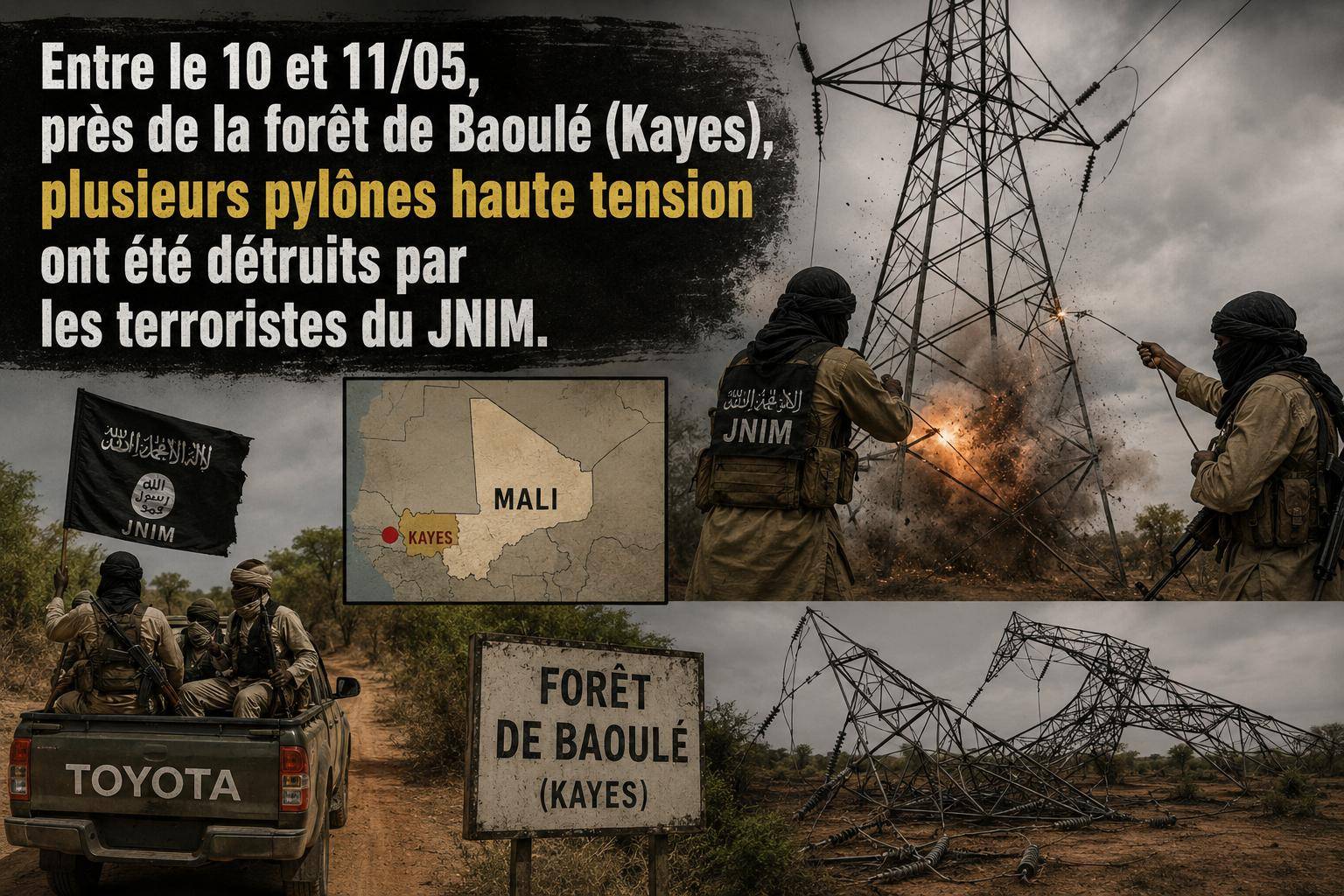
The weekend of May 10-11, 2026, will be etched in Mali’s energy crisis as a dark milestone. Close to the Baoulé forest in the Kayes region, militants from the Group for the Support of Islam and Muslims (JNIM) executed a coordinated strike against multiple high-voltage power pylons. This strategic sabotage unfolded under the watch of a Russian ally, Africa Corps, whose battlefield effectiveness is increasingly questioned. With record-breaking heatwaves, water shortages, and total darkness enveloping the capital, Bamako is suffocating as the terror threat creeps closer to the critical Manantali and Sélingué hydroelectric dams.
JNIM targets Mali’s economic lifelines
The insurgent group is no longer waging a distant bush war—it is executing a silent siege. After systematically choking off major roads into the capital by torching cargo trucks and civilian buses, the JNIM has escalated its campaign. By striking power transmission lines near Kayes, the militants are directly attacking the daily lives of Bamako residents and the stability of the transitional government.
Their operation was surgical. Pylons hidden in rugged terrain near the Baoulé forest were toppled with alarming technical precision, triggering a massive blackout that plunged entire districts into suffocating darkness. This escalation compounds an already fragile energy situation, leaving families without light, water, or relief from the sweltering heat.
Russian-backed military partnership under scrutiny
The timing of the attack could not have been more damaging. It occurred just as Malian Armed Forces and Africa Corps units claimed to have secured these same strategic zones. How armed groups manage to transport explosives, rig massive metal structures, and vanish without detection raises serious doubts about the effectiveness of Bamako’s alliance with Moscow.
On the ground, the reality is stark. While Russian paramilitary units excel in urban show-of-force demonstrations, their track record in preventing hybrid strikes on critical infrastructure remains abysmal. Drones and joint patrols have failed to shield the power grid, forcing citizens to question the true value of this costly partnership.
For Bamako’s residents, the blackout is the final straw. The capital is enduring an unprecedented heatwave, with temperatures nearing 45°C. With no electricity to power fans and no electric pumps to deliver drinking water, daily life has become unbearable. Government promises of fuel convoys escorted by Malian troops and Africa Corps offer little comfort when the grid’s collapse leaves hospitals running on backup generators and maternity wards operating under dire conditions.
Manantali and Sélingué: a looming regional catastrophe
The most alarming development is the JNIM’s shift in focus toward the Manantali and Sélingué dams. This escalation threatens far beyond Mali’s borders. These facilities are the energy and water lungs of West Africa, and a successful attack would plunge Bamako into months of darkness and extend the crisis across Senegal and Mauritania, which rely on shared energy agreements.
The sabotage progression—from trucks to pylons to dams—reveals a deliberate strategy of chaos that the military and its allies are struggling to counter. The transitional government and its Russian partners now face an existential test. Rhetoric about territorial liberation clashes with the reality of a nation whose vital infrastructure collapses one after another. The costly deployment of Africa Corps has so far failed to secure the economy or protect basic services.
The hour is no longer for triumphant statements but for urgent action to shield sensitive sites. If the dams fall, the credibility of the Malian state could vanish like Sahel dust in the midday sun. Bamako’s citizens are no longer satisfied with sovereignty slogans—they demand water, light, and real security that translates into dignity.