
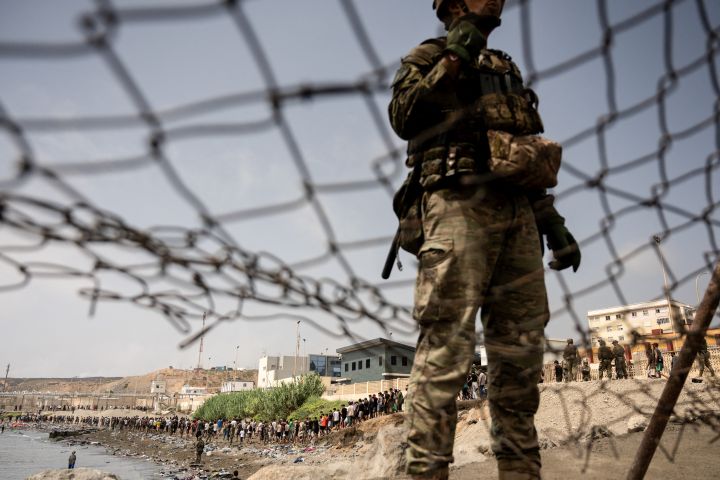
The Moroccan government had cautioned Spain in advance about the potential migration surge stemming from a recent Spanish court decision, a senior Moroccan official stated. The warning came as nearly 60,000 individuals—primarily Moroccans—entered or attempted to enter the Spanish enclave of Ceuta on foot or by swimming from the nearby city of Fnideq. This unprecedented influx overwhelmed Ceuta’s capacity, leading to thousands of forced returns to Morocco.
According to the high-ranking official, who spoke on condition of anonymity, Moroccan authorities had alerted their Spanish counterparts to the risks posed by a Spanish Supreme Court ruling that prohibited immediate repatriation of migrants arriving by sea. ‘We explained that this ruling would create a problem—and it did,’ the official remarked.
Spanish Prime Minister Pedro Sánchez attributed the crisis to ‘rumors spread by human trafficking mafias,’ suggesting an incorrect interpretation of the court’s decision. The Moroccan official, however, noted that discussions with Spain had already begun around July 22-23, as smuggling networks started circulating news of the ruling.
The official firmly rejected claims of any failure in Morocco’s border security measures. ‘It’s simplistic to suggest Morocco should have simply used force to stop them. That misunderstands the reality of the situation,’ he said, emphasizing that law enforcement could not feasibly confront such a large crowd. ‘This isn’t Morocco’s burden to bear alone,’ he added, noting that the country spends approximately €500 million annually on migration management.
Despite the tensions, he reaffirmed strong bilateral cooperation between Rabat and Madrid, describing their relationship as one of ‘trustworthy partners’ working in ‘perfect coordination’ on migration issues. ‘Now, it’s Spain’s responsibility to address the challenges posed by this ruling,’ he concluded.