
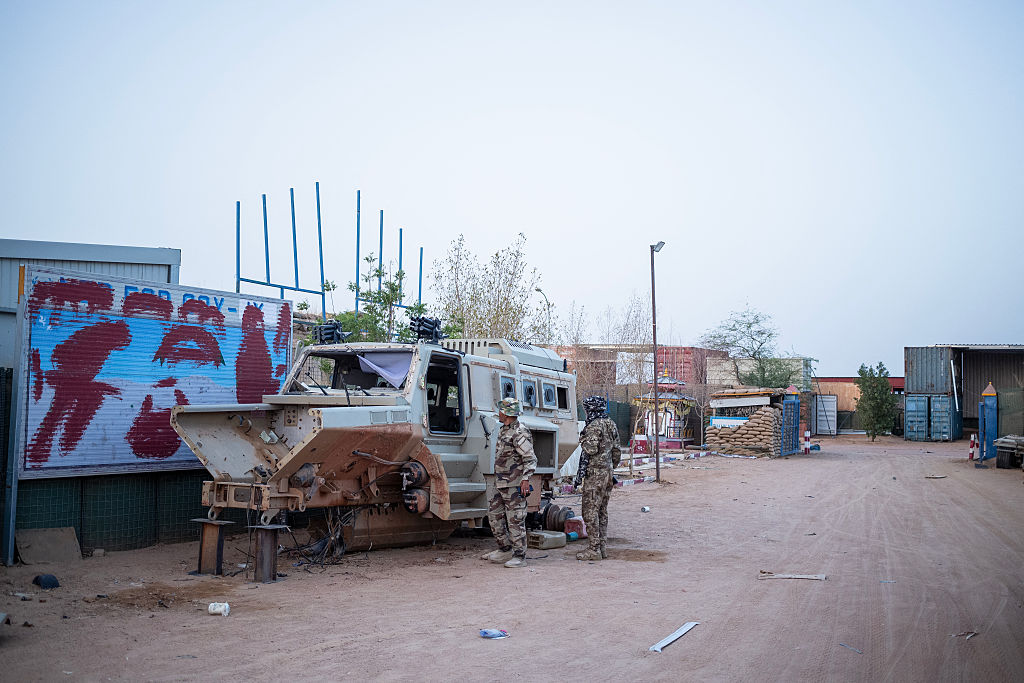
Russia’s Africa Corps has altered its military approach in Mali, redeploying its forces away from the volatile northern regions to prioritize the protection of Bamako and the country’s ruling junta. The shift includes providing air support, intelligence, and logistical assistance to Malian troops engaged in ground operations.
The transition comes after the Africa Corps replaced the infamous Wagner Group in mid-2024, following heavy losses incurred during a devastating ambush by the Azauad Liberation Front (FLA) near Tin Zaouatine, close to the Algerian border. Reports indicate that Wagner suffered dozens of casualties in the attack, prompting the restructuring of Russian-backed forces in the region.
The Africa Corps currently fields approximately 2,000 personnel, including many former Wagner mercenaries, though its numbers remain significantly lower than the former Wagner contingent. In fact, its current strength is roughly half that of the counterterrorism force of France’s Operation Barkhane, which was expelled from Mali in 2022 following a series of political disputes.
Why the shift in focus?
The loss of Kidal to a coalition of the Azauad Liberation Front (FLA) and the Group for the Support of Islam and Muslims (GSIM) in late April played a decisive role in the Africa Corps’ decision to consolidate operations near Bamako. In response, Russian-backed forces launched retaliatory airstrikes on Kidal, targeting key infrastructure and forcing civilians to flee. These strikes were part of a broader effort to bolster the Malian Armed Forces (FAMa), which now serves as the primary ground force in the northern territories.
«We are seeing a greater reliance on air resources,» noted Benedict Manzin, chief analyst for the Middle East and Africa at the intelligence firm Sybiline. Recent operations have included the use of Russian-made cluster munitions in Kidal—a move that violates Mali’s commitments under international treaties banning their use.
«They have fewer resources to spare,» Manzin added. «Their strategy is to avoid scattering their forces in the North, where they risk being overwhelmed by local resistance fighters.»
Analysts, including Jacob Boswall from a leading international media outlet, have observed through social media statements that the Africa Corps has redirected its efforts toward central and southern Mali, focusing the majority of its operations near the capital.
Propaganda and supply line operations
Following the withdrawal from Kidal, the Africa Corps launched an extensive propaganda campaign, publishing over 500 articles across platforms like Telegram in the weeks afterward. This effort aimed to counter negative narratives and reinforce the junta’s control over public perception.
Beyond combat operations, the Africa Corps has also taken on a logistical role, escorting supply convoys entering Mali from landlocked neighboring countries such as Côte d’Ivoire, Guinea, and Sénégal. These convoys, transporting essential goods, are increasingly targeted by the GSIM, which has imposed economic blockades across key regions.
Despite the Africa Corps’ attempts to minimize its battlefield exposure, the GSIM has escalated its own tactics, deploying drones to strike Russian positions. Recent social media footage shows drone attacks on Africa Corps bases in Sévaré, resulting in casualties and damage to military aircraft.
In retaliation, the Africa Corps has deployed armed drones to target GSIM positions, including a recent strike on a fuel depot in the Tombouctou region, according to Africa Terrorism Tracker analysts.
Economic and political fallout
Since late 2021, Mali has spent nearly $1 billion to secure the services of Wagner and the Africa Corps. However, the strategy has backfired, with the government and its Russian allies losing control over northern territories. The GSIM has expanded its influence across the Sahel, partly due to the brutal tactics employed by Russian forces and Malian troops against civilians in the North.
«The approach adopted by the Malian state is counterproductive,» Manzin concluded. «In the long run, it threatens the stability of the state itself. The result? A growing appeal for the GSIM among disillusioned communities.»