
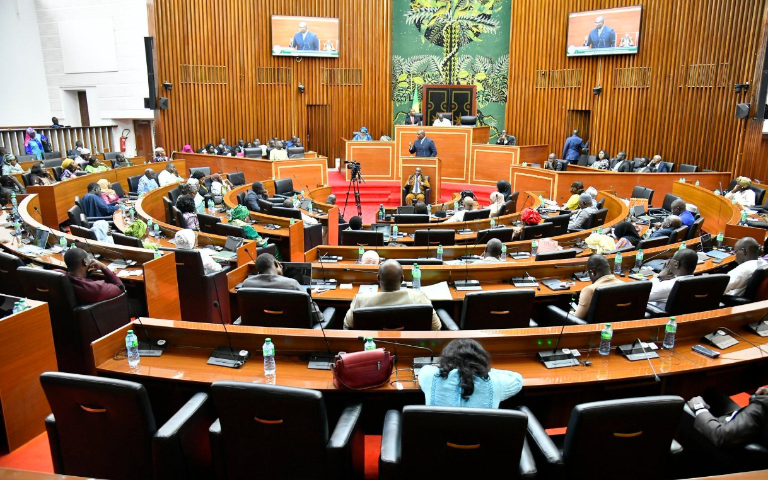
The political alliance that once united President Bassirou Diomaye Faye and the Pastef movement has fractured, with consequences now shaking Senegal’s institutions to their core. On November 3, 2026, the National Assembly dealt a decisive blow to the government by rejecting the 2026 supplementary budget bill, signaling an escalation in tensions between the executive branch and a parliamentary majority loyal to Pastef’s Ousmane Sonko.
What led to the historic parliamentary rejection?
The vote was not just a procedural setback—it was a deliberate act of defiance. The National Assembly rejected the supplementary budget by a vote of 109 to 20, with three abstentions, out of 132 participating lawmakers. The decisive moment came when Amadou Ba, a Pastef deputy, tabled a preliminary motion to block the bill before substantive debate even began.
The government had sought to pass the revised budget to adjust fiscal forecasts amid shifting economic pressures. But with a majority of parliamentarians aligned against it—despite historical ties to the ruling party—the proposal was dead on arrival. This refusal reflects more than disagreement over numbers; it signals a fundamental erosion of trust between the presidency and the legislative body.
From allies to adversaries: the rise of a new political rift
The irony is striking: both President Faye and National Assembly President Sonko emerged from the same political movement. Yet, since Sonko stepped down as Prime Minister in May 2026, their paths have diverged sharply. While Sonko’s party still dominates Parliament, it no longer supports the government unconditionally—creating a rare institutional standoff in Senegal’s democratic history.
This is not a classic cohabitation, but it shares key traits: a president leading a government, opposed by a parliamentary majority from the same political lineage. The rejection of the budget is not just about fiscal policy—it’s a statement of political independence, one that forces the executive to reckon with a legislature no longer bound by loyalty.
Where the numbers clash: debt, deficits, and public investment
The government proposed a budget with revenues of 5,848.7 billion West African CFA francs—down from the initial 6,188.8 billion forecast. Spending was set at 7,583.9 billion, pushing the deficit to 7.6% of GDP, up from 5.4% in the original budget. A particular flashpoint: a 555 billion CFA franc cut in investment credits, raising alarms over stalled infrastructure and development projects.
Pastef lawmakers argue the cuts are poorly justified and demand greater transparency, especially around energy subsidies, family security grants, and priority spending. The Ministry of Economy and Finance insists it provided full documentation, but the parliamentary majority remains unconvinced. Two competing narratives—one of urgent fiscal adjustment, the other of democratic oversight—have collided with no resolution in sight.
Beyond politics: the cost of financial uncertainty
The consequences of this impasse extend far beyond the walls of Parliament. Senegal is negotiating a new financing program with the International Monetary Fund (IMF), and approval of the revised budget was a key step in those talks. The rejection risks delaying disbursements, tightening liquidity, and straining the state’s ability to meet obligations to businesses and strategic sectors.
Without a functioning budget, the government may face delays in paying contractors, public employees, and social program beneficiaries—threatening economic stability and public confidence. This isn’t just a political crisis; it’s a fiscal one, with real-world impacts on lives and livelihoods.
What’s next for Senegal’s fragile balance of power?
The November 3 vote raises a critical question: how far can this internal confrontation go before it paralyzes governance? With no clear path to consensus, the executive must now seek alternative routes—potentially through constitutional amendment, emergency decrees, or renewed negotiation. Meanwhile, Pastef lawmakers appear resolute in using their parliamentary muscle to extract concessions.
One thing is clear: this budget defeat marks a turning point. It signals the end of automatic legislative support for the government, even on economic matters. As Bassirou Diomaye Faye and Ousmane Sonko navigate this new reality, Senegal’s political and economic future hangs in the balance—not just for the next budget cycle, but for the stability of its institutions.