
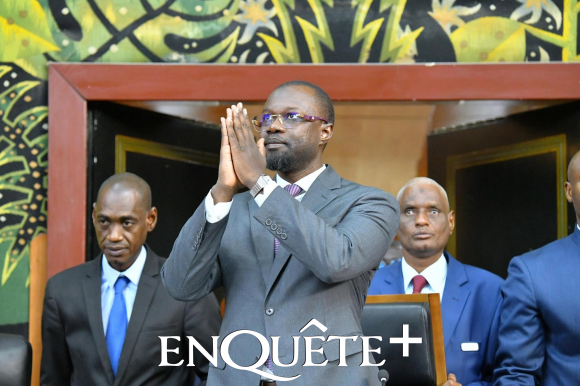
The Supreme Court has dismissed a motion filed by the National Union for Integrity and Sovereignty (UNIS) seeking to suspend the installation of Ousmane Sonko as President of the National Assembly. The ruling, delivered by the court’s emergency judge, has intensified a high-stakes legal confrontation between the UNIS and Senegal’s legislative body.
UNIS condemns Supreme Court’s decision as a denial of justice
In a strongly worded statement released by its president, Amadou Gueye, the UNIS accused the Supreme Court of creating a “negative conflict of jurisdiction” and failing to uphold citizens’ right to legal recourse. The organization argues that the June 25 ruling undermines the rule of law by refusing to intervene in what it describes as a matter of administrative illegality.
The dispute centers on an act issued by the Bureau of the National Assembly to install Ousmane Sonko as its president. The UNIS had appealed to the Supreme Court for both the annulment of this administrative act and its immediate suspension via an emergency procedure. The constitutional context was set by a June 17 decision in which the Constitutional Council declared itself incompetent, ruling that the contested act was administrative—not legislative—in nature.
Legal reasoning under scrutiny
The UNIS challenges the Supreme Court’s justification for rejecting the emergency motion, particularly its reliance on the separation of powers doctrine. The organization contends that the Constitutional Council’s classification of the act as an “administrative act of integration” implicitly recognized the Supreme Court’s jurisdiction over the dispute. By refusing to hear the emergency appeal, the UNIS argues, the highest court has left the matter in a legal void—no jurisdiction willing to rule on its merits.
This assertion is supported by recent rulings in which the Constitutional Council invalidated provisions of a constitutional reform, affirming that the judiciary retains oversight over administrative actions of other branches when legal violations are alleged. The UNIS warns that the Supreme Court’s interpretation could create a “lawless zone” within the National Assembly, enabling unchecked administrative decisions to evade judicial review.
Despite the setback, the UNIS has vowed to pursue its case on the merits before the Supreme Court. It has requested that the full bench of the court convene to clarify its jurisdiction and resolve what it calls a dangerous precedent affecting the balance of powers in Senegal.
The outcome of this legal confrontation is seen as pivotal for defining the boundaries of judicial oversight over legislative branch actions and ensuring legal certainty in public administration.