
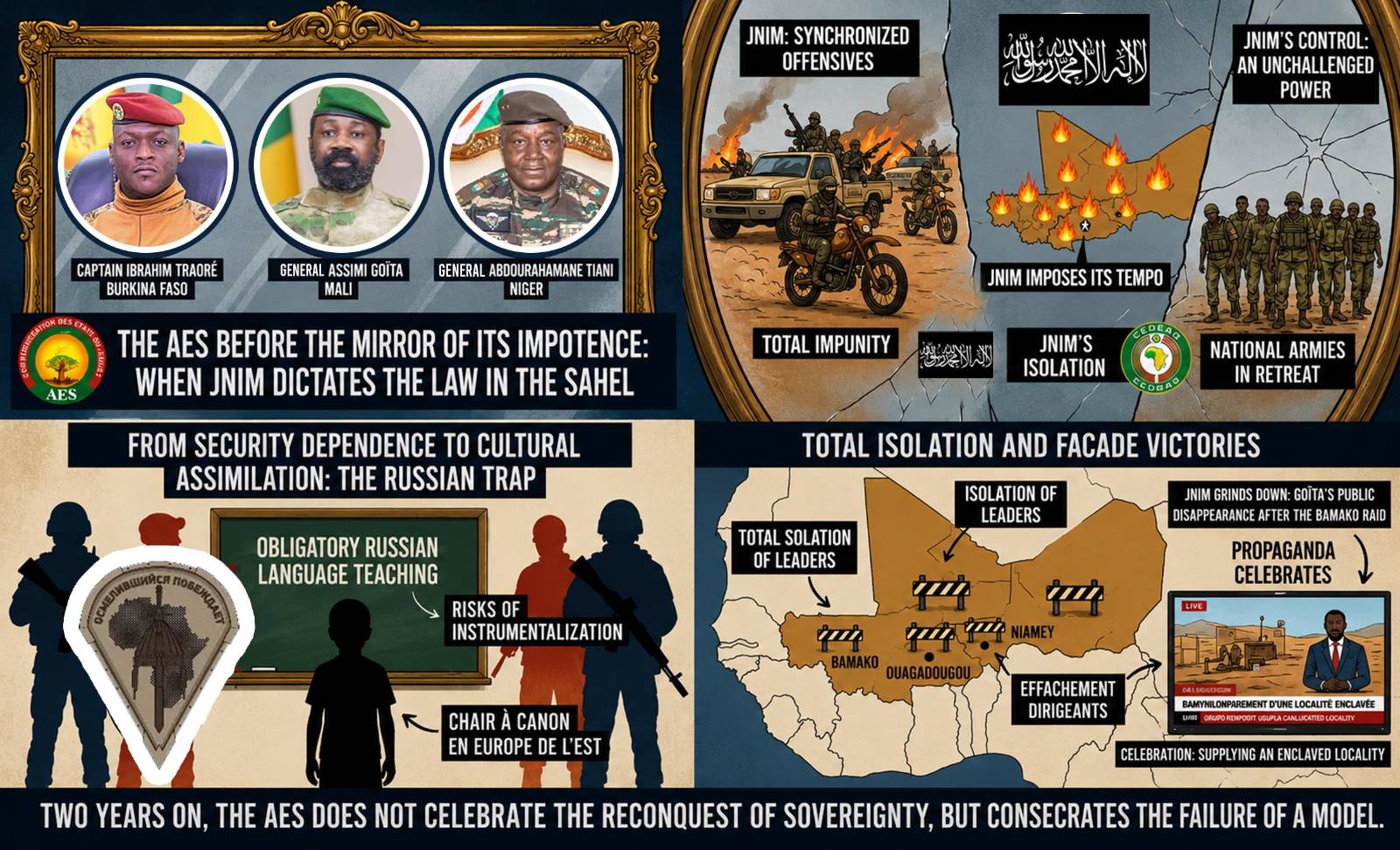
Two years after the Alliance of Sahel States (AES) was established with great fanfare, its grand promises are crumbling under the weight of harsh reality. The sovereignist rhetoric and fiery speeches from the juntas in Bamako, Ouagadougou, and Niamey are yielding little more than symbolic victories. On the ground, the only force truly capable of coordinating operations, dictating the pace, and striking at will remains the Group for the Support of Islam and Muslims (JNIM).
Military ineptitude meets terrorist precision
While the AES touts its unity and strength, the JNIM operates with terrifying efficiency. The armed group orchestrates coordinated offensives across multiple key regions, overwhelming even well-equipped national armies. Neither the theoretical integration of intelligence services nor the shift toward Moscow’s geopolitical orbit has managed to curb this relentless advance. The reality is stark: the AES’s model has failed to deliver security, leaving populations vulnerable and governments scrambling.
From security dependence to cultural assimilation: Russia’s expanding influence
The AES’s desperation for survival has led Burkina Faso’s military leadership, under Captain Ibrahim Traoré, to deepen ties with Russia beyond mere military cooperation. The recent decision to introduce Russian as a language of instruction in Burkinabè schools marks a pivotal ideological shift. Ostensibly framed as an act of cultural decolonization, this move is far more insidious—it represents a calculated effort to shape the minds of the next generation.
The long-term implications are deeply concerning. By embedding Russian into the educational curriculum, the regime is laying the groundwork for Burkinabè youth to be drawn into Moscow’s sphere of influence. The fear is not unfounded: these young minds, once sent to Russia under the guise of academic or professional training, could be exploited as tools in conflicts far removed from the Sahel. The specter of Sahelian youth being used as cannon fodder or human shields in Europe’s wars looms large, a grim trade-off for Russian military support.
A façade of control crumbles under JNIM’s relentless campaign
As the AES struggles to maintain its grip, the JNIM continues its methodical expansion. The group’s tactics have succeeded in isolating the three regimes, leaving their leaders paralyzed and ineffective. In Mali, the prolonged absence of Assimi Goïta from public life—following a deadly raid in Bamako that reportedly claimed the life of the Defense Minister—exemplifies this erosion of authority. The junta’s once-vibrant propaganda machine now celebrates minor logistical successes, such as the resupply of remote towns, or defensive skirmishes, underscoring its inability to reverse the tide.
The harsh truth is undeniable: while the JNIM advances, the AES’s military and political strategies collapse under their own contradictions. The alliance’s leaders, once hailed as liberators, now preside over a failing model. By swapping one dependency for another—substituting Western influence with cultural and military subservience to Russia—they have surrendered the initiative to the JNIM. The Sahel is not reclaiming its sovereignty; it is trading one set of masters for another, with its youth bearing the brunt of the consequences.