
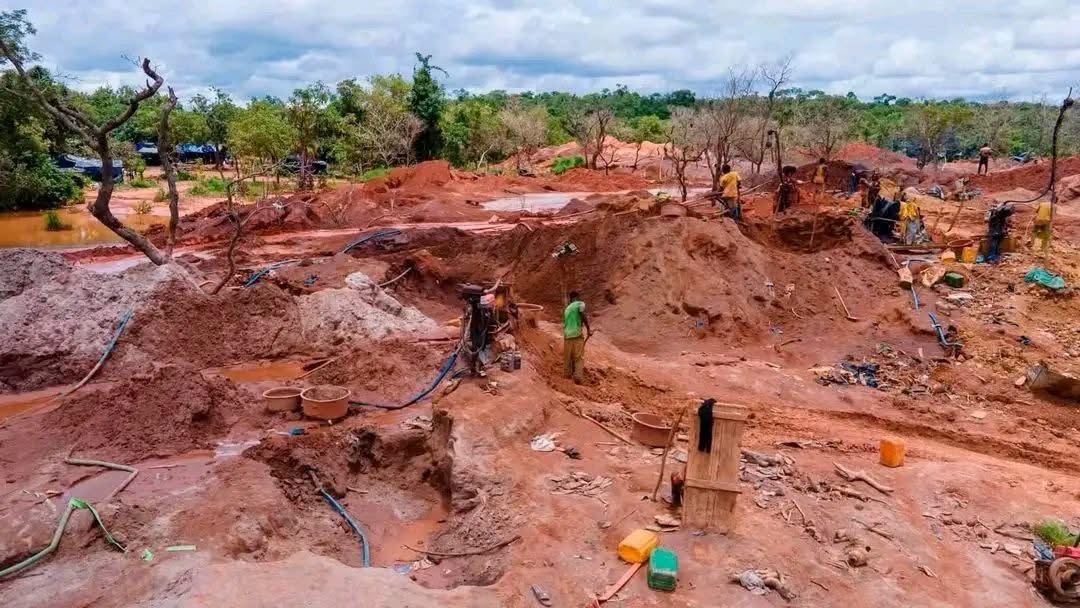
The unchecked spread of illegal gold extraction across West Africa is forcing a critical question upon governments and communities alike: what happens when the land of others is exploited without accountability, and will the same destruction one day reach our own borders?
Cross-border gold mining: a shared crisis demanding collective responsibility
Illegal gold panning operations conducted by Burkinabè miners in neighboring countries are not isolated incidents they are part of a broader ecological and political crisis that threatens regional stability. While the pursuit of profit may drive individuals across borders, the environmental and social toll is borne disproportionately by local populations in Benin, Côte d’Ivoire, Ghana, and beyond. These communities face irreversible damage: contaminated water sources, deforested landscapes, abandoned mine pits, and compromised agricultural productivity. These are not abstract consequences; they are lived realities that reshape lives and livelihoods.
Protectionism or accountability: where should the line be drawn?
The dilemma is clear. On one side, governments are justified in protecting their citizens, especially when individuals are expelled from foreign soil after engaging in illicit activities. On the other, such protection must not extend to shielding those who actively contribute to environmental degradation in neighboring states. The principle of reciprocity is not negotiable. If Burkina Faso expects its borders and resources to be respected, it must also uphold the sovereignty and ecological integrity of its neighbors.
Why legal frameworks fail to curb illegal extraction
Despite existing laws in both origin and host countries, enforcement remains inconsistent. Weak border controls, porous frontiers, and the lure of quick profits create an environment where illegal mining thrives. Moreover, the absence of cross-border cooperation allows perpetrators to evade justice. Without coordinated investigations, information-sharing, and joint patrols, the cycle of exploitation continues unchecked. The result? A patchwork of environmental damage that no single nation can address alone.
The unspoken risk: a mirror turned inward
Perhaps the most pressing question is not about foreign lands but about Burkina Faso’s own future. The same practices now being condemned abroad unregulated extraction, environmental neglect, and disregard for local communities could take root at home. Local farmers and rural communities would face the same devastation: polluted rivers, eroded soil, and lost livelihoods. History shows that environmental harm does not respect nationality. The land does not differentiate between a foreigner’s pickaxe and a local one. Once degradation begins, it spreads. The time to act is not after the damage is done, but before it starts.
From expulsion to education: rebuilding trust through accountability
The return of expelled miners to Burkina Faso presents an opportunity not just for legal consequences, but for broader education. Those who have participated in illegal mining abroad must understand the full cost of their actions. This is not about punishment alone; it is about fostering a culture of environmental responsibility. Mining practices that defy national laws and neighborly respect cannot be defended on the grounds of economic necessity when they leave entire communities in ruin.
A call for regional solidarity, not division
The goal is not to pit nations against one another, but to strengthen the bonds of shared responsibility. Burkina Faso can and must play a leading role in this effort. This includes supporting repatriated miners through community reintegration programs, promoting alternative livelihoods, and reinforcing environmental education. It also means advocating for stronger regional agreements that criminalize cross-border illegal mining and ensure that perpetrators face consequences in their home countries.
This is not a matter of blame, but of shared stewardship. The environment is not a resource to be exploited in one place and defended in another. It is a finite system that connects us all. Until every nation treats its neighbors’ lands with the same care it demands for its own, the cycle of destruction will persist. The question is not whether Burkina Faso will face the consequences of illegal gold mining it is when. And when that day comes, it will be too late to ask why the warning signs were ignored.
Environmental justice begins at home
Ultimately, the fight against illegal mining is not just a legal or diplomatic challenge it is a moral one. It demands that every nation, every community, and every individual recognize that the earth’s resources are not infinite and that the damage we cause to others will eventually circle back. Respect for the environment is not a negotiable policy; it is a shared responsibility. And in a region where borders are more than lines on a map they are lifelines protecting the land means protecting the future.
By Henri Nkeng — Journalist