
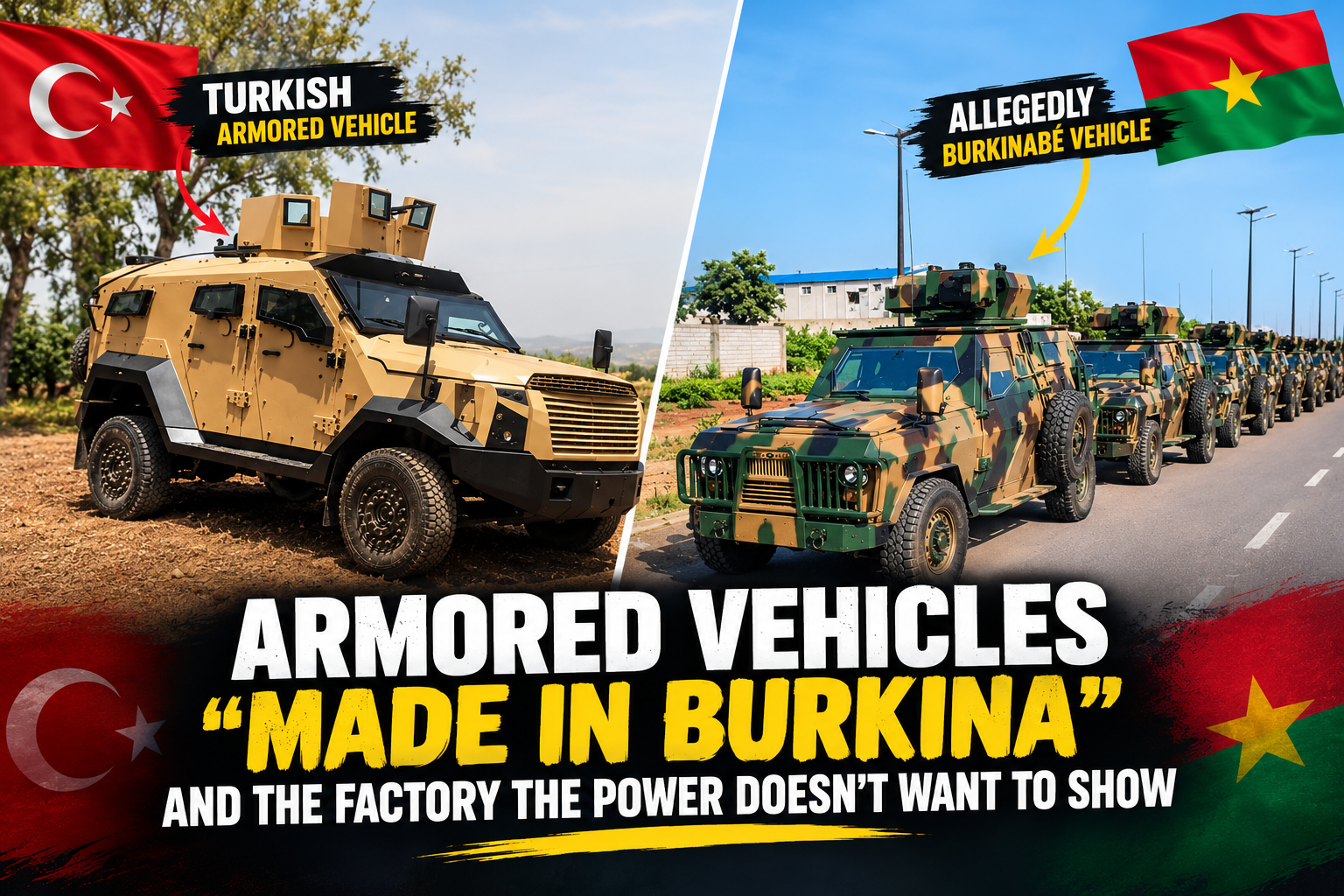
The Burkina Faso military has recently unveiled a fleet of 300 locally produced armored vehicles, the Nanga, presented as a landmark achievement in national defense independence. However, as the government celebrates this milestone, critical questions about the true origins and manufacturing process of these vehicles remain unaddressed, leaving doubts about the extent of local production.
From announcement to accountability: what does “made in Burkina Faso” really mean?
On September 21, Captain Ibrahim Traoré announced the completion of nearly 300 Nanga armored vehicles, developed under the auspices of Faso Armored, a company claimed to be Burkinabè. The government has emphasized the secrecy surrounding Faso Armored, citing national security concerns as the reason for withholding details about its operations, location, or production chain. Yet, this lack of transparency raises fundamental questions about the actual scope of local manufacturing.
Production claims vs. industrial reality
The official narrative describes the Nanga as vehicles whose locally designed and manufactured armored bodies have been retrofitted onto existing platforms. Authorities describe the process as adaptation and transformation rather than full-scale indigenous production. This distinction is crucial: if core components such as chassis, engines, transmissions, and electronics are imported while only the armor and assembly are done locally, the claim of a “made in Burkina Faso” vehicle is technically incomplete.
The government’s reluctance to disclose the origins of critical vehicle components such as chassis suppliers, engine manufacturers, or electronic systems only deepens skepticism. Without verifiable data on the supply chain and production capacity, the assertion of a fully Burkinabè-made armored vehicle remains, at best, unproven.
Turkish connections: a shadow over the Nanga’s origins
The timeline of Burkina Faso’s military acquisitions adds another layer of complexity. In December 2022, reports documented the delivery of four Nurol Ejder 6×6 armored vehicles Turkish-made and produced by Nurol Makina to Burkina Faso. While this does not confirm that the Nanga are repurposed Ejder models, it introduces a legitimate inquiry: Are the Nanga vehicles entirely designed and built in Burkina Faso, or are they foreign platforms that have undergone local modifications, rebranding, and armor installation?
The distinction between “fabricated” and “adapted” is not merely semantic. It speaks to the heart of national industrial capability. If the Nanga are primarily foreign vehicles retrofitted with Burkinabè armor and systems, the government’s claim of a new era in military self-sufficiency would be a significant overstatement.
Why the lack of transparency undermines credibility
In stark contrast to the secrecy surrounding Faso Armored, Burkina Faso has taken a different approach with other military-related industrial projects. For instance, the TEXFORCES-BF initiative, aimed at producing military uniforms, was publicly inaugurated in Bobo-Dioulasso on September 9, 2026. The factory’s location, infrastructure, and operational details were made available, demonstrating a commitment to transparency and tangible industrial progress.
By contrast, the absence of accessible information about the Nanga’s production chain including images or descriptions of assembly lines, welding workshops, monthly output, or component sourcing creates a credibility gap. Such transparency would not compromise national security; rather, it would provide concrete evidence of Burkina Faso’s evolving defense industry.
What would resolve the uncertainty?
To substantiate the claim that 300 Nanga vehicles represent a true industrial breakthrough, the government must provide independent verification. Key elements that would dispel doubts include:
A documented breakdown of the percentage of each Nanga that is locally produced, including chassis, engines, transmissions, armor, and electronics;
Photographic or video evidence of the Faso Armored production facilities, showing assembly lines and operational workflows;
Public disclosure of suppliers for critical components, particularly chassis and engines;
Technical specifications and performance data demonstrating indigenous engineering and manufacturing capabilities;
Independent audits or third-party inspections of the production process.
Until such evidence is presented, the assertion that the Nanga vehicles are a product of Burkina Faso’s own industry remains an official claim one that demands scrutiny rather than blind acceptance.
A turning point or a communication strategy?
The unveiling of the Nanga vehicles marks a pivotal moment in Burkina Faso’s public discourse on military self-sufficiency. However, without the necessary transparency and verifiable data, this moment risks becoming little more than a symbolic gesture. True industrial sovereignty requires more than rhetoric; it demands proof of capability, investment, and sustainable production.
The question is no longer whether Burkinabè hands have worked on these vehicles, but what proportion of each Nanga is truly made in Burkina Faso. Until that question is answered with concrete evidence, the claim of a “made in Burkina Faso” armored fleet remains a promise unfulfilled.
By Henri Nkeng — Reporter