
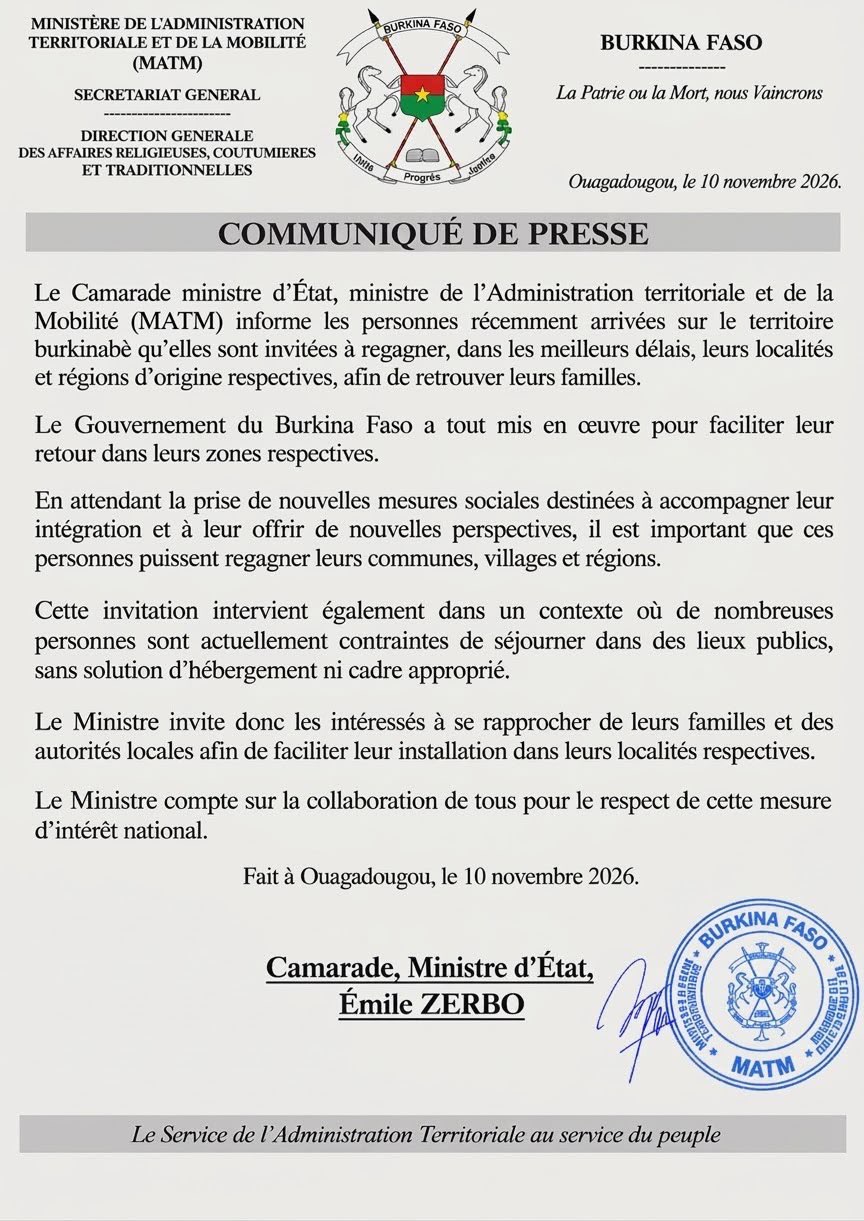
The lofty rhetoric of economic sovereignty and national dignity championed by Burkina Faso’s leadership now collides head-on with an uncomfortable reality: thousands of Burkinabè gold miners expelled from Guinea find themselves stranded without viable pathways to rebuild their livelihoods. Beyond the patriotic declarations and diplomatic outcry lies a pressing question what concrete measures is the Traoré administration prepared to implement to ensure these returnees do not merely return home, but return to opportunity?
The illusion of a simple homecoming
The government’s current approach offers little more than administrative guidance urging expelled miners to leave urban centers, return to rural villages, and ‘reintegrate’ with their families. While framed as a humanitarian gesture, this directive lacks the substance of a structured reintegration program, complete with defined timelines, identifiable funding mechanisms, and measurable outcomes. The absence of such a framework exposes a fundamental disconnect between policy intent and practical reality.
From goldfields to unemployment: the economic rupture
It is essential to acknowledge that these miners did not venture to Guinea by choice alone. For many, artisanal gold mining represented not just a profession, but a lifeline their primary, and often only, source of income for supporting dependents. Their expulsion from Guinea does not merely relocate bodies; it severs economic lifelines, disrupts family finances, and dismantles projects built on fragile subsistence.
The return to Burkina Faso, therefore, is not an endpoint but a new beginning fraught with uncertainty. Will these returnees secure employment? Do they possess the financial means to restart an enterprise? Is there a support system in place to lift them out of precarity? The government cannot assume the crisis is resolved simply because individuals have physically returned to their communities. A returnee without income remains unemployed. A family without a breadwinner remains vulnerable. And a nation cannot claim economic sovereignty while failing to deliver tangible opportunities to its citizens.
Sovereignty in rhetoric vs. sovereignty in action
Since assuming leadership, Ibrahim Traoré has positioned resource sovereignty particularly in gold as a cornerstone of his political narrative. Yet the expulsion crisis starkly exposes a glaring contradiction: if Burkina Faso boasts control over its mineral wealth, why are so many citizens many of whom contributed directly to that wealth through artisanal mining left economically adrift upon their return?
True economic sovereignty transcends control over natural resources. It is measured not by nationalization decrees or denunciations of foreign exploitation, but by the state’s ability to convert those resources into jobs, income, and sustainable livelihoods for its people. A nation may reclaim its goldfields, but if its youth cannot secure dignified employment, the promise of sovereignty remains hollow.
Reconversion slogans cannot replace economic substance
Government proposals for reconversion into agriculture, livestock, artisanal crafts, or vocational training are well-intentioned, but dangerously insufficient. Transitioning from artisanal mining to farming demands more than advice; it requires arable land, seeds, farming equipment, technical support, and market access. Livestock ventures necessitate start-up capital, veterinary services, and stable supply chains. Artisanal production assumes skill development and a receptive market.
A three-month training course devoid of seed funding does not constitute reintegration. A cooperative registered on paper but lacking equipment or operating capital is not a solution. The government must answer critical questions: How many returnees will receive genuine training? What budget is allocated for their transition? How many will access affordable credit? Which lands will be allocated? What equipment will be financed? How will progress be tracked over time?
Without these answers, the policy of reconversion risks becoming little more than an injunction: abandon mining and ‘figure it out.’
The silent crisis of capital access
Many returnees return from Guinea not with savings, but with debt or depleted funds. Some may have liquidated assets to finance their repatriation. Few can restart an economic activity without external support. In this context, demanding self-sufficiency without providing financial instruments microcredit, start-up grants, public guarantees, entrepreneurial mentorship amounts to economic abandonment.
The social ripple effects are profound. Behind each miner lies a web of dependents children in school, aging parents, spouses, extended family all financially reliant on remittances. The loss of a single income source can trigger cascading hardship. The government must recognize that reconversion is not a technical exercise, but a human one, with long-term social consequences.
Artisanal mining: a sector worthy of policy integration
If Ibrahim Traoré’s vision of mining sovereignty is to be credible, it must encompass not only large-scale industrial control but also the fate of small-scale miners. A coherent policy would include regulated artisanal mining sites, improved safety standards, functional cooperative structures, and official gold-buying channels.
Such a framework would not only preserve livelihoods but also curb illegal mining, reduce accident risks, formalize trade, and mitigate environmental damage from unregulated operations.
The paradox is stark: a state that asserts mastery over its gold wealth must also ensure that the very citizens who have worked its land are not abandoned to informality and poverty.
A moment of truth for the Traoré administration
The expulsion crisis serves as a litmus test for Ibrahim Traoré’s leadership. It demands more than diplomatic protest or public indignation it requires deliverable solutions. How many returnees secure gainful employment within six months? How many escape poverty through government support? How many families regain stability?
Until these questions are met with concrete numbers, timelines, and budgets, the rhetoric of reintegration will remain empty, and the promise of sovereignty unfulfilled. The true test of governance is not in denouncing injustices abroad, but in preventing them at home. Economic sovereignty is not declared it is built, funded, and delivered.
By Yvette Tchuente — Journalist