
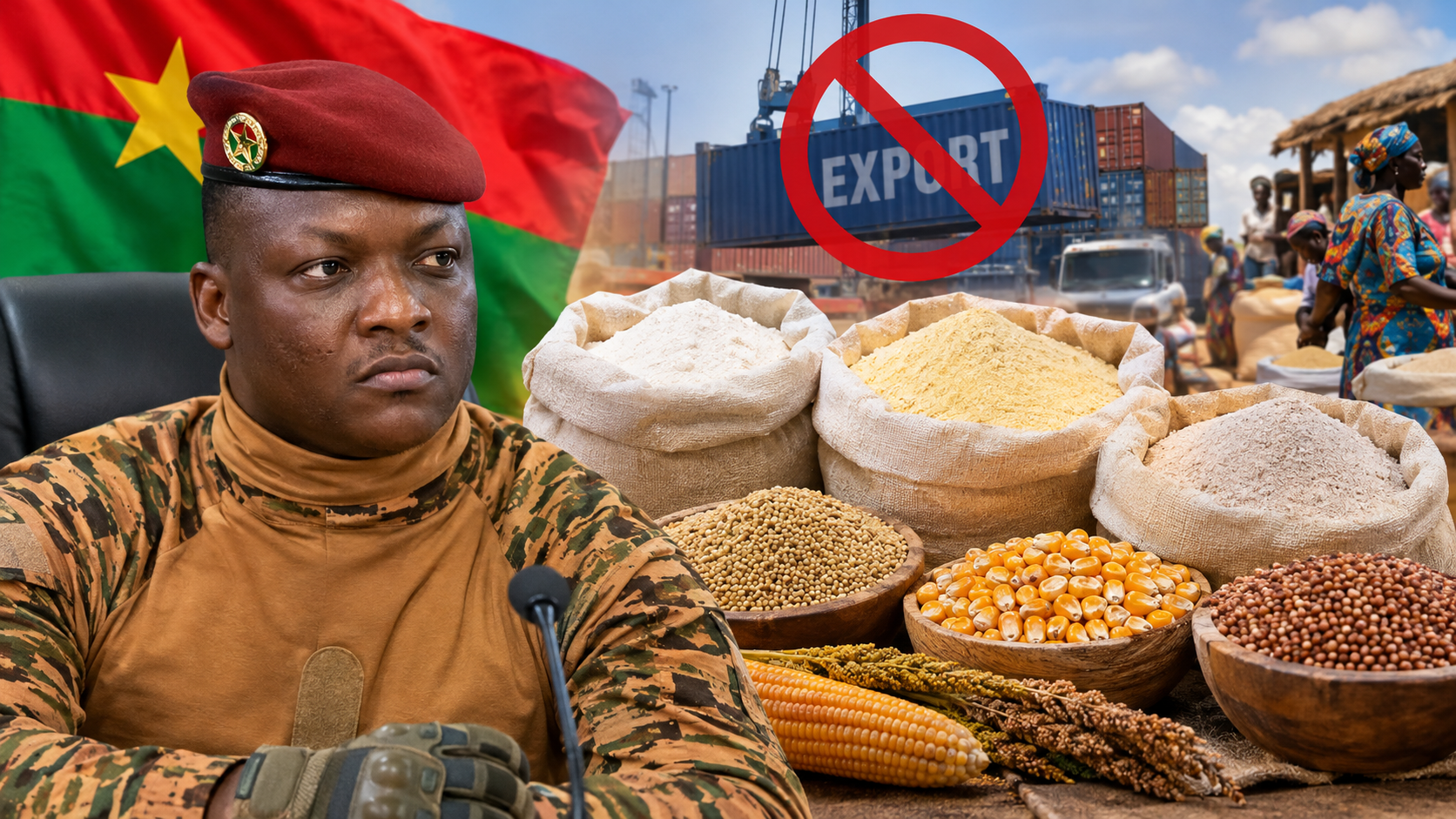
The Burkinabè government has imposed an immediate ban on the export of millet, maize, and sorghum flours, along with their derivatives. This sweeping measure, which suspends all special export permits, raises a pressing question: when does national protection become an infringement on economic liberties?
Exports halted to preserve domestic supply
The stated objective of this ban is to ensure sufficient supply of these staple flours within Burkina Faso. Given the country’s ongoing food security challenges, safeguarding essential goods may appear justified on the surface. Yet beneath this rationale lies a broader dilemma: how far should a government go in restricting economic activity under the guise of market protection?
While the ban aims to retain more products domestically, it offers no guarantee of lower prices or improved access for consumers. Success hinges on factors beyond the restriction itself, including actual stock availability, production capacity, and the state’s enforcement of distribution policies. Will urban households benefit as much as rural ones? Can every Burkinabè truly rely solely on locally produced flours?
Protecting citizens or stifling innovation?
The government’s decision to curtail exports may inadvertently weaken producers and traders who depend on these channels to sustain their livelihoods. Far from being a simple tariff adjustment, this policy could disrupt entire supply chains, prompting concerns about the long-term resilience of local agriculture.
Moreover, the manner in which the ban was implemented abruptly and with no prior consultation leaves open a critical question: does Burkina Faso risk normalizing top-down economic controls without adequate public debate? The decision reflects a growing trend where state intervention increasingly shapes daily life, raising fears that restrictions may multiply beyond food products.
Could future measures target other essential goods? Might access to digital services or individual liberties follow a similar path? While no one equates this ban with the extreme controls of authoritarian regimes, the absence of transparent justification and periodic review warrants close scrutiny.
Beyond rhetoric: tangible outcomes for citizens
The true measure of this policy’s success lies not in its implementation but in its results. Will consumers see genuine improvement in affordability and availability? Will producers receive fair remuneration? Will traders operate within a stable, predictable framework?
Citizens cannot be satisfied with assurances alone. They demand concrete evidence: lower prices, reliable stock levels, fair compensation for farmers, and a transparent mechanism to evaluate the policy’s effectiveness. Restricting exports is a blunt tool; ensuring food security requires far more nuanced solutions.
The government must not mistake short-term restrictions for long-term solutions. Genuine consumer protection encompasses safeguarding purchasing power, bolstering production, and fostering an economy where both producers and citizens thrive not one where decisions are imposed without recourse.
What comes next for Burkina Faso’s economic model?
This export ban marks another chapter in Burkina Faso’s evolving economic governance. While the intention to secure food supplies is commendable, it must not overshadow the need for dialogue and accountability. Markets function best when freedoms are balanced with safeguards not when prohibitions replace policy.
The challenge ahead is clear: to protect without oppressing, to regulate without stifling, and to govern without silencing the voices of those most affected by such decisions.
By Yvette Tchuente — Journaliste / Rédacteur