
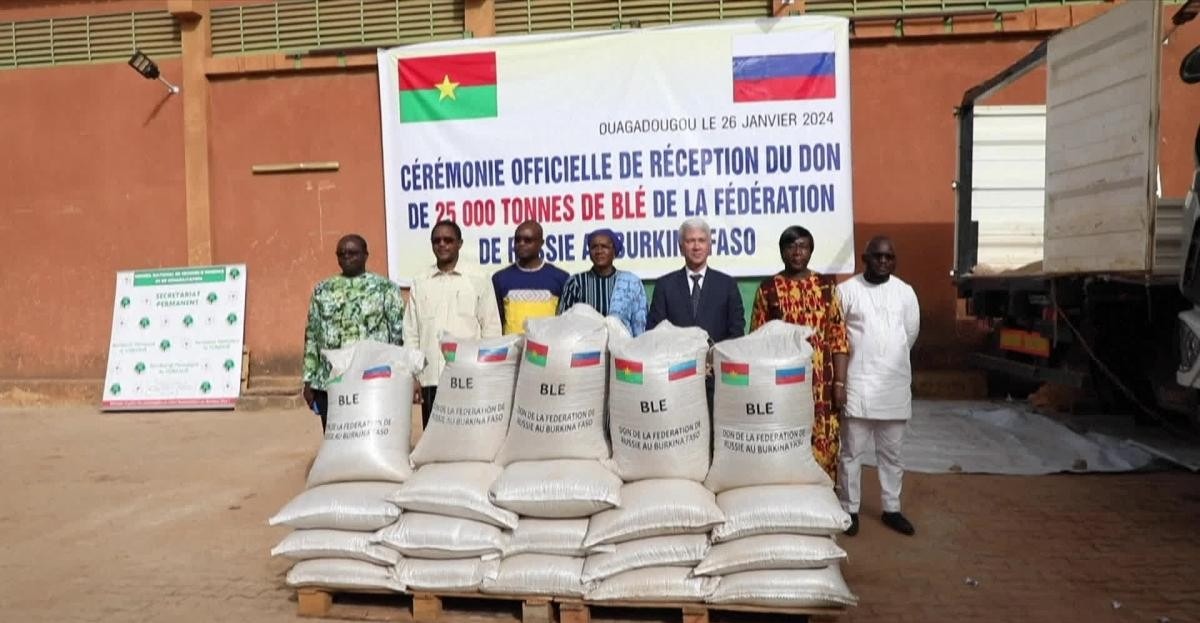
The gap between Burkina Faso’s bold claims of food self-sufficiency and the stark reality on the ground has never been wider. While Captain Ibrahim Traoré’s speeches repeatedly declare victory over hunger through sweeping agricultural campaigns and a so-called ‘reclaimed sovereignty,’ the transitional government rolled out the red carpet last September 23, 2026, to welcome 25,000 tons of wheat from the Russian Federation—undeniable proof that Burkina Faso still relies on foreign aid to feed its people.
The turning point that shattered the illusion of food independence
How can a nation claim to be nearing self-sufficiency when it continues to accept thousands of tons of foreign grain? The disconnect reveals the theatrical nature of Burkina Faso’s national policy. By asserting that the country no longer needs external support to secure its food supply, officials are attempting to mask a deepening agricultural crisis—one fueled by the loss of control over vast rural territories and the forced abandonment of farmlands by displaced communities.
If food independence were more than a propaganda slogan, Burkina Faso’s granaries would already be full enough to feed its cities and displaced camps without waiting for shipments from the Black Sea. Instead, the arrival of emergency wheat shipments exposes the fragility of a food system still in tatters.
Is this ‘gift’ actually a hidden purchase in disguise?
Beneath the veneer of ‘humanitarian generosity’ and a strategic partnership with Moscow lies a murky transaction whose financial and political details remain carefully concealed. In diplomatic circles, the term ‘free gift’ often serves as a smokescreen. Observers suggest this shipment may be part of a disguised purchase or a high-stakes barter deal: in exchange for grain, Russia strengthens its grip on Burkina Faso’s economy, security, and foreign policy, trading food for gold mine concessions, lucrative contracts, and unwavering diplomatic alignment.
These 25,000 tons of wheat come at a steep price—not in currency, but in lost sovereignty. Far from an act of selfless solidarity, this transfer functions as an indirect political invoice, with the Burkinabe taxpayer footing the bill through deeper external dependence.
When food aid becomes a lever of influence
Framing external food deliveries as symbols of national strength represents a fundamental distortion of values. True sovereignty belongs to a nation that produces what it consumes on its own soil, protected by its own security forces. As long as Captain Ibrahim Traoré’s speeches clash with the reality of imported wheat sacks filling urgent gaps in the food supply, the dream of sovereign food independence remains just that—a mirage spun from political necessity.
What lies ahead for Burkina Faso’s agricultural future
The arrival of this Russian wheat shipment has triggered urgent questions about Burkina Faso’s long-term food strategy. Can the country break free from cycles of dependence, or will it continue to trade food security for political concessions? With rural insecurity and climate pressures intensifying, the path forward demands more than rhetoric—it requires concrete investment, secure farming conditions, and a clear-eyed assessment of what sovereignty truly means in an era of global uncertainty.