
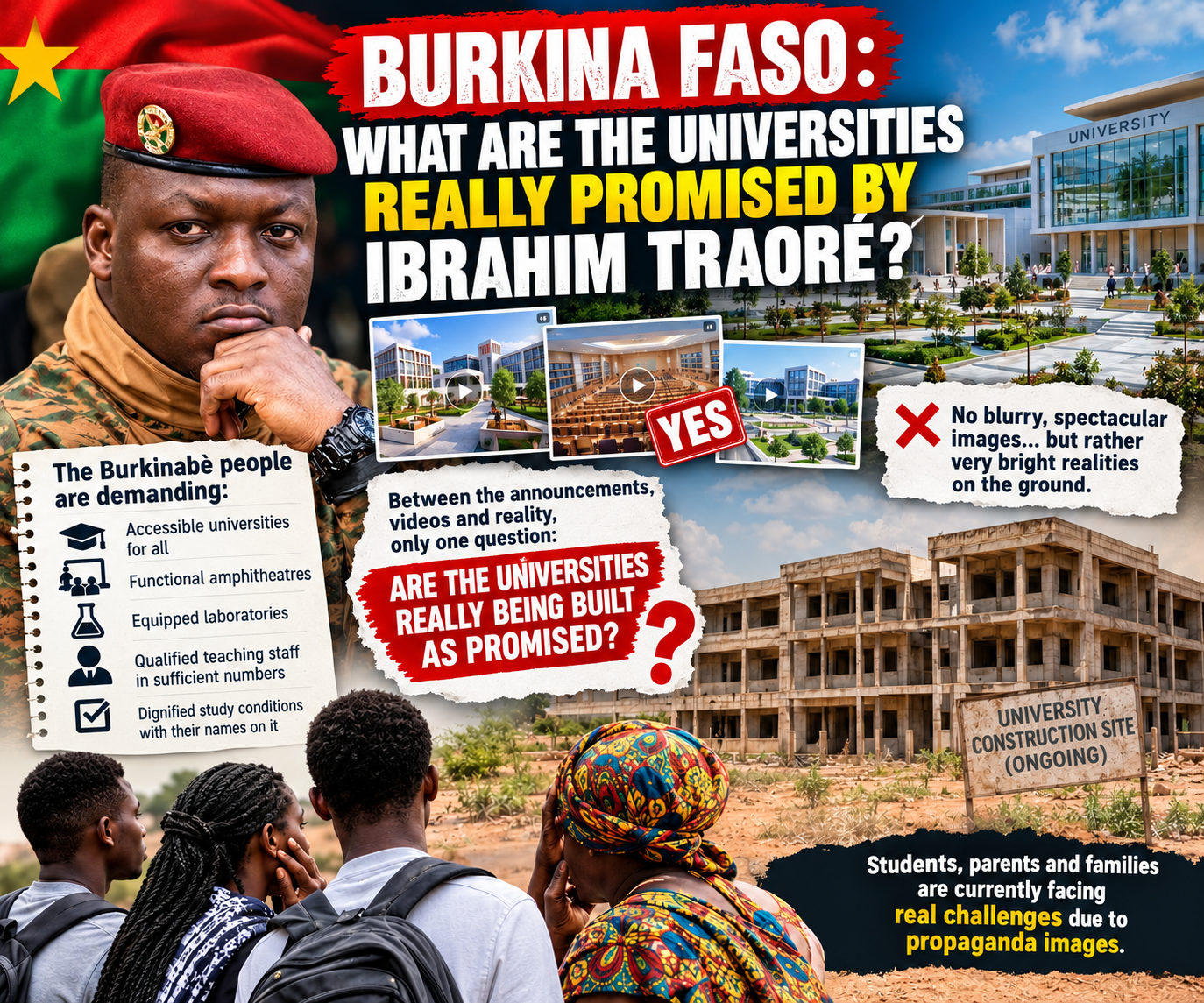
As Burkina Faso’s political discourse increasingly relies on social media imagery, a critical question emerges: beyond the viral videos of promised ultramodern universities, what tangible progress can today’s students actually see on campus?
For families investing life savings into their children’s education, the spectacle of digital propaganda offers little comfort. They demand functional lecture halls, equipped laboratories, qualified instructors, and learning environments that match the promises made by political leaders. Yet the gap between official communications and on-the-ground reality remains a persistent source of frustration. Are these universities truly being built, or are they merely visual illusions in an era of AI-generated content?
The power of images and the risk of digital deception
In an age where artificial intelligence can fabricate convincing videos of non-existent buildings, distinguishing truth from fabrication has become a national challenge. Investigative reports have already exposed misleading footage such as a widely circulated video in April 2025 that claimed to show construction work attributed to Ibrahim Traoré, but was later traced back to an unrelated project in Algeria.
While these examples primarily involve urban development, they raise a troubling question: if even commercial real estate can be misrepresented, what guarantees exist that academic infrastructure claims are immune to the same distortions? Without rigorous verification, viral content whether created by supporters, critics, or external actors—risks becoming a tool of political manipulation rather than a reflection of real progress.
From announcements to actual institutions: what do families really need to know?
Education policy thrives on concrete outcomes, not just announcements. A university may be inaugurated, but if it lacks essential equipment, qualified faculty, or sufficient enrollment capacity, its impact remains minimal. Parents and students deserve clarity: how many institutions have been completed? Which are fully operational? How many students are currently enrolled, and under what conditions?
In September 2026, official sources highlighted the inauguration of a major academic complex at Nazi-Boni University in Bobo-Dioulasso, featuring a 1,200-seat auditorium, four 210-seat lecture halls, and six laboratories. Such announcements are meaningful, but they must be supplemented by independent assessments. Are these facilities accessible to all students? Are they fully staffed and operational? Most importantly what about the dozens of other projects announced but not yet inaugurated?
Where transparency meets accountability
The credibility of Burkina Faso’s higher education initiative depends not on the volume of digital praise, but on the quality and accessibility of verifiable information. A responsible government would not only showcase completed projects but also publish detailed inventories: completed campuses, functional labs, equipped classrooms, and transparent data on student enrollment and graduation rates.
Students, teachers, and parents should not have to rely on unverified social media posts to assess the state of their institutions. They need official reports, accessible records, and opportunities to visit campuses without political interference. Only then can education truly serve as a foundation for national development, not a stage for digital illusion.
Education built on truth, not pixels
At its core, this debate transcends Burkina Faso. It reflects a global challenge: how to govern in an era where perception can be manufactured as easily as it can be shared. Leaders who prioritize accountability over spectacle demonstrate maturity. Those who obscure reality behind manipulated images risk eroding public trust and delaying the progress their nations desperately need.
The real question is not how many people have seen a video—but how many students are actually learning. And whether Burkina Faso’s government is committed enough to let the answer speak for itself.
By Yvette Tchuente — Journalist