
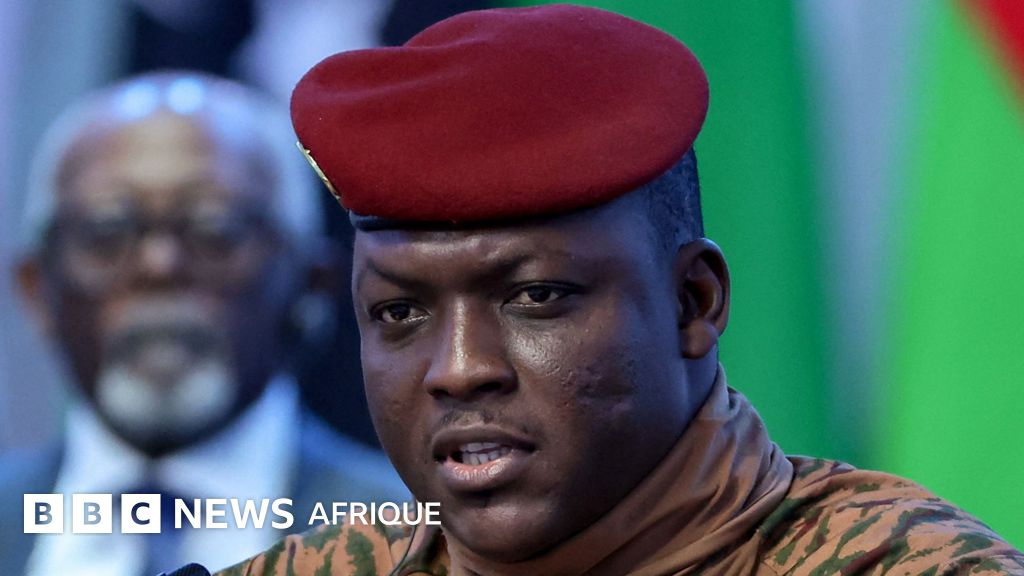
Burkina Faso’s military leader rejects democracy as governance model

Photo credit: TASS via Reuters
The military leader of Burkina Faso, Captain Ibrahim Traoré, has declared that the nation must “forget” democracy, calling it incompatible with the country’s needs. In a prime-time television interview, he stated that Burkina Faso would pursue an alternative governance model, though he did not elaborate on its specifics.
Traoré seized power three years ago and had previously pledged to restore democratic rule by July 2024. However, with two months remaining before the deadline, the military junta extended its mandate by five years, citing the need for stability and development.
In January, authorities banned all political parties as part of a broader plan to “rebuild the state,” arguing that traditional politics had failed the nation. Traoré has since consolidated power, suppressing dissent through restrictions on opposition groups, media outlets, and civil society organizations.
Traoré’s Vision: Sovereignty and Revolutionary Change
During the interview, Traoré dismissed democracy as an unsuitable model for Burkina Faso, stating, “People must forget about democracy. It is not for us.” He drew parallels with Libya, highlighting the chaos that followed the fall of Muammar Gaddafi’s regime as a cautionary tale. Gaddafi’s autocratic rule provided social services but collapsed into civil war after Western intervention, leaving Libya without stable governance.
Traoré’s alternative vision prioritizes national sovereignty, patriotism, and revolutionary mobilization. He emphasized the need for economic and military self-reliance, arguing that shorter workdays would hinder Burkina Faso’s progress. “We have our own approach,” he stated. “We are not trying to copy anyone. We are here to completely change how things are done.”
Criticism of Western Influence and Political Parties
The military leader accused Western powers of imposing democracy at the cost of bloodshed worldwide. “Wherever they try to establish democracy, it always comes with bloodshed,” he claimed. While Traoré acknowledged that elections still occur in many African nations, he criticized them as often manipulated to favor incumbent leaders.
He went further, denouncing political parties as divisive and corrupt, stating, “In Africa—or at least in Burkina Faso—what we’ve seen is that a true politician embodies all the vices: a liar, a flatterer, a smooth talker.” The dissolution of parties was framed as necessary to prevent further instability.
Human Rights Concerns and Ongoing Violence
Since Traoré’s rise to power, Burkina Faso has faced escalating violence, with over 1,800 civilians killed in the past two years, according to reports. Human rights organizations attribute two-thirds of these deaths to state forces and allied militias, while the remainder are linked to Islamist militants. The conflict, now in its second decade, has worsened despite Burkina Faso’s shift away from Western military partnerships in favor of Russian support.
Traoré’s government has also been accused of silencing critics by deploying opponents to frontline combat positions. Despite these controversies, his anti-Western rhetoric and panafricanist stance have garnered significant support across the continent.
The junta’s decision to abandon democratic processes and centralize authority reflects a broader trend in the Sahel region, where military-led governments in Mali and Niger have similarly distanced themselves from Western influence. However, the violence shows no signs of abating, raising concerns about the long-term stability of Burkina Faso’s new governance model.